Chinchero Guide
Chinchero gets thirty minutes from most tour buses. It deserves an afternoon: a painted 1600s church standing on an Inca king's palace platform, huge terraces almost nobody walks down, and weaving cooperatives worth telling apart from the commission stops.
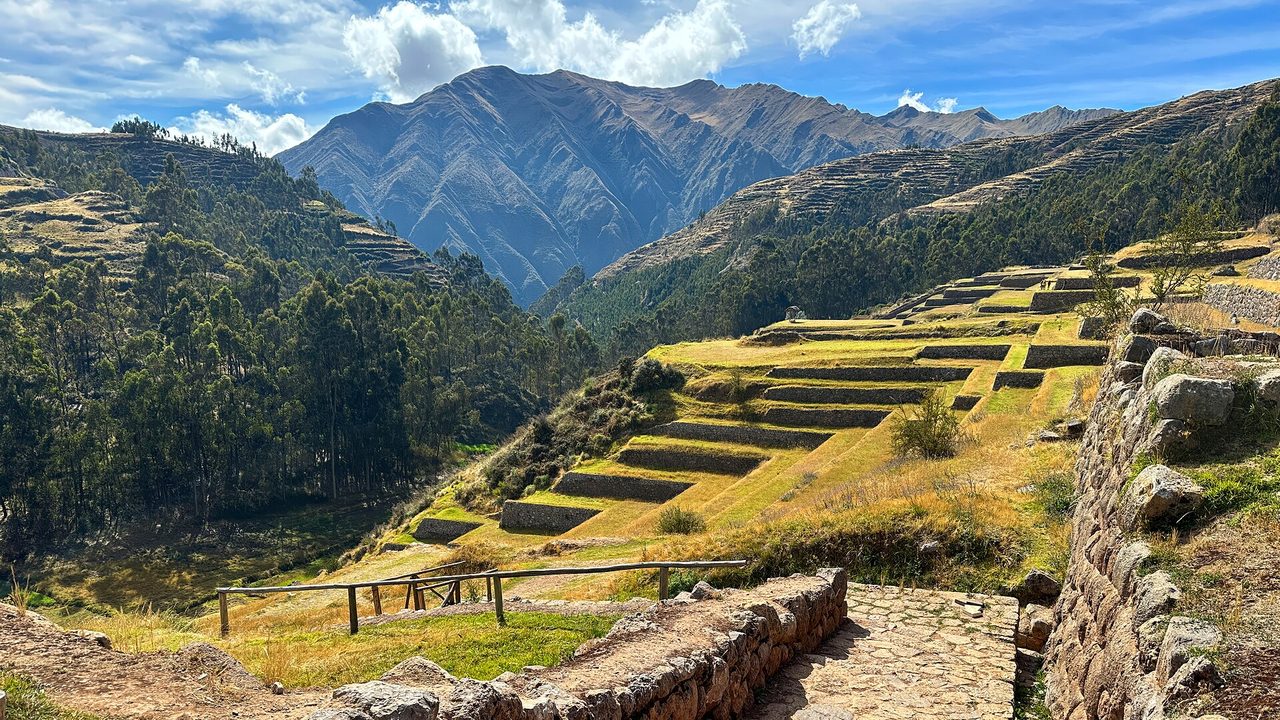
Most people see Chinchero from a coach window for about thirty minutes. The bus pulls in, everyone files into a courtyard, a woman in a red montera boils water with soap-root and shows you how cochineal turns from grey powder to blood red, and then a table of jumpers appears. Twenty minutes later you are back on the road to Maras. That is the standard visit, and it is a shame, because this small town at 3,760 m is the clearest place in Peru to stand in front of the colonial project and see exactly what it did: a 17th-century adobe church sitting squarely on the polished stone platform of an Inca king’s country estate, still holding it up.
I have been three times now, twice on my own two feet rather than a tour bus, and my honest view is that Chinchero deserves an afternoon. Not a stop. An afternoon. Below is what is actually there, what things cost, which weaving cooperatives are worth your money and which are paying your driver a commission, and the one piece of altitude advice that half the internet gets backwards.
Why Chinchero is worth more than thirty minutes
The short version: the site has four distinct things going on and the standard tour gives you one and a half of them.
- The church of Nuestra Señora de la Natividad, one of the most completely painted colonial interiors in the Cusco region, sitting on Inca foundations you can put your hand on.
- The Inca esplanade and walls around the plaza, including a run of trapezoidal niches that most visitors walk past while looking for the toilets.
- The terraces, which are enormous, and the carved rock outcrops below them, which almost nobody sees because the coaches never go down the steps.
- The weaving, which is genuinely one of the strongest living textile traditions in the Andes and also the thing most aggressively monetised.
A group tour gives you the church (sometimes), a glance at the plaza, and a weaving demonstration attached to a shop. It skips the terraces and the outcrops entirely. If you are already planning a run through the valley of the Urubamba and its Inca towns, this is the stop where going independent changes the day most.
Chinchero altitude: higher than Cusco, and why that matters
Chinchero sits at roughly 3,762 m (12,343 ft). Cusco is about 3,400 m. Do the subtraction: you are going up by around 360 m, not down.
This matters because of a piece of advice you will read everywhere, including on tour operator blogs that have the altitude figure printed correctly two paragraphs earlier: “fly into Cusco and go straight to the Sacred Valley to acclimatise.” That advice is sound — for the valley floor. Urubamba and Ollantaytambo are around 2,800–2,900 m, which is a real 500 m of relief and does help. It is not true of a standard Sacred Valley day tour, because the classic loop starts by climbing to Chinchero and then takes in Moray at about 3,500 m. You spend the morning higher than the city you were trying to escape.
| Place | Approximate altitude | Relative to Cusco |
|---|---|---|
| Chinchero | 3,762 m / 12,340 ft | +360 m |
| Moray | 3,500 m / 11,480 ft | +100 m |
| Cusco | 3,400 m / 11,150 ft | — |
| Urubamba | 2,870 m / 9,420 ft | −530 m |
| Ollantaytambo | 2,790 m / 9,160 ft | −610 m |
| Machu Picchu | 2,430 m / 7,970 ft | −970 m |
Practically: do not put Chinchero on your first day off the plane. If you have just arrived and you are still working out how badly the thin air is going to hit you, give it 48 hours. The walking here is not hard, but the terraces involve a couple of hundred steps and you will feel every one of them if you arrived yesterday. If you genuinely want to sleep low to acclimatise, sleep in Urubamba, not here.
The other altitude consequence is temperature. Chinchero is cold. Nights in the dry season drop below freezing, and even a bright June afternoon turns bitter the moment the sun goes behind a cloud. In the wet months the town is often in the cloud rather than under it.
The church of Nuestra Señora de la Natividad
Get the history straight, because the competing versions online are muddled. Viceroy Francisco de Toledo founded the colonial settlement here in 1572 as part of his programme of reducciones, forcibly consolidating scattered Andean communities into Spanish-style grid towns. The parish was dedicated to Nuestra Señora de Monserrat. The church building that stands today was completed in the early 1600s, with 1607 the date most often cited. It is now known as Nuestra Señora de la Natividad, and you will see both names used, sometimes on the same signboard.
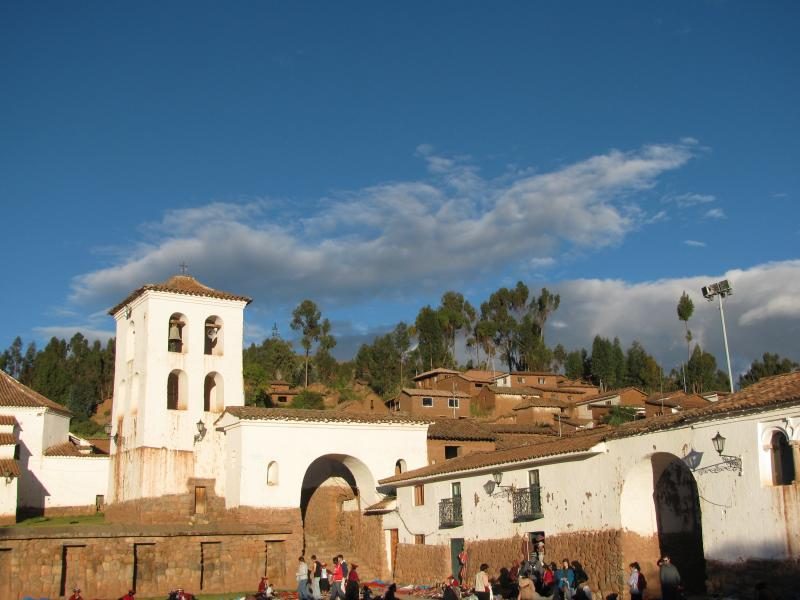
What makes it extraordinary is not the exterior. From the plaza it is a plain whitewashed adobe box with a squat separate bell tower and a tiled roof, handsome but not remarkable. The point is what it is standing on and what is inside it.
It was built directly on the stone platform of the royal estate of Túpac Yupanqui — the tenth Sapa Inca, son of Pachacuti, who took this high plain as his personal country residence in the late 15th century. You can walk around the outside of the church and see the join: dressed Inca ashlar for the first metre or two, adobe above. The Spanish did not clear the site and start again. They decapitated the Inca building and used its base. It is difficult to think of a more literal illustration of what happened after 1533.
Inside, the entire interior is painted. Walls, beams, the underside of the roof, the arch over the nave: 17th-century mural work in ochres, reds, deep blues and a great deal of gold, plus a gilded baroque retablo and a set of Cusco School canvases hanging in the nave. Several of the paintings are associated with named Cusco School artists, Diego Quispe Tito and Francisco Chihuantito among them, though attributions here are argued over and I would treat any confident single-artist claim on a tour with mild scepticism. What is not in doubt is the density of it. Very few colonial churches in Peru preserve this much painted surface, and almost none in a village of this size.
Photography is not permitted inside. This is enforced, and I have watched a guardian stop three people in ten minutes. It is genuinely frustrating — it is the best thing in the town and you cannot photograph it — but arguing gets you nothing. Put the phone away, sit down on a bench for ten minutes and actually look, which is what you should be doing anyway. Opening hours track the archaeological site rather than mass times; expect roughly 8am to 5pm, with the caveat that the church is a working parish and can close without warning for a funeral, a baptism or a fiesta.
The Inca site: plaza, walls, niches and terraces
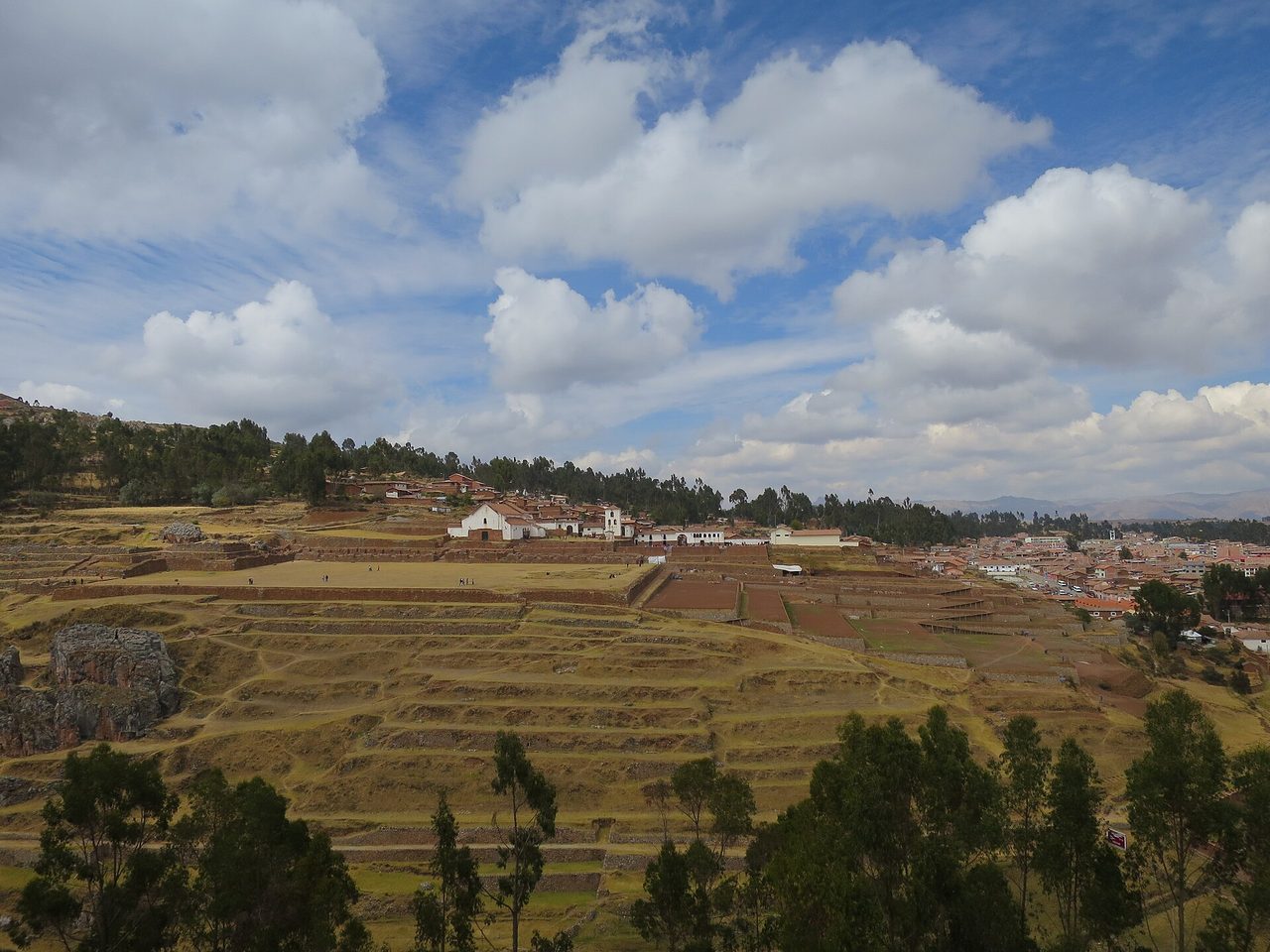
The archaeological park is much bigger than the postcard view suggests. Working outward from the church:
The esplanade and the wall of niches
The huge flat rectangular space below the church is often called Capellanpampa. In Inca times it was a ceremonial and public plaza; today the town still uses it for parades and school events, and on market mornings it fills with cloth laid straight on the ground. On the western side of the church there is a long Inca wall carrying a row of large trapezoidal niches — hornacinas — usually counted as twelve. These were almost certainly display niches: the standard Inca arrangement for setting out ancestral mummies, idols and offerings on ceremonial days.
Stand in front of them for a minute. The stonework is the good kind, tightly fitted polygonal blocks of the sort you see at the great zigzag walls above Cusco, not the rough field-stone used for ordinary storehouses. That is the tell that this was a royal site rather than an administrative one.
The terraces
Below the plaza the hillside drops away in wide agricultural terraces, and they are on a scale that photographs badly and impresses in person. They are still farmed. The soil up here is exceptionally good and the crops are what they have always been: potatoes in absurd variety, plus oca, olluco, quinoa and broad beans. If you visit in the planting or harvest weeks you will see families working the terraces with foot-ploughs while the coaches idle above them, and the contrast between those two activities happening ten metres apart is more or less the whole story of Andean tourism.
Walking down is the single best thing you can do here and takes twenty minutes. Walking back up takes closer to forty at this altitude.
The carved outcrops almost nobody sees
Below and around the terraces are several worked limestone outcrops, natural rock formations that Inca masons cut into steps, seats, channels and platforms. The main ones have names: Titiqaqa (the largest, a rock face rising many metres with cut stairways and what are usually described as thrones), Pumaqaqa and Chinkana. These were huacas, sacred features in the landscape, and they were deliberately damaged during the colonial extirpation-of-idolatry campaigns, which is why several look hacked about rather than eroded.
They are a ten to fifteen minute walk from the plaza and they are, for my money, the most interesting thing on the site after the church. They are also empty. In three visits I have never shared them with more than two other people. If you like Inca stonework and the sites where it is at its strangest, this is why you come to Chinchero rather than to the more famous stops.
The walk down to Urquillos
An original stretch of Qhapaq Ñan, the Inca road network, leaves the site and drops off the plateau into the Urquillos valley. It is a properly paved Inca road for long sections, it descends from 3,762 m to about 2,980 m over roughly 12 km, and it takes most people three to four hours at a relaxed pace. There is a waterfall, Poqpoq, part way down. At the bottom you come out at Urquillos on the valley floor, from where colectivos run to Urubamba in fifteen minutes.
It is all downhill, needs no permit, and costs nothing beyond the boleto you already bought. Knees are the limiting factor rather than lungs. If you have been sizing up the longer multi-day routes around Cusco and want a low-commitment sample of what walking an Inca road feels like, this is the best half-day version in the region, and it is a far better use of the afternoon than being driven to a third viewpoint.
The weaving cooperatives, told straight
This is where I have to be blunt, because being vague about it does nobody any favours — least of all the weavers doing it properly.
How the commission model works
A large share of the weaving “centres” along the road into Chinchero pay tour operators and drivers to bring groups in. The payment is usually a per-head fee, a cut of sales, or both. That is not a conspiracy theory; it is the standard economics of the Sacred Valley circuit and any Cusco guide will confirm it over a beer. It is also why your driver knows exactly which gate to pull into, and why the demonstration lasts a tightly timed fifteen minutes before the tables come out.
None of that makes the demonstration fake. The soap-root wash, the cochineal, the qolle flowers for yellow, the chilca leaves for green, the drop spindle: all of it is real technique and the women showing it grew up doing it. The problem is what happens at the sales table. At commission stops the goods on display are frequently a mix of genuine handwoven pieces and factory-made acrylic bought in bulk in Cusco, sold at the same table, at similar prices, with the same story attached.
Telling a real cooperative from a sales funnel
Signs that you are somewhere serious:
- It is an association with a name and a membership, not a generic “Centro Textil” sign. The Centro de Textiles Tradicionales del Cusco (CTTC), founded in 1996 by Nilda Callañaupa Alvarez — herself a Chinchero weaver — works with a network of weaving communities across the region, and the Chinchero association Away Riqcharicheq was among the original founding group. Organisations of that type publish who they work with and where the money goes.
- Pieces are individually labelled or tagged with the weaver’s name, community and often the hours or days of work.
- The prices are high and the staff do not flinch when you ask why. A genuine handspun, naturally dyed piece takes weeks. If everything is cheap, everything is not handmade.
- Colours are muted and slightly irregular. Natural dyes do not produce fluorescent magenta or highlighter orange, and two batches never match exactly.
- They will happily let you handle everything and answer questions about fibre content without steering you to the till.
Signs you are at a commission stop: coach parking for six vehicles, a fixed loop that ends at a counter, identical stock to the shop you saw in Pisac, and a guide who stays outside on their phone.
If you want to visit a serious cooperative, walk into town rather than stopping at the first gate on the highway, and ask at the municipal office or the interpretation centre on the plaza which associations are currently working. Tipping the weavers directly at the end of a demonstration is normal and appreciated whichever kind of place you end up in.
Alpaca or acrylic: the tests that actually work
Learn these once and they serve you for the whole trip.
| Test | Real alpaca | Acrylic sold as alpaca |
|---|---|---|
| Touch | Cool and slightly slippery, like silk, warms slowly in the hand | Warm and slightly grippy or squeaky immediately |
| Burn a single thread | Smells like burnt hair, leaves crumbly ash | Smells like burning plastic, melts into a hard bead |
| Rub between palms | Fibres stay put | Pills quickly, fuzzes up |
| Colour | Muted, uneven, natural browns and greys common | Uniform and often very bright |
| Weight | Light for its warmth | Either very light and thin, or oddly heavy |
On price: as a rough sanity check in 2026, anything under about S/80 labelled “baby alpaca” is almost certainly not, and a genuine baby alpaca sweater realistically starts around S/200 and climbs well past that in a Cusco boutique. A large handwoven, handspun, naturally dyed lliclla or wall piece representing several weeks of work is a several-hundred-soles object and should be. The S/25 “alpaca” scarf on the market table is acrylic. It might still be a perfectly good scarf. Just know what you are buying, and do not tell people at home it is alpaca.
Bring cash. Card acceptance in Chinchero is patchy at best, ATMs are limited, and haggling is expected in the craft market but is rude at a cooperative with fixed labelled prices. That distinction is worth internalising along with the rest of the practical habits that make travel in Peru smoother.
Chinchero market: the Sunday one and the other one
There are two things both called “the market” and conflating them is the most common mistake in the guides.
The Sunday market is the real one. People come in from the surrounding communities to trade produce, and a proportion of that trading is still barter rather than cash — potatoes for maize, herbs for wool. That practice is often described with the Quechua term for reciprocal exchange, and it is not staged for anybody. Sunday mornings the plaza fills early, from around 7am, and by early afternoon it is thinning out. Sunday is also when the town is busiest with tour groups, so the trade-off is authenticity against crowds.
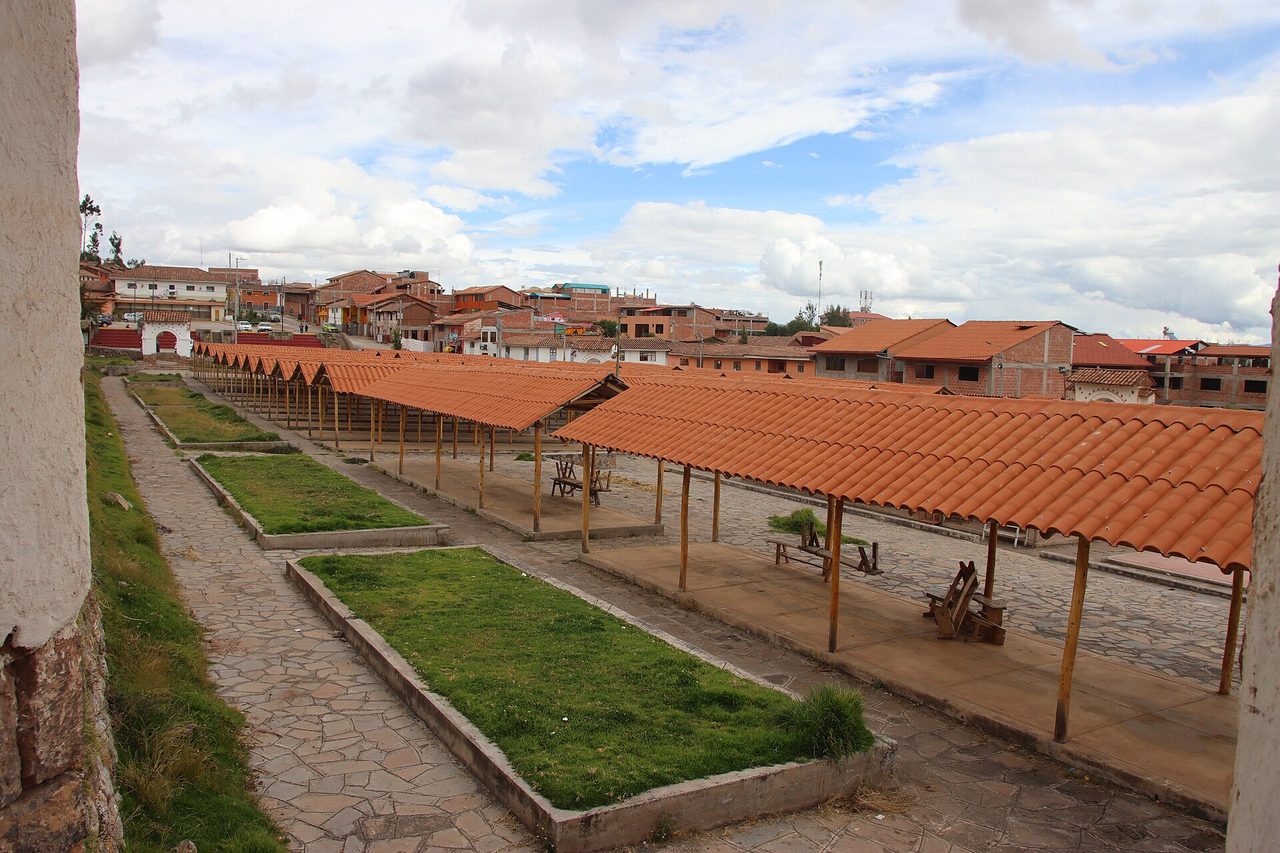
The daily craft market is a different animal: permanent tiled stalls near the church selling textiles, hats, jewellery and souvenirs to whoever gets off the bus. It runs most days, roughly 7am to 5pm, and on a quiet Tuesday it can be almost deserted. Some of the stock is local and good. A lot of it is the same mass-produced inventory you will find in San Blas, and prices are not notably better here.
Some sources also list Tuesday and Thursday as market days. Those are smaller and inconsistent, so do not build a trip around them. If market day is the point of your visit, go Sunday and go early. If you want the site to yourself, go any other morning and accept that the stalls will be half empty.
Honest read on what to buy: the produce is fascinating and mostly not practical for a traveller. The best purchases are textiles from a named cooperative, and, if you are self-catering in an apartment back in the city, the native potato varieties, which are genuinely excellent and cost almost nothing. Skip the “Inca” jewellery. For an actual meal you are better off eating in town or waiting until you get back among the kitchens doing serious Andean cooking in Cusco, and if you want to understand what you are looking at on the produce stalls, the ingredient side of Peruvian cooking starts right here with those potatoes.
Tickets: the Boleto Turístico del Cusco
You cannot pay a small entrance fee at the gate. Entry to the archaeological site and the church requires the Boleto Turístico del Cusco (BTG), the combined ticket run by COSITUC.
| Ticket | Foreign adult | Validity | Covers |
|---|---|---|---|
| Boleto General (full) | S/130 | 10 days | 16 sites including Chinchero, Pisac, Ollantaytambo, Moray, Sacsayhuamán and the Cusco museums |
| Circuit III (partial) | S/70 | 2 days | Pisac, Ollantaytambo, Chinchero, Moray |
| Circuit I (partial) | S/70 | 1 day | Sacsayhuamán, Q’enqo, Puka Pukara, Tambomachay |
Two things people get wrong. First, the arithmetic: two partial circuits cost S/140, more than the S/130 full ticket, so if you plan to see the valley sites and the ruins above Cusco, buy the full boleto. Second, the currency: at least one page-one result currently states the price as “130 dollars” for foreigners. It is S/130, soles, roughly US$35 at the time of writing. Peruvians and Andean Community nationals pay less, and COSITUC still accepts an ISIC card for the discounted 18–25 rate — which is worth flagging because Machu Picchu no longer does, so do not assume the same card works everywhere.
Buy at the COSITUC office on Avenida El Sol in Cusco or at the site entrance itself. Cash. The ticket is not sold online and cannot be reserved. Keep it: the same one gets you into Moray on the same run, and the clock on Circuit III starts the first time it is stamped. Note that the Maras salt pans are not on the boleto and take a separate community-run cash fee. And to head off the obvious comparison: none of this has anything to do with the separate and much more complicated Machu Picchu ticketing system, which is booked through a different portal entirely and now sits at S/163 for a foreign adult since the conservation surcharge added on 1 May 2026.
Getting to Chinchero from Cusco
Chinchero is about 30 km from Cusco on a good paved road, which makes it the closest of the Sacred Valley stops — roughly 45 minutes door to door, sometimes less.
| Option | Cost (2026, approximate) | Time | Verdict |
|---|---|---|---|
| Colectivo van from Cusco | S/10–15 each way | 45–60 min | Best value. Take anything headed to Urubamba or Ollantaytambo and ask for Chinchero. They leave when full, from early morning. |
| Taxi, one way | S/70–120 | 40–45 min | Worth it if there are three or four of you and you want an early start. |
| Private driver for the day | S/250–400 | Flexible | The best way to combine Chinchero with Moray without the coach schedule. |
| Group Sacred Valley tour | S/60–120 plus boleto | Full day | Cheap and comprehensive, but you get thirty minutes here and a commission stop. |
Colectivos drop on the main road rather than in the plaza, so budget ten minutes of uphill walking. Coming back, flag anything heading towards Cusco from the same junction; they run until early evening but thin out fast after dark, and you do not want to be standing on that road at 7pm in July. The wider picture on how shared transport works across the country applies here: vans are cheap, frequent and slightly chaotic, and nobody publishes a timetable.
Building a day that is not the standard coach loop
Here is the version I would do again, assuming you are already acclimatised.
- 07:00 — colectivo from Cusco. You want to be at the site before the first coaches, which start arriving around 9:30.
- 08:00–09:00 — the church first, while it is empty and the light through the west windows is on the murals.
- 09:00–10:30 — the plaza, the niched wall, then down through the terraces to the carved outcrops. Take water.
- 10:30–12:00 — walk into town for a cooperative, not the highway gate. Or, on a Sunday, the market on the plaza.
- 12:00 — two choices. Either pick up the Inca road and walk down to Urquillos, coming out on the valley floor mid-afternoon and continuing to Urubamba or Ollantaytambo. Or take a colectivo on to Maras for the salt pans and Moray, both within twenty minutes.
Either version turns Chinchero from a photo stop into the anchor of the day. It also solves the itinerary problem a lot of people have, which is that the standard full-day valley circuit tries to fit four major sites into eight hours and does justice to none of them. Splitting the valley over two days — Chinchero and Moray on one, Pisac and Ollantaytambo on the other — is the single best change most people can make to their Cusco plans. If you are still working out how much time to give the region, budget for it.
It also works neatly if you are heading onward: end the day in Ollantaytambo and you are already at the station for the train down the Urubamba gorge the following morning, rather than backtracking to Cusco to sleep.
Chinchero international airport: where it actually stands
You will hear about this on any tour, usually with a confident opening date attached. Treat all of them with suspicion, including this paragraph, which is accurate as of September 2026 and will need re-checking.
The Aeropuerto Internacional de Chinchero has been in some form of planning since 1978 and under construction since 2019. It sits on the plateau at around 3,720 m, a few kilometres from the town, and is intended to replace Cusco’s Alejandro Velasco Astete airport with a facility handling roughly five million passengers a year, expandable to eight.
The dates have moved repeatedly: 2021, then 2025, then 2026. In November 2025 the Ministry of Transport pushed the horizon out again, and by mid-2026 the ministry’s own line was that pre-operational activity would run through 2027 with operations starting somewhere between late 2027 and early 2028. Reported physical progress around mid-2026 was under 50% overall, with the passenger terminal at roughly a fifth complete. The control tower — a seven-level, 36.77 m structure costing around US$47.9 million — was awarded to Acciona, with preliminary works starting at the end of June 2026 and completion targeted for late 2027. The runway package was still being tendered separately.
My honest read: do not plan a trip around it, do not book anything on the assumption it will be open, and be sceptical of any article that gives you a month. This project has slipped past every date it has ever been given.
What it would mean if it opens
The case for it is straightforward. Cusco’s current airport is hemmed in by the city, cannot take wide-bodies, and is closed at night, which forces almost every international visitor through Lima and adds a day to a lot of itineraries. A larger airport would remove that bottleneck, and the ministry has projected tourism growth of up to 40% in the first year of operation.
The case against is equally straightforward, and Chinchero itself is exhibit A. UNESCO asked Peru in 2019 to pause construction pending a heritage impact assessment covering Machu Picchu, Cusco and the Qhapaq Ñan. The World Monuments Fund followed in 2021, warning that the earthworks would irreversibly damage the cultural landscape of Chinchero — the same terraced plateau described above. Hydrologists at the university in Cusco have warned about the springs feeding Piuray, the lake that supplies a large share of Cusco’s drinking water. And there is a straightforward capacity question: the valley and the citadel are already at their limits in high season, and adding several million arrivals a year without adding carrying capacity at the far end is not a plan.
There is also a technical wrinkle that gets glossed over. The ministry conceded years ago that genuine transoceanic flights are not realistic from a runway at 3,720 m, because thin air cuts engine performance and forces payload restrictions. Regional connections to Bogotá, Santiago or São Paulo are plausible. Direct from Europe is not the same conversation.
For the town, it is a genuine dilemma rather than a villain story. Land has already been expropriated, jobs are real, and the community was not unanimous. Whatever you think of it, the plateau you are standing on is the site.
When to go
The dry season, roughly May to September, gives you the clear skies and the mountain views, and it is when Chinchero looks like the photographs. It is also cold at night and busy in the middle of the day. The wet months from November to March bring green terraces, far fewer people, and a serious chance of spending your visit inside a cloud. The shoulders, April and October, are the sweet spot: the terraces are still green, the rain has mostly stopped, and the coaches have thinned. This is essentially the same calculus as everywhere in the highlands, and it is covered in more depth in the breakdown of when to visit Cusco and the surrounding valleys.
One extra: if your dates are flexible, check whether they collide with a local fiesta. Chinchero’s patronal celebrations and the general run of the Andean festival calendar can turn a quiet plaza into something extraordinary, or close the church entirely, depending on your luck.
What to bring
- Layers. The temperature swing between shade and sun at 3,760 m is brutal. A fleece and a windproof shell, even in June.
- Serious sun protection. The UV index up here is extreme and people badly underestimate it because the air is cold.
- Cash in small notes. Nobody can break a S/200 note and the colectivo driver will not try.
- Shoes with grip. The terraces and the Inca road are uneven stone that gets slick in the wet.
- Water. There is not much for sale below the plaza.
Frequently asked questions
Is Chinchero worth visiting?
Yes, if you give it more than the tour allocation. As a thirty-minute stop bolted onto a weaving sales pitch it is forgettable, and plenty of people come away thinking it was the weakest part of their valley day. As a half-day with the church, the terraces, the carved outcrops and either the Inca road or the market, it is one of the better things you can do near Cusco. The variable is you, not the site.
How long do you need in Chinchero?
Two to three hours covers the church, the plaza, the terraces and the outcrops without rushing. Add an hour for a proper weaving visit, or three to four if you walk the Inca road down to Urquillos.
Do I need the Boleto Turístico?
Yes, for the archaeological site and the church. Circuit III at S/70 covers Chinchero, Moray, Pisac and Ollantaytambo for two days; the full S/130 ticket covers those plus the Cusco sites for ten. Note that the Maras salt pans sit outside the boleto entirely and charge their own cash entry at the gate. There is no single-site ticket.
What day is the Chinchero market?
Sunday is the traditional trading market and the one worth timing for. The craft market near the church operates most days, roughly 7am to 5pm. Smaller Tuesday and Thursday markets are sometimes listed but are inconsistent, so confirm locally rather than planning around them.
Can you take photographs inside the church?
No. The ban on interior photography is enforced. You can photograph the exterior, the bell tower and the plaza freely.
Is Chinchero good for acclimatising?
No, and this is worth repeating because so many pages say the opposite. At 3,762 m it is about 360 m higher than Cusco. The Sacred Valley floor at Urubamba and Ollantaytambo, around 2,800–2,900 m, is where the acclimatisation advantage actually is. Sleep down there, visit Chinchero after a couple of days.
Are the weaving demonstrations a scam?
Not in themselves. The techniques and the people are real. The commercial arrangement behind many of them — operators paid to deliver you to a specific gate, mixed genuine and factory stock on the same sales table — is the part to be alert to. Buy from a named association with labelled pieces, use the fibre tests above, and tip the weavers directly.
When will the Chinchero airport open?
Unknown. As of September 2026 the official expectation was operations between late 2027 and early 2028, with the terminal roughly a fifth built and the runway not yet contracted. Every previous date has slipped. Do not book around it.
Can I combine Chinchero with Maras and Moray?
Easily. They are twenty minutes apart, Moray is on the same boleto, and the salt pans take a separate small community fee. A private driver or an early colectivo makes a relaxed day of the three. This is a much better half-day than most of the standard excursions sold out of Cusco.
Where does Chinchero fit in a longer trip?
It slots naturally into the two or three days most people give the valley between arriving in Cusco and going to Machu Picchu. On a tighter schedule it is a defensible thing to skip in favour of Ollantaytambo. On any itinerary of ten days or more it is an easy include, and it is one of the stops that rewards travellers hunting for the quieter corners of the country without going anywhere remote. Fit it into a standard route through Peru on the Cusco leg and you lose nothing.
The verdict
Chinchero is not the prettiest Sacred Valley town, it is not the most dramatic ruin, and its market is not the biggest. What it has is layering: a royal Inca estate, a Spanish church built on its bones, a weaving tradition that survived both, a landscape of terraces still being farmed, and an airport that may or may not flatten part of it. All of it is visible from one spot in a single afternoon. Give it that afternoon, walk down the terraces rather than photographing them from above, and buy your textiles from someone whose name is on the label.