Best Hikes & Treks in Peru
Most lists of Peru's best treks stop at the Inca Trail. This one covers the Cordillera Blanca, the Huayhuash, Ausangate and Colca too, with altitudes, permits and real 2026 prices for every route.
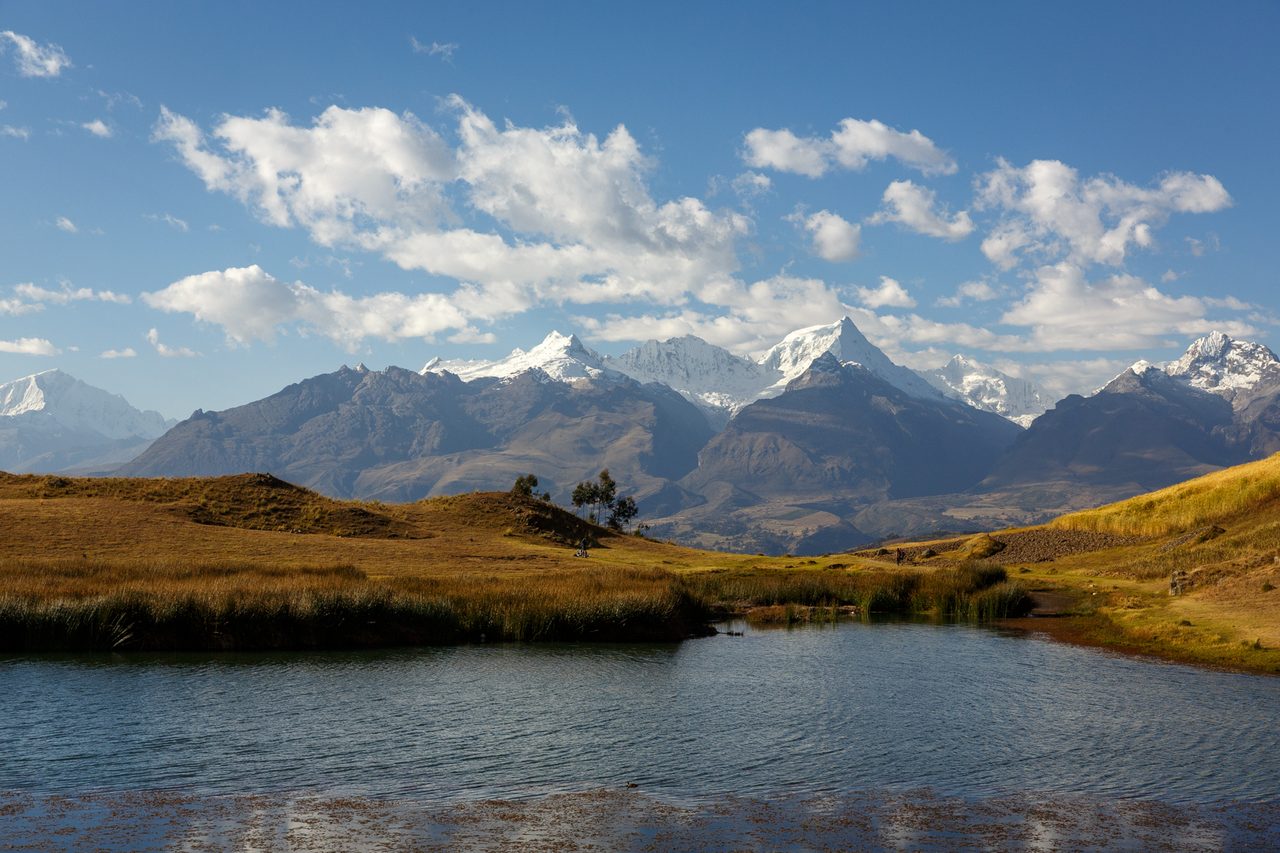
Almost every list of the best treks in Peru is really a list of ways to walk to Machu Picchu. Four or five routes, all starting within two hours of Cusco, all finishing at the same ruin. It is a strange blind spot, because the finest mountain walking in the country is nowhere near Cusco. It is eight hours north of Lima, in the Cordillera Blanca and the Cordillera Huayhuash, where the peaks are higher, the glacial lakes are a colour that looks edited, and the whole thing costs about a third as much.
This guide covers both. It covers the Cusco routes properly, because most people trekking in Peru are there for Machu Picchu and that is fine. But it also covers Huaraz, Colca, Ausangate and the north, because if nobody tells you the Santa Cruz trek exists you will never think to look for it.
The short version: if the ruins are the point, trek from Cusco — the classic Inca Trail to Machu Picchu if you booked six months ago, Salkantay if you did not. If the mountains are the point, go to Huaraz and walk the Santa Cruz trek. If you are an experienced high-altitude hiker with ten spare days and you want the best trekking in South America, walk the Cordillera Huayhuash circuit. And if you have four days and you are not sure yet, do Santa Cruz. It is the best value big trek in the country.
The best treks in Peru at a glance
Altitude and difficulty are the two things that actually decide whether you enjoy a trek here, and almost nobody puts them in a table. So here they are. Costs are rough per-person guided rates for a standard group departure in 2026, excluding tips and international flights. Prices at the top of each range buy better food, smaller groups and, crucially, better treatment of the porters and muleteers.
| Trek | Base | Days | Distance | Max altitude | Difficulty | Permit? | Guided cost | Best months |
|---|---|---|---|---|---|---|---|---|
| Classic Inca Trail | Cusco | 4 (or 5) | 43 km | 4,215 m | Moderate–hard | Yes, months ahead | US$700–1,500 | May–Sep |
| Short Inca Trail | Cusco | 2 | ~12 km | ~2,730 m | Easy–moderate | Yes | US$500–750 | Mar–Nov |
| Salkantay | Cusco | 4–5 | ~70 km | 4,630 m | Hard | No | US$450–700 | Apr–Oct |
| Lares | Cusco | 3–4 | ~33 km | ~4,700 m | Moderate | No | US$450–700 | Year-round |
| Huchuy Qosqo | Cusco | 1–2 | ~14–20 km | ~4,350 m | Moderate | No | US$180–350 | Apr–Oct |
| Ancascocha | Cusco | 4–5 | ~45 km | ~4,650 m | Hard | No | US$550–850 | May–Sep |
| Choquequirao (return) | Cachora | 4–5 | ~62 km | ~3,050 m | Very hard | No (S/60 site fee) | US$400–750 | May–Sep |
| Choquequirao to Machu Picchu | Cachora | 8–9 | ~110 km | ~4,600 m | Very hard | No | US$900–1,700 | May–Sep |
| Ausangate circuit | Cusco | 4–6 | ~70 km | 5,165 m | Hard | No (community fees) | US$450–800 | May–Sep |
| Santa Cruz | Huaraz | 4 (3 if fit) | ~50 km | ~4,750 m | Moderate | No (park ticket) | US$165–410 | Jun–Aug |
| Alpamayo Base Camp | Huaraz | 8–11 | ~100 km | ~4,860 m | Hard | No (park ticket) | US$700–1,300 | Jun–Aug |
| Huayhuash circuit | Chiquián | 8–12 | ~120–130 km | ~5,000 m | Very hard | No (community fees) | US$600–1,300 | Jun–Aug |
| Mini Huayhuash | Chiquián | 4–5 | ~50 km | ~4,800 m | Hard | No (community fees) | US$350–600 | Jun–Aug |
| Colca Canyon | Arequipa | 2–3 | ~25 km | ~3,300 m (rim) | Moderate–hard | No (S/70 ticket) | US$35–120 | Apr–Nov |
| Misti volcano | Arequipa | 2 | ~25 km | 5,822 m | Hard | No | US$120–220 | Apr–Nov |
| Gran Vilaya | Chachapoyas | 3–4 | ~54 km | ~3,500 m | Moderate | No | US$250–500 | May–Sep |
Two things jump out of that table. First, the treks people have heard of are not the high ones. Ausangate tops out 950 m above Dead Woman’s Pass on the Inca Trail, and the Huayhuash spends over a week above the altitude where most people start feeling it. Second, the price gap between Cusco and Huaraz is enormous. A four-day guided trek out of Huaraz can cost less than a quarter of a four-day Inca Trail permit package, for scenery that many experienced hikers rate higher.
Cusco and Huaraz are two different trekking countries
This is the framing that makes the rest of it make sense. Peru has two serious trekking hubs and they attract completely different people.
Cusco is about archaeology. You walk to ruins, you camp near ruins, the guide explains ruins. The mountains are a backdrop rather than the subject, the trails are busy, the operators are numerous and slick, and the whole industry is organised around delivering you to Machu Picchu at the end. You will pay a premium for that. It is also where you will find the country’s best altitude-adjusted infrastructure — there are a hundred agencies on the Plaza de Armas and dozens of other things to do around Cusco while you acclimatise.
Huaraz, in the Ancash region, is about mountains. The Cordillera Blanca is the highest tropical mountain range on earth: more than 30 peaks above 6,000 m packed into roughly 180 km, plus glacial lakes in colours that look artificially saturated in photographs. There is no world-famous ruin at the end. There is no permit lottery. There are, instead, gringo-trail hostels full of people comparing pass times, arrieros with donkeys at every trailhead, and prices that will make you slightly cross about what you paid in Cusco.
Getting to Huaraz is the friction that keeps it quiet. It is an 8–9 hour bus ride from Lima on the overnight services, and a fairly comfortable one if you pay for a proper cama seat — our guide to bus and flight options within Peru covers the operators worth using. There is an airstrip at Anta, half an hour outside town, but scheduled flights have come and gone repeatedly, so check current schedules rather than planning around them. That bus is the single reason most first-time visitors never see the Cordillera Blanca, and the single reason it is still good.
Useful accident of geography: Huaraz sits at about 3,050 m, roughly 350 m lower than Cusco. Acclimatising there is genuinely easier, and the ladder of day hikes above town is better designed for it than anything around Cusco.
The Cusco treks: walking to Machu Picchu
The classic Inca Trail (4 days, 43 km, 4,215 m)
The famous one, and the only route that walks you into Machu Picchu through the Sun Gate at dawn. Four days, three nights, an unbroken procession of Inca sites, and one genuinely brutal morning climbing stone steps to Dead Woman’s Pass at 4,215 m. It deserves its reputation.
It also has a permit problem that ruins a lot of trips. Roughly 500 people start each day and only about 200 of those are trekkers — the rest are the licensed guides, porters and cooks. Permits are issued to registered operators, tied to your passport, and for June to September departures they routinely sell out four to six months ahead. Independent hiking is not allowed. And the trail closes for the whole of February every year for maintenance, which catches people out because Machu Picchu itself stays open. If you are set on the Inca Trail, book it before you book anything else and build the trip around the date you get.
I have kept this deliberately short because we have a full guide to reaching Machu Picchu on foot or by train, and a dedicated pillar covering the Inca Trail day by day, the permit process, costs, the two-day version and how to vet an operator. Read that one if this is the route you want.
Salkantay (5 days, ~70 km, 4,630 m)
The default answer when the Inca Trail is sold out, and increasingly the first choice rather than the fallback. Salkantay crosses a pass at 4,630 m under the 6,271 m face of Salkantay itself, then drops through cloud forest into humid valleys, which means you get glaciers and orchids in the same trip. Most itineraries take in Humantay Lake on the first afternoon.
Be clear that it is harder than the Inca Trail, not easier. It is higher, the days are longer, and there are no stone steps but there is a lot more raw ascent. What it does not have is a permit, so you can book it a week out from a Cusco agency. Budget group departures start around US$450 for five days all-in; the lodge-to-lodge versions run past US$3,000 and are a completely different product. The trek finishes with a walk or a minibus into Aguas Calientes, a night in town, and Machu Picchu the following morning.
Lares (3–4 days, ~33 km)
The cultural option. Lares takes you through Quechua herding villages in the high country north of the Sacred Valley, where weaving and alpaca herding are still ordinary work rather than a demonstration. Fewer ruins, more people. It is the gentlest of the Cusco multi-day options, it starts at hot springs, and because the valleys drain well it is one of the few routes that stays viable in the wet season. It finishes with a train to Aguas Calientes rather than a walk into the site.
Honest caveat: the “cultural encounter” element varies enormously by operator, and at the cheap end it can tip into something staged. Ask specifically how the communities are compensated before you book.
Choquequirao (4–5 days out and back, or 8–9 days to Machu Picchu)
The best ruin in Peru that almost nobody sees, because the only way in is on foot. From the trailhead above Cachora you drop about 1,500 m to the Apurímac river and climb the same again on the other side, twice, in heat, on exposed switchbacks. The site itself sits at around 3,050 m and is thought to be larger than Machu Picchu, with well over half of it still under vegetation. On a normal day you might share it with a dozen people.
The site fee is S/60. There is no permit and no daily cap, which tells you something about the visitor numbers. The 8–9 day traverse that links Choquequirao to Machu Picchu is one of the great walks in South America and one of the hardest. A cable car from the Apurímac side has been announced repeatedly for over a decade and is still not operating as of 2026, so plan on walking. Also note the Capuliyoc–Cachora access route was closed by rain damage in early 2026 and only reopened in mid-April, which is a good argument for staying out of the canyon in the wet months anyway.
Ausangate (4–6 days, ~70 km, 5,165 m)
This is where the Cusco region stops being a holiday walk. The Ausangate circuit loops around a 6,384 m glaciated massif southeast of Cusco, and it never drops below 4,000 m. There are two passes over 5,000 m, the highest at about 5,165 m. Nights are properly cold. Weather changes in twenty minutes. Herds of alpacas, hot springs, hanging glaciers and lakes in improbable colours, and almost no other trekkers.
Most operators now attach Rainbow Mountain to the circuit, since Vinicunca sits just off the route. That is the good way to see it — you arrive already acclimatised, on foot, before the day-trip buses. Do not treat Ausangate as an upgrade on Salkantay for a first-time visitor to altitude. It is a serious high-altitude undertaking and people get properly ill on it. Come with at least a week at altitude behind you.
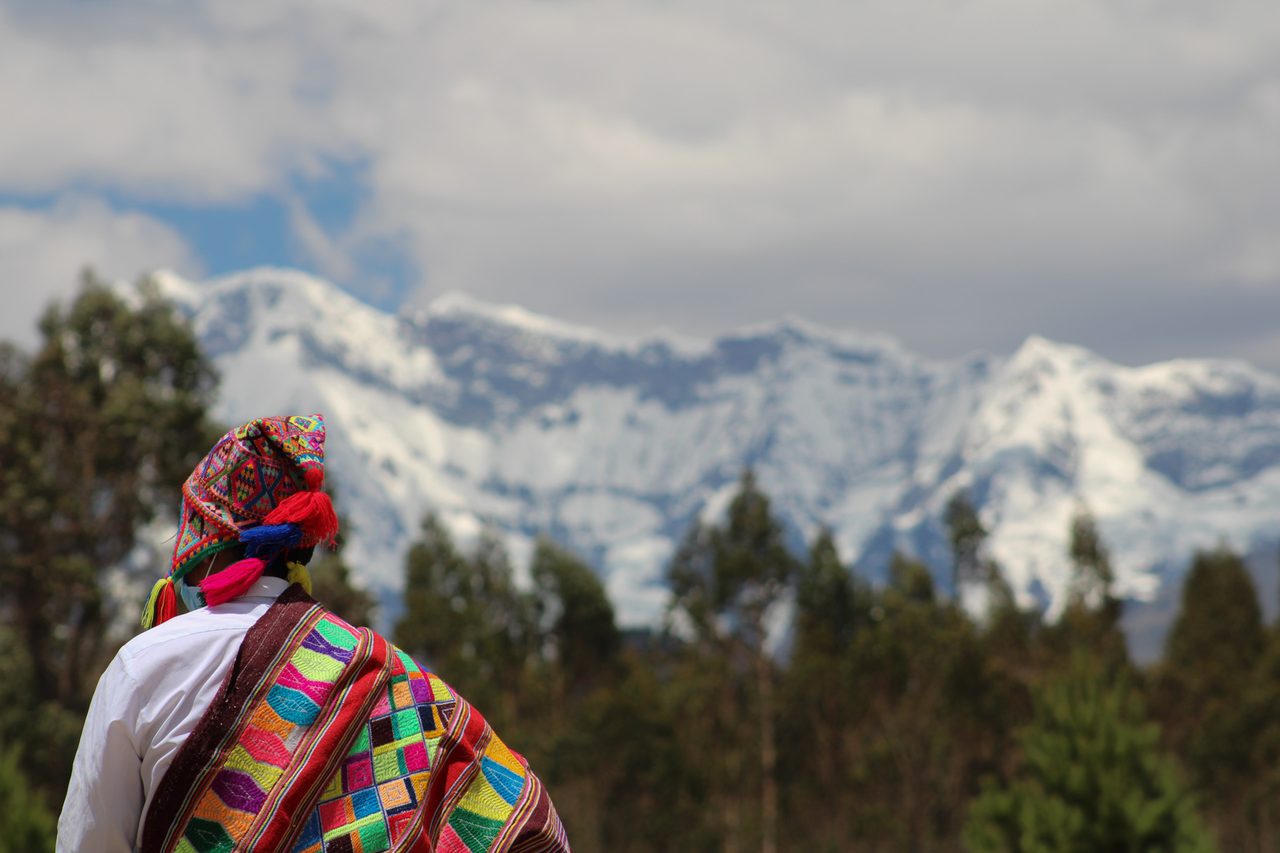
Rainbow Mountain (Vinicunca), and the case for Palccoyo
Vinicunca deserves its own honest paragraph because it is the single most oversold hike in Peru. The mineral stripes are real and genuinely striking. Everything around them is not great: a 3am pickup from Cusco, a three-hour drive, a short but savage walk topping out around 5,036 m, and in high season several hundred people queueing for the same photo while horse handlers work the line. Many people attempt it in their first 48 hours in Cusco, which at that altitude is asking for trouble. The entrance fee is S/25–30 in cash at a community checkpoint; the tour itself runs from about US$25 for a cattle-truck operation to US$80 for something civilised.
Two better options. Go to Palccoyo instead: three colour-banded ridges rather than one, a gentle 40-minute walk, a max altitude around 4,900 m, and a fraction of the crowd. The colours are softer, which is the trade-off. Or reach Vinicunca on foot as part of the Ausangate circuit, which is how it was seen before 2015. And check the forecast — the mountain is regularly under snow or cloud, and there is no refund for a white hillside.
The Cordillera Blanca: Peru’s real trekking country
Santa Cruz (4 days, ~50 km, ~4,750 m)
If I could send every visitor on one multi-day trek in Peru, it would be this one. Santa Cruz crosses the Cordillera Blanca from Cashapampa to Vaquería (or the reverse), climbing to the Punta Unión pass at about 4,750 m, with Alpamayo, Taulliraju and Artesonraju standing over the valley and a string of glacial lakes on the way up. Four comfortable days, or three if you are fit and acclimatised. It is a through-hike, so no ground gets repeated.
The reason to shout about it is the value. Guided group departures start around US$165 and top out near US$410 for a properly run trip with a cook and donkeys, which is what a single day of some Inca Trail packages costs. It is also one of the few big Peruvian treks that a competent, acclimatised hiker can genuinely do independently — the route is obvious, there is water, and you can hire an arriero and donkey in Cashapampa. You will need a Huascarán National Park ticket: S/30 for one day, S/60 for two to three days, S/150 for four to thirty days, cash only.
Santa Cruz, day by day
Nobody publishes the stages for this trek the way they do for the Inca Trail, so here they are, walking the standard Cashapampa to Vaquería direction. Distances vary a little between operators.
- Day 1 — Cashapampa to Llamacorral (~9 km, 2,900 m to 3,760 m). A steady climb up the Santa Cruz gorge, walls closing in on both sides, ending at a broad camp by the river. An easy first day by design.
- Day 2 — Llamacorral to Taullipampa (~12 km, up to ~4,250 m). Past the Ichiccocha and Jatuncocha lakes, with Artesonraju and Quitaraju appearing over the ridgeline. Camp under the north face of Taulliraju. This is the day people take too many photographs.
- Day 3 — Taullipampa over Punta Unión to Cachinapampa (~13 km, 4,750 m). The pass. A long, switchbacking morning climb to a narrow notch in the rock with the whole range on one side and the Huaripampa valley on the other. It is the hardest three hours of the trek and, on a clear morning, the reason to be here.
- Day 4 — Cachinapampa to Vaquería (~13 km, downhill). Through Quechua hamlets and grazing land to the road, then a spectacular minibus ride back over the Portachuelo de Llanganuco pass to Huaraz.
Fit, well-acclimatised hikers regularly compress this into three days by combining days one and two. Do not compress it if you have not already been above 4,500 m without trouble.
Laguna 69 (day hike, 4,600 m)
The most photographed lake in Peru and, unusually, worth the hype. About 13–14 km round trip from the Cebollapampa trailhead, roughly 800 m of ascent, finishing at a lake the colour of antifreeze under the hanging glaciers of Chacraraju. Six to seven hours of walking, plus two and a half hours of driving at each end.
It is not technically difficult. It is hard because it finishes at 4,600 m and most people do it on day two in Huaraz. The last 45 minutes is where the trip is won or lost, and it is a very common place to be quietly, comprehensively defeated by altitude. Tours from Huaraz run S/40–70 and do not include the S/30 park fee. Go on day three or four, not day two.
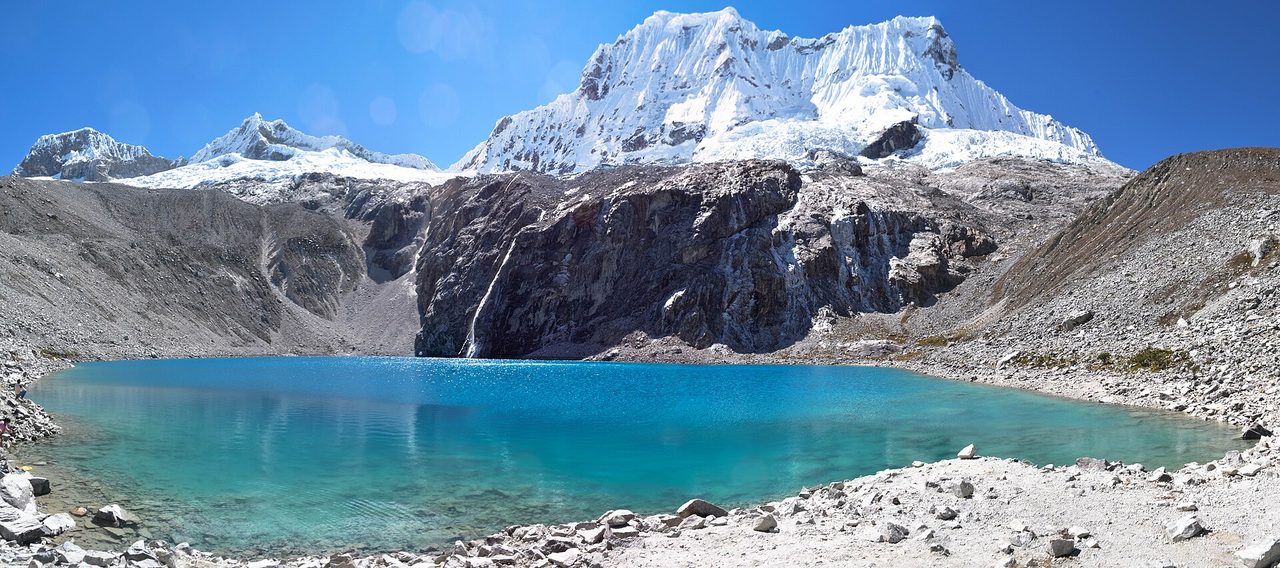
Alpamayo Base Camp (8–11 days, ~100 km)
The long version of the Cordillera Blanca. The Cedros–Alpamayo circuit strings together a week and a half of high passes to reach the base of Alpamayo, the fluted snow pyramid that gets called the most beautiful mountain in the world roughly once a year. Average altitude over 4,000 m, several passes near 4,800 m, cold nights, and remarkably few people. If you have done Santa Cruz and want more of the same at four times the length, this is it.
The day-hike ladder above Huaraz
This is the practical genius of Huaraz as a base: the day hikes form a natural acclimatisation staircase, each one a bit higher than the last, all reachable by colectivo or cheap tour. Laguna Wilcacocha at 3,750 m on day one or two. Laguna Churup at 4,450 m — short, steep, with a rock scramble on a fixed rope near the top that catches people out. Laguna Parón at 4,200 m, which is barely a walk but is arguably the most beautiful lake of the lot. Then Laguna 69. Then a multi-day trek.
The Cordillera Huayhuash: the serious one
Twenty peaks in a 30 km chain, including Yerupajá at 6,617 m and Siula Grande, the mountain from Touching the Void. The full circuit is 120–130 km over eight to twelve days, crossing eight or more passes, with most of the walking above 4,000 m and the high points around 5,000 m. Trekkers who have done circuits all over the world routinely call it the best they have walked. I would not argue.
I want to be unambiguous about what this is, because it gets listed alongside Colca Canyon as if they belong in the same conversation. The Huayhuash is a remote, cold, sustained high-altitude expedition. There is no road access for days at a time, no reliable phone signal for most of it, and evacuation means a horse and then a very long drive. Groups where everyone gets some form of altitude sickness are normal, not remarkable. Weather in the shoulder months can turn to snow. Even with donkeys carrying the loads it is physically relentless. Do not make it your first Peruvian trek. Do Santa Cruz first, in the same season, and see how you feel at Punta Unión.
The permit situation is unusual and worth understanding. The land belongs to seven campesino communities, each of which charges its own right-of-way and camping fee in cash: Llámac S/50, Pocpa S/20, Queropalca S/40, Quisuarcancha S/30, Túpac Amaru S/30, Uramaza S/30, Huayllapa S/50, Pacllón S/30, plus S/10 extra for the Cutatambo valley below Siula Grande. That totals roughly S/260–300 for the full circuit, collected by community representatives who will meet you at their boundary or at camp in the evening. Bring small notes. On a guided trip these are usually included, but confirm it, and check whether the “mini Huayhuash” four or five day loops your agency is offering actually reach the good viewpoints or just clip the edge of the range.
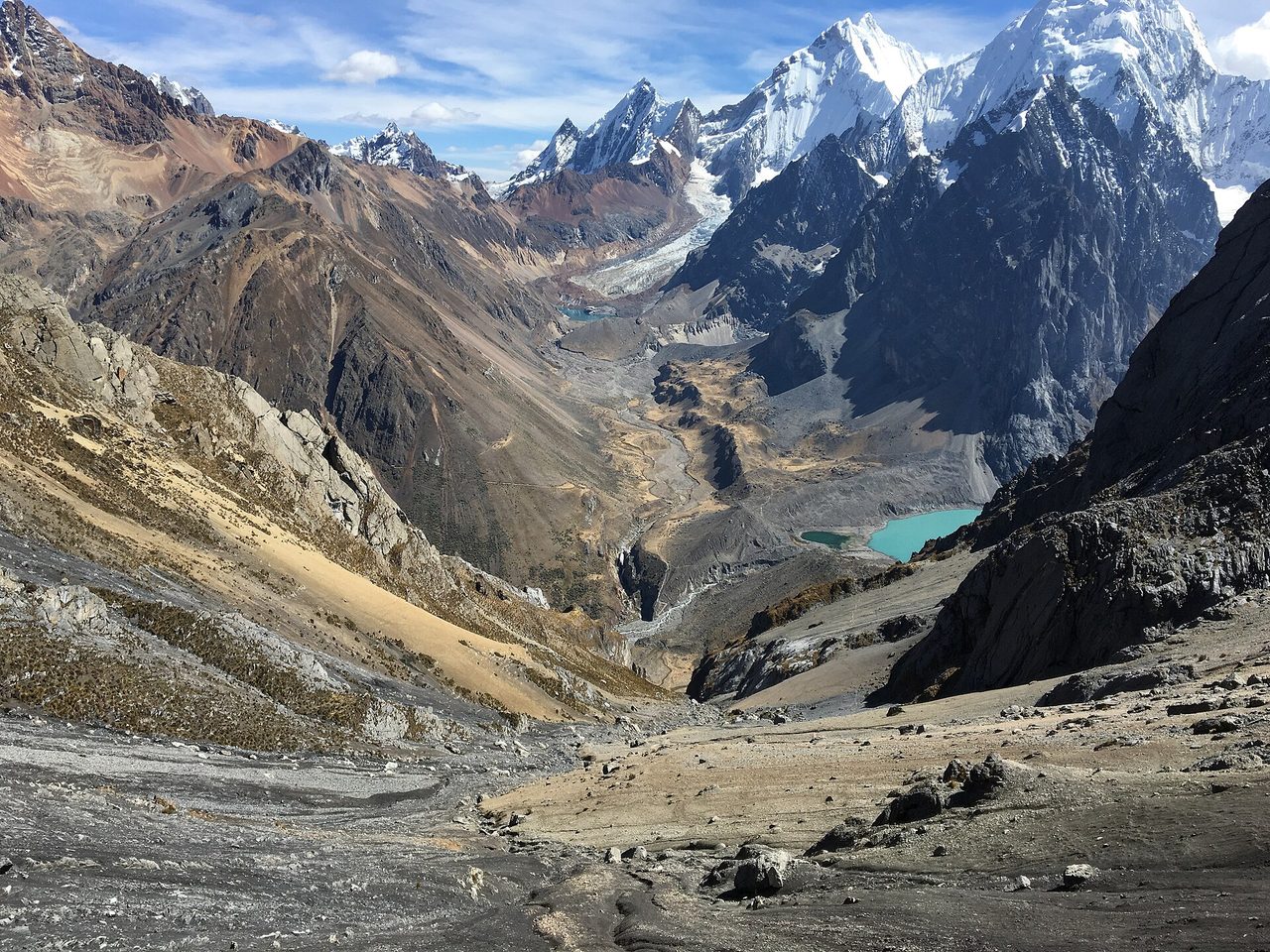
What the Huayhuash circuit actually involves
The shape of a ten-day classic circuit, from Chiquián or Llámac, anticlockwise:
- Days 1–2: in from Llámac or Cuartelhuain over the Cacananpunta pass, camping at Mitucocha under Jirishanca. You are already above 4,000 m by the end of day one, which is why the acclimatisation you did beforehand matters so much.
- Days 3–4: Carhuacocha, which is the trip’s postcard — a line of turquoise lakes strung beneath the 6,000 m wall of Yerupajá and Siula Grande. The high traverse above the lakes rather than the valley route is the version you want; ask your operator which they walk.
- Days 5–6: over Punta Cuyoc, the highest pass of the standard route at roughly 5,000 m, then down to the Viconga hot springs. Cold nights, big descents, the point where tired groups start to fray.
- Days 7–8: the San Antonio pass and the optional side trip up the Cutatambo valley to the base camp below Siula Grande, which is where Touching the Void happened. Worth the extra S/10 and the extra day.
- Days 9–10: Huayllapa, then over the last passes to Jahuacocha, the finest campsite on the circuit, and out to Llámac for the drive back.
Operators sell four and five day “mini Huayhuash” versions. Some are genuinely good and reach Carhuacocha and Jahuacocha; others are essentially a walk-in, a night, and a walk out. Ask for the campsite names before you pay.
Six treks that deserve more attention than they get
These rarely make the standard lists, which is precisely their appeal.
- Vilcabamba to Espíritu Pampa (5–7 days, Cusco region). The route to the last refuge of the Inca resistance, where Túpac Amaru I was finally captured in 1572. It runs from high grassland down into genuine jungle, the ruins are barely cleared, and you will likely have the whole thing to yourself. If the history of the Inca state and its collapse is what draws you to Peru rather than the scenery, this is the trek.
- Quilcayhuanca to Cojup (3 days, Huaraz). A quiet Cordillera Blanca alternative to Santa Cruz, crossing the Huapi pass near 5,000 m, with almost no other groups and a trailhead you can reach in an hour from town.
- Cotahuasi Canyon (3 days, Arequipa region). Deeper than Colca and far less visited, with terraced villages, hot springs and waterfalls. The catch is a ten to twelve hour road journey from Arequipa, which is exactly why it stays empty.
- Ancascocha (4–5 days, Cusco). Sometimes marketed as the “wild Inca Trail”. It uses genuine Inca paths, crosses passes near 4,650 m, passes glacial lakes and finishes near Ollantaytambo for the train. Harder than the Inca Trail and vastly quieter.
- The Inca Jungle route (3–4 days, Cusco). A downhill mountain bike, some rafting, some zip-lining and a couple of days walking to Aguas Calientes. It is not a serious trek and purists sneer at it, but it works in the wet season, it is cheap, and it suits people who want activity rather than altitude.
- Waqrapukara (long day hike, Cusco). A horned Inca fortress on a cliff edge, three hours or so of walking, and until recently nobody at all. It is the best day walk in the Cusco region for anyone who has already done Rainbow Mountain and Humantay.
Colca Canyon and the Arequipa treks
Colca Canyon (2–3 days)
A completely different kind of walk, and a good one to slot in if you are already heading to Arequipa. Colca is around 3,270 m deep, roughly twice the Grand Canyon, and the trek is essentially a steep descent to the river, a night or two in the villages and oasis lodges on the canyon floor, and a punishing climb out. That climb is the whole difficulty: 1,100–1,300 m of switchbacks, usually started at 4am to beat the heat, and it takes most people three hours. Mules are available and there is no shame in one.
It is cheap. Two-day group tours from Arequipa run US$35–80, and the Boleto Turístico for the Colca valley is S/70 for foreign adults, S/40 for Latin American visitors and S/20 for children aged six to fifteen, cash only in Chivay. Because the canyon floor sits around 2,100 m rather than 4,000 m, this is also the one significant trek in Peru you can reasonably do without a long acclimatisation period, which makes it a good early-trip option. Skip the one-day tours if you actually want to walk; they are mostly bus, condor viewpoint and buffet.
Misti (2 days, 5,822 m)
The volcano above Arequipa, and the one on this list I would most readily talk you out of. It is a non-technical two-day slog up loose ash and scree to 5,822 m, which is a genuinely impressive number and a genuinely tedious walk. There are no lakes, no ruins and not much variety until the crater. Climb it if you want to stand higher than you ever have; there are better ways to spend two days in the region.
Northern Peru: Gran Vilaya, Kuélap and Gocta
Around Chachapoyas, the trekking is pre-Inca and almost entirely tourist-free. The Gran Vilaya trek runs three to four days through cloud forest and Chachapoya sites — sarcophagi cut into cliffs, circular stone citadels swallowed by vegetation — usually finishing at the fortress of Kuélap, which has more stonework than Machu Picchu and a fraction of one percent of the visitors. Gocta Falls is a good four to five hour round-trip day hike. It is a long way from everything, and the northern circuit takes real time to build into an itinerary, but the pay-off is walking significant archaeology with nobody else on the path.
The best day hikes in Peru
Not everyone wants to camp for four days, and several of Peru’s best walks are done by lunchtime. These also double as acclimatisation.
| Day hike | Base | Distance | Max altitude | Time on foot | Difficulty | Typical cost |
|---|---|---|---|---|---|---|
| Laguna Wilcacocha | Huaraz | ~6.5 km | 3,750 m | 3–4 h | Easy–moderate | A few soles by colectivo |
| Laguna Churup | Huaraz | ~7 km | 4,450 m | 5–6 h | Hard (scramble) | Colectivo + S/30 park fee |
| Laguna Parón | Huaraz | ~4 km | 4,200 m | 2 h | Easy | Tour ~S/50 + local fee |
| Laguna 69 | Huaraz | ~13–14 km | 4,600 m | 6–7 h | Moderate–hard | S/40–70 + S/30 park fee |
| Humantay Lake | Cusco | ~6 km | 4,200 m | 3 h | Moderate (steep) | US$30–50 + entry |
| Rainbow Mountain | Cusco | ~6–10 km | ~5,036 m | 3–5 h | Moderate at brutal altitude | US$25–80 + S/25–30 |
| Palccoyo | Cusco | ~4 km | ~4,900 m | 2 h | Easy | US$35–60 + entry |
| Chinchero to Urquillos | Sacred Valley | ~8 km | 3,760 m start | 4 h | Moderate (all downhill) | Free, plus transport |
| Gocta Falls | Chachapoyas | ~14 km | ~2,300 m | 4–5 h | Moderate | ~S/20 entry + guide |
Two more that get filed as hikes but are really site add-ons: Huayna Picchu and Machu Picchu Mountain, the two peaks you can climb from inside the citadel. Both are steep, both are excellent, and both need the correct circuit on your entry ticket rather than a separate trek booking. Our comparison of the two Machu Picchu summit climbs explains which suits which kind of walker, and the Machu Picchu ticket system is worth reading before you book, because the circuits determine what you can actually climb.
Altitude: the thing that actually decides your trip
Fitness matters far less here than acclimatisation. I have watched marathon runners turned around at 4,600 m and comfortably unathletic people walk over 5,000 m passes without drama, and the difference was almost always how they spent the previous week.
The reference altitudes: Lima is at sea level. Arequipa is 2,335 m. Huaraz is 3,050 m. Cusco is 3,399 m. The Sacred Valley towns of Urubamba and Ollantaytambo sit around 2,800 m, which is why sleeping there for your first nights is smarter than sleeping in Cusco. Most trekking passes here fall between 4,200 m and 5,200 m.
A workable plan looks like this:
- Days 1–2: arrive and do almost nothing. Walk on the flat, drink water constantly, eat lightly, skip alcohol. Coca tea is pleasant and mildly helpful; it is not a treatment.
- Day 3: a low day hike. Wilcacocha above Huaraz, or something in the Sacred Valley.
- Days 4–5: a hike that touches 4,400–4,600 m and returns to sleep low. Churup, or Laguna 69.
- Day 6 onwards: start the multi-day trek.
That is five or six days before the trek even begins, which people find annoying until they meet someone who skipped it. If your schedule cannot absorb that, choose a lower trek: Colca, Lares, or the two-day Inca Trail. Sequencing your route through Puno and Lake Titicaca at 3,800 m, or up from Arequipa, also builds tolerance gradually in a way that flying straight into Cusco does not.
Two safety points that get glossed over. First, if symptoms are getting worse rather than better, or you get confused, breathless at rest, or unsteady on your feet, the answer is to descend, immediately, not to push for the pass. Second, check your travel insurance wording. A lot of standard policies cap trekking cover at 4,500 m, which quietly excludes Ausangate, the Huayhuash, Santa Cruz, Laguna 69, Rainbow Mountain and Misti — that is most of this article. Buy a policy that names the altitude you will actually reach and includes helicopter evacuation. Our general Peru travel tips cover insurance, water and the other unglamorous logistics.
Permits, fees and what you actually have to book
Simplest possible summary: only the Inca Trail needs a permit. Everything else on this page needs a ticket or a community fee that you pay on the spot, or nothing at all.
- Inca Trail (classic and 2-day): permit required, issued only to licensed operators, tied to your passport, capped at roughly 500 people a day including staff. Closed the entire month of February. June–September dates typically go four to six months out; April and October are often available two to three months out. If a date matters more than the route, you will end up on Salkantay, and that is fine.
- Huascarán National Park (Santa Cruz, Laguna 69, Churup, Alpamayo): S/30 for one day, S/60 for two to three days, S/150 for four to thirty days. Cash. Keep the ticket, it gets checked.
- Cordillera Huayhuash: no permit, but roughly S/260–300 in community fees across the circuit, paid in cash on the trail.
- Choquequirao: S/60 site entry, no cap, no advance booking.
- Colca Canyon: Boleto Turístico S/70 for foreign adults, cash only, and losing it means paying twice.
- Rainbow Mountain / Palccoyo: S/25–30 at a community checkpoint. Carry small notes.
- Machu Picchu: a separate timed ticket unless it is bundled into an Inca Trail permit. Book it as far ahead as the trek.
Rules and prices here move more than in most countries. Confirm current figures with your operator or the official portal shortly before you travel rather than trusting any article, including this one.
What trekking in Peru costs
Guided trekking prices split cleanly by region, and it is worth understanding why. In Cusco you are paying for a permit or a permit-adjacent industry, higher wages, train tickets and Machu Picchu entry. In Huaraz you are paying for a guide, a cook, some donkeys and a park ticket. Same mountains, different economics.
As a working guide: Cusco multi-day treks run US$450–800 for the permit-free routes and US$700–1,500 for the classic Inca Trail. Huaraz multi-day treks run roughly US$40–70 per person per day. Colca is the cheapest serious trek in the country at US$35–80 for two days. Doing Santa Cruz, Ausangate or Choquequirao independently — food, transport, park fees, an arriero if you want one — can bring the cost below US$100 for the whole trek, though you take on all the risk and logistics yourself.
Two costs people forget. Tips for guides, cooks, porters and muleteers are customary and a meaningful part of their income; budget 10–15 percent of the trek price and hand it over as a group at the end. And gear rental, which is cheap and abundant in both Huaraz and Cusco — sleeping bags, mats, poles and down jackets for a few dollars a day, so there is no need to fly with a full kit. Set all of this against your wider Peru trip budget, because a serious trek plus its acclimatisation days is easily a third of a two-week trip.
When to trek: the season, honestly
The dry season runs roughly May to September, and for high-altitude trekking it is not a preference, it is close to a requirement. Passes at 5,000 m in the wet season mean snow, whiteout and no view of the thing you came for.
Within that: June to August is the most stable window in the Cordillera Blanca and the Huayhuash, and also the coldest at night, with camp temperatures well below freezing. May and September are the sweet spot around Cusco: reliable weather, greener hillsides after the rains, noticeably fewer people. April and October are a gamble that often pays off, with the best Inca Trail permit availability. November to March is the wet season: the Cordillera Blanca treks are effectively off, Salkantay and the Inca Trail turn to mud, and the Choquequirao access route has been closed by rain damage in recent years. Lares and Colca are the routes that hold up best in the rain.
Peru’s regions do not share a season, which is the detail that trips up itineraries. Month by month, for trekking specifically:
| Month | Cordillera Blanca & Huayhuash | Cusco region | Colca & Arequipa | Crowds |
|---|---|---|---|---|
| January | Wet, avoid | Wet, muddy | Wet but walkable | Low |
| February | Wettest, avoid | Inca Trail closed all month | Wet | Low |
| March | Wet, tail end | Improving late in month | Improving | Low |
| April | Drying out, green | Very good, green, quiet | Good | Low–moderate |
| May | Good, few people | Excellent, the sweet spot | Excellent | Moderate |
| June | Excellent, cold nights | Excellent, busy | Excellent | High |
| July | Peak conditions, coldest | Peak, busiest | Excellent | Highest |
| August | Peak conditions | Peak, busiest | Excellent, windy | Highest |
| September | Very good | Excellent, thinning out | Very good | Moderate |
| October | Variable, showers start | Good, quiet | Good | Moderate |
| November | Rain returning | Variable | Still decent | Low |
| December | Wet | Wet, festive in Cusco | Wet | Low |
February is the month to avoid outright for anything Cusco-based — wettest month, Inca Trail closed all month. Our guides to Peru’s seasons region by region and the best months at Machu Picchu specifically go into more detail, and the seasons do not line up neatly across the country, which is worth knowing if you are combining a trek with the coast or the jungle.
Basing yourself: Huaraz and Cusco in practice
Where you sleep between treks matters more than people expect, because you will spend more nights in town than on the trail.
Huaraz is a working Andean city rather than a pretty one: concrete, traffic, a good market, and a compact core of trekking hostels and agencies around Luzuriaga and the Plaza de Armas. Almost everything is walkable. Colectivos to the day-hike trailheads leave from fixed street corners and cost a few soles, which is the cheapest way to run your acclimatisation ladder. There is a decent café and pizzeria scene aimed squarely at hungry trekkers, gear rental on every second block, and laundry that will take on four days of trail clothes without flinching. Book a room with heating; nights are cold and many budget places have none.
Cusco is the opposite: beautiful, expensive, thoroughly geared to tourism, and 350 m higher, which is why several experienced travellers deliberately spend their first nights down in Urubamba or Ollantaytambo instead and come up to Cusco later. Both work. If you have the flexibility, sleeping low and day-tripping high is the better pattern, and it also puts you in easy reach of the Sacred Valley ruins while you adjust.
One scheduling note: if you are trekking from Cusco and want to see the citadel without adding another trek, a single-day trip to Machu Picchu by train slots neatly into the acclimatisation week, because the site itself sits at 2,430 m and the day is easy on the body.
Gear: what to bring, what to rent, what to leave
Nearly every packing list for Peru is a wall of affiliate links to boots. The genuinely useful advice is narrower than that.
Bring from home: boots you have already walked a hundred kilometres in, because blisters at 4,500 m are the most common trip-ruiner after altitude. Good socks, several pairs. Base layers, a fleece and a waterproof shell. Sunglasses that actually block UV, high-factor sunscreen and lip balm with SPF, because the sun at 4,500 m near the equator is savage and reflects off snow. A wide-brimmed hat and a warm hat. Any prescription medication, plus a blister kit you trust.
Rent in Huaraz or Cusco: sleeping bag (get one rated to at least −10 °C for high camps), sleeping mat, down jacket, trekking poles, gaiters, duffel. These cost a few dollars a day, the quality is generally fine, and dragging them through airports is a waste of your baggage allowance. Try everything on in the shop rather than at the trailhead.
Leave at home: cotton anything, a giant pack if you are on a supported trek (you carry a daypack; the animals or porters take the rest), and camping stoves if you are going guided. Also leave behind the idea that you need technical mountaineering kit. None of the treks in this guide involve ropes, crampons or ice axes.
Bring more cash than you think. Park tickets, community fees, colectivos, gear rental, tips and trailhead snacks are all cash-only and often need small notes. There are ATMs in Huaraz, Cusco, Arequipa and Chachapoyas, and effectively none once you leave them.
Porters, arrieros and choosing an operator you can live with
This is the part of trekking in Peru worth taking seriously, and it barely appears on competing lists.
On the Inca Trail your gear is carried by human porters, who work under a legal weight limit that decent companies respect and bad ones quietly do not. On most other routes the loads go on donkeys or mules handled by arrieros, usually from the communities the trail crosses. In both cases these people are the reason the trek functions, and they are also where a cheap quote finds its savings: lower wages, heavier loads, worse food, no proper sleeping gear for the crew.
Questions worth asking before you book, and the answers you want:
- What is the weight limit per porter, and who checks it? A specific number, and a named checkpoint.
- Do the crew get tents, sleeping bags and the same food as clients? Yes, without hesitation.
- Are they on the payroll or hired per trip? Either can be fine, but you want to hear that they are insured.
- How big is the group? Eight to twelve is normal; sixteen means a production line.
- Which campsites, and which route variant? Vague answers usually mean the budget version.
Tipping is customary and matters. Budget roughly 10–15 percent of the trek price, work it out as a group on the last evening, and hand it over separately for guide, cook and crew rather than in one lump to the guide. Beyond money: stick to the trail so you are not widening erosion scars, carry out everything including fruit peel, do not climb on Inca stonework, and ask before photographing people. Communities along the Huayhuash and Lares routes charge fees precisely because tourism has costs for them as well as benefits, and paying without grumbling is the least any of us can do.
What I would skip
An honest list, since almost every other page selling these treks has nothing to lose by recommending all of them.
- Rainbow Mountain in July, on your second day at altitude. You will be ill, it will be crowded, and there is a fair chance the colour is under cloud. Palccoyo, a later date, or the Ausangate approach all fix this.
- The Pastoruri Glacier “hike”. A short paved walk at 5,000 m to a visibly shrinking glacier, sold as a trek. It is a legitimate lesson in glacial retreat and not a legitimate day hike.
- One-day Colca tours if you want to walk. Fourteen hours, most of it in a minibus, with about forty minutes at the condor viewpoint. Do the two-day trek or do something else.
- Misti, unless the altitude number is the point. Two days of ash and scree.
- The very cheapest Salkantay and Inca Trail quotes. The gap between a US$350 Salkantay and a US$550 one is mostly food, group size and how the crew is treated.
- Booking a big trek for your first three days in the country. The most expensive mistake on this page, because you cannot buy the days back.
Guided or independent?
The Inca Trail settles itself: you cannot walk it without a licensed operator, full stop.
Everything else is a genuine choice. Santa Cruz is the best independent trek in Peru — obvious route, water, reliable arrieros in Cashapampa. Ausangate and Salkantay are both walked independently by plenty of people; both are well-trodden enough to follow, and both punish you hard if the weather turns and you have no support. Choquequirao is doable solo but the heat, exposure and water management on the canyon walls are serious. The Huayhuash can be done independently by very experienced parties, and every year some go badly; unless you have real high-altitude experience, take a guided trip.
On choosing an operator, the useful signal is not the price, it is how they answer questions about their staff. Weight limits for porters and arrieros, wages, tents and food for the crew, insurance. A company that answers that crisply is usually good at everything else too. The cheapest quote in Cusco is almost always cheap because someone in the supply chain is being squeezed.
Trekking with children, teenagers and older parents
This gets asked constantly and answered badly, usually with a cheerful “anyone can do it” from someone selling the trek.
The honest position is that age matters much less than acclimatisation and much less than how the group handles a bad morning. I have seen fit sixty-somethings walk over Punta Unión without breaking stride and twenty-five-year-olds turned back at 4,600 m. Altitude does not sort people by age in any predictable way, and there is no reliable test beforehand. What you can control is the margin you build in.
For children, most Inca Trail operators set a minimum age somewhere around eight to twelve, and the four-day route is a genuinely long ask for a small child even with porters carrying everything. Better options: the two-day Inca Trail, the Lares trek with a horse available, Colca Canyon with a mule for the climb out, or a run of Sacred Valley day walks with the train to Machu Picchu at the end. Younger children do better at 2,800 m in the valley than at 3,400 m in Cusco.
For older travellers, the questions worth asking are about knees rather than lungs. The Inca Trail’s descending stone staircases are punishing on joints, and the climb out of Colca is unforgiving. Poles help enormously. So does choosing a route with pack animals rather than a route where a bad day means walking anyway. Lodge-based Salkantay and Ausangate trips exist precisely for this, and while they are expensive they remove the two things people find hardest: cold nights on the ground and no bail-out option.
For any mixed-ability group, the two useful rules are to add a full extra acclimatisation day beyond what you think you need, and to book a private departure rather than joining a group. On a private trip the pace is yours; on a group departure it belongs to the fastest person in it.
Which trek should you actually choose?
- First time in Peru, want Machu Picchu, booked early: classic Inca Trail.
- Want Machu Picchu, booked late: Salkantay. It is harder and higher; train for it.
- Short on time or fitness but want the Sun Gate: the two-day Inca Trail.
- Care about mountains more than ruins: Santa Cruz, and stay in Huaraz for two weeks.
- Want the ruins without the crowds: Choquequirao.
- Experienced high-altitude hiker with 10+ days: Huayhuash circuit.
- Want people and culture rather than scenery: Lares, or Gran Vilaya in the north.
- Two spare days, low altitude, small budget: Colca Canyon.
- Travelling with older parents or children: day hikes from the Sacred Valley, Colca, or the two-day Inca Trail.
- Don’t actually want to camp: take the train. Nobody is grading you.
That last one is not a joke. If multi-day camping at altitude does not appeal, the train through the Urubamba valley is a genuinely lovely journey and gets you to exactly the same place, and we have written honestly about whether Machu Picchu justifies the effort and expense at all. Trekking is an experience in its own right, not a better ticket.
How a trek fits into a wider trip
A multi-day trek plus proper acclimatisation is a nine to twelve day commitment, which is most of a standard Peru holiday. Put it in the back half of the trip, after your body has adjusted, and leave a rest day afterwards, because you will want one.
The usual shape: a couple of days in Lima, a few days acclimatising in Cusco or the Sacred Valley, the trek, then Machu Picchu, then whatever comes next. If you are adding the Amazon lowlands, do it after the trek, not before, since dropping to 200 m and flying back to 3,400 m undoes your acclimatisation. Our Peru itinerary planner shows how the pieces fit, and if you are still working out how many days the citadel itself needs, this breakdown of Machu Picchu timings is the place to start. There is a wider survey of everything else on the country’s things to do if trekking is only part of the plan.
Practical afterthoughts: layers matter more than anything else you pack, because a single day can run from below freezing at dawn to fierce UV by mid-morning, and the same logic applies to what to wear at Machu Picchu after the trek. Book somewhere decent for the night you come off the trail rather than the night you start — our guide to accommodation across Peru covers both regions. And the first proper meal after four days of trail food is one of the better arguments for eating your way around Peru.
Trekking in Peru FAQ
What is the best trek in Peru?
For scenery, the Cordillera Huayhuash circuit, and it is not a close call among people who have walked several. For most travellers, though, the honest answer is Santa Cruz: four days, world-class mountains, no permit, and a fraction of the cost of the Cusco routes. If Machu Picchu is the point, the classic Inca Trail wins because no other route walks you in through the Sun Gate.
What is the hardest trek in Peru?
The Huayhuash circuit, on sustained difficulty: eight to twelve days, mostly above 4,000 m, eight-plus passes, remote enough that evacuation is slow. Choquequirao is the hardest short trek, because of the repeated 1,500 m descents and climbs of the Apurímac canyon in heat. Ausangate is the hardest of the Cusco-region routes.
Which trek to Machu Picchu should I choose?
Inca Trail for history and the Sun Gate arrival, if you can get a permit. Salkantay for bigger mountains and last-minute availability, accepting that it is harder. Lares for Andean village culture. Choquequirao if you want almost no other people and can handle very steep days. The two-day Inca Trail if you are short on time.
Do you need a permit to trek in Peru?
Only for the Inca Trail, including the two-day version. Everything else needs either nothing, a national park ticket bought on the day, or community fees paid in cash on the trail. That is why Salkantay, Santa Cruz and Ausangate can all be booked a few days out.
Can you trek in Peru without a guide?
Yes, except on the Inca Trail, where independent hiking is prohibited. Santa Cruz is the most straightforward independent option, and Ausangate, Salkantay and Colca are all regularly walked unguided. The Huayhuash is technically open to independent trekkers but demands real high-altitude experience.
What is the best trek in Peru for beginners?
Colca Canyon, because it is only two days, the canyon floor is around 2,100 m so altitude is far less of a factor, and you can hire a mule for the climb out. After that, the two-day Inca Trail or the Lares trek. Do not let anyone talk a first-time trekker onto Ausangate or the Huayhuash.
Is Huaraz or Cusco better for trekking?
Huaraz, if you are there for mountains. Higher peaks, better lakes, far fewer people, roughly a third of the price, and a natural ladder of acclimatisation day hikes. Cusco is better if you want ruins, want Machu Picchu at the end, or have limited time, since it has flights and a huge choice of operators. Serious hikers with three weeks should do both.
How long do you need to acclimatise before a big trek?
Three days minimum at 3,000–3,400 m, and five is much better if you are heading above 4,800 m. Build up with day hikes that go high and return to sleep low. Arriving in Cusco and starting a trek 48 hours later is the single most common planning mistake in Peru.
When is the best time of year for trekking in Peru?
May to September. June to August is the driest and most reliable in the Cordillera Blanca and Huayhuash, and also the coldest at night. May and September are the sweet spot around Cusco. November to March is the wet season, when high-altitude routes are largely off, and the Inca Trail is closed for all of February.
How much does trekking in Peru cost?
Roughly US$450–800 for a guided permit-free trek from Cusco, US$700–1,500 for the classic Inca Trail, and around US$40–70 per person per day out of Huaraz. Colca is the cheapest at US$35–80 for two days. Add park and community fees in cash, tips of 10–15 percent, and cheap gear rental if you need it.
How fit do you need to be?
Less fit than you fear, and better acclimatised than you probably plan to be. You need to be able to walk five to eight hours a day on uneven ground for several days in a row. Hill walking and stair sessions in the months beforehand help far more than gym cardio. On the day, going slowly is the technique.
What is the best day hike in Peru?
Laguna 69 from Huaraz, on the strength of the lake alone. Laguna Churup is the better workout and Laguna Parón involves barely any walking for an equally spectacular view. Around Cusco, Humantay Lake beats Rainbow Mountain for most people, and Palccoyo beats Vinicunca for anyone who dislikes crowds.
Is Rainbow Mountain worth it?
Conditionally. The stripes are real and striking, but you are looking at a 3am start, a three-hour drive, an assault on 5,036 m and, in high season, a queue. Go acclimatised, go early in the week, check the forecast, or go to Palccoyo instead. Reaching Vinicunca on foot as part of the Ausangate circuit is by far the best version of it.
Is the Santa Cruz trek harder than the Inca Trail?
They are close. Santa Cruz goes higher, to about 4,750 m at Punta Unión against 4,215 m at Dead Woman’s Pass, and there is less support if you go independently. The Inca Trail has more relentless stone stairs, which are harder on knees. Most people who have done both find Santa Cruz the easier walk with the bigger scenery.
How high is the Huayhuash circuit?
Most of the walking sits above 4,000 m, and the passes on the classic route reach around 5,000 m, with optional detours higher. That sustained altitude, rather than any single climb, is what makes it hard. Expect eight or more passes over eight to twelve days.
When does the Inca Trail close?
Every February, for the full month, for maintenance and conservation during the wettest part of the year. That closure covers the two-day route as well. Machu Picchu itself stays open, and the permit-free treks such as Salkantay and Lares run through February.
Do you need special travel insurance?
Yes, and read the altitude clause. Many mainstream policies limit trekking cover to 4,500 m, which excludes most of the treks in this guide. You want a policy that explicitly names your maximum altitude and covers emergency evacuation, including by helicopter where available.
Can you trek in Peru during the rainy season?
Some routes, yes. Lares and Colca hold up reasonably well, and the Inca Jungle route through lower country is designed for it. The Cordillera Blanca and Huayhuash are effectively out from December to March, and Salkantay and the classic Inca Trail become mud and cloud. The Inca Trail is closed entirely in February.
What should I pack for a trek in Peru?
Layers above all: thermals, fleece, a down jacket and a waterproof shell, because a single day runs from below freezing to strong sun. Broken-in boots, camp shoes, poles with rubber tips, a headlamp, high-SPF sunscreen and a hat, blister kit, water treatment, and your passport if the route involves checkpoints. Rent bulky items in Huaraz or Cusco rather than flying with them.
How do you get from Lima to Huaraz?
By bus, in eight to nine hours, usually overnight, from the terminals in central Lima. Pay for a full-recline cama seat on one of the better companies and it is a comfortable trip. An airstrip at Anta exists but scheduled flights have started and stopped repeatedly, so treat any flight you find as a bonus rather than a plan.
Do you have to camp, or are there lodge treks?
Most routes are camping, with tents carried by porters or pack animals. Lodge-to-lodge versions exist for Salkantay and Ausangate, with hot showers and beds each night, and they cost several times more — roughly US$1,900 to US$3,700 rather than US$450 to US$800. Colca is the exception at the budget end, since you sleep in simple lodges on the canyon floor either way.
How far in advance should you book a trek in Peru?
The Inca Trail, four to six months for peak season and as early as you can manage for June to August. Everything else, a few days to a few weeks. Huaraz agencies fill group departures for Santa Cruz and the Huayhuash within a day or two in July and August, but outside that you can walk in and book for the following morning.
Can you combine a trek with the rest of Peru?
Easily, if you sequence it sensibly. Trek in the back half of the trip, and do low-altitude regions either before you go up or well after you come down. The desert and coastal stretch running south from Lima is a comfortable low-altitude opener, and our guide to Paracas, Huacachina and the southern coast covers how it links to Arequipa and Cusco by bus.
Are Peru’s treks safe for solo travellers?
Generally yes, particularly on the popular routes where you will see other groups daily and can join an agency departure as a single. The real risks are altitude and weather rather than crime. Tell someone your route, carry a way to signal for help, and be honest with yourself about going alone on remote circuits like the Huayhuash.
Final thoughts
The mistake I see most often is treating Peru as a country with one trek in it. Book the Inca Trail if you want the Inca Trail, and book it early, because the permits genuinely are the constraint everything else bends around. But if that date does not exist, or the price makes you wince, or you simply care more about mountains than masonry, get on the night bus to Huaraz. The Cordillera Blanca has better peaks, better lakes, cheaper trips and a fraction of the crowds, and almost nobody planning their first trip to Peru knows it is there.
Whatever you pick, give the altitude the respect it wants. Five slow days before the trek will do more for your enjoyment than five months of training. Then walk slowly, eat everything the cook gives you, tip the crew properly, and take the extra day at the end.
Sources
- PROMPERÚ — the official Peru tourism board
- UNESCO World Heritage Centre — Huascarán National Park
- SERNANP — Peru’s protected natural areas service
About this guide: written by the Peru Tourism Guide team, who have walked in the Cordillera Blanca, the Cusco region and the Colca valley and have spent a lot of time talking people out of doing Rainbow Mountain on their second day at altitude. We update prices and fees as they change.