Sacsayhuaman & the Cusco Tourist Ticket (Boleto Turistico)
You cannot buy a ticket to Sacsayhuaman on its own. Entry comes bundled into the Boleto Turistico, at S/70 for one circuit or S/130 for all sixteen sites. Here is the arithmetic, what the pass leaves out, and whether the walls justify the fuss.
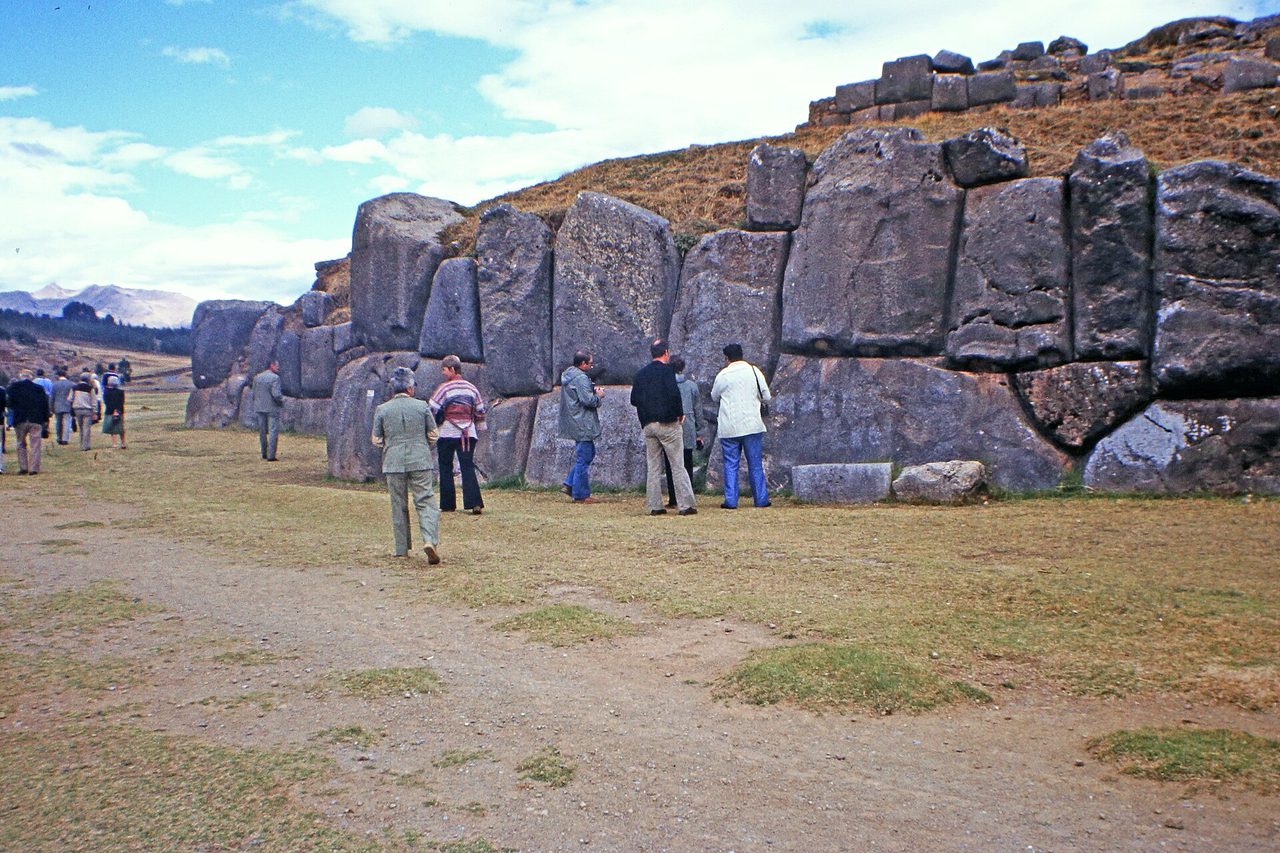
You cannot buy a ticket to Sacsayhuaman. That is the first thing to understand, and it is the thing almost nobody tells you until you are standing at the gate on the hill above Cusco being turned away. There is no S/20 turnstile, no card reader, no QR code on your phone. The only way through the door is the Boleto Turistico del Cusco — a bundled multi-site pass that costs either S/70 or S/130 depending on which version you buy, and which you have to pay for in cash, in soles, in person.
So a guide to Sacsayhuaman is really two guides bolted together: one about a 15th-century Inca ceremonial complex with stone blocks the size of delivery vans, and one about a ticketing system that was designed in the 1970s and has been confusing visitors ever since. I have written both, and I have put the ticketing first, because that is where people lose money.
Quick pronunciation note before we go further, because you will hear it fifty times in Cusco: sak-sai-wa-MAN, stress on the last syllable. Roughly half the guides in Cusco will tell you the mnemonic is “sexy woman” and wait for the laugh. It is close enough to be useful and old enough to be tired. Say it once in your head, then use the real pronunciation.
There is no standalone Sacsayhuaman ticket — only the Boleto Turistico
The Boleto Turistico (officially the Boleto Turistico del Cusco, administered by an agency called COSITUC) is a single pass covering 16 archaeological sites and museums across Cusco city, the hills above it, the Sacred Valley and the South Valley. Sacsayhuaman is one of the 16. It has no separate entry fee, no separate queue, no separate ticket. Neither do Pisac, Ollantaytambo, Chinchero, Moray, Tipon or Piquillacta.
This is deliberate. The system exists to make you subsidise the sites nobody visits by charging you for them alongside the sites everybody visits. Whether that is fair depends on your mood, but it is not optional. If you want to walk among those walls, you buy the bundle.
There are four versions on sale. Here are the current 2026 prices for foreign adults, with the Peruvian-national and student rates alongside, because the gap is startling.
| Ticket | Foreign adult | Peruvian adult | Student / 10–17 | Valid for | Sites |
|---|---|---|---|---|---|
| Boleto Integral (BTCI) — all three circuits | S/130 (~US$35) | S/70 | S/70 | 10 days | 16 |
| Partial Circuit I — the Cusco ruins | S/70 (~US$19) | S/40 | S/40 | 1 day | 4 |
| Partial Circuit II — city museums + South Valley | S/70 | S/40 | S/40 | 2 days | 8 |
| Partial Circuit III — Sacred Valley | S/70 | S/40 | S/40 | 2 days | 4 |
| Children under 10 | Free | Free | — | — | — |
And here is what sits inside each circuit:
- Circuit I (1 day): Sacsayhuaman, Q’enqo, Puka Pukara, Tambomachay. All four sit on the same road climbing north out of the city, within about 8 km of the Plaza de Armas.
- Circuit II (2 days): Qorikancha Site Museum, Museo Historico Regional, Museo de Arte Contemporaneo, Museo de Arte Popular, Centro Qosqo de Arte Nativo, the Pachacutec Monument, plus Tipon and Piquillacta in the South Valley.
- Circuit III (2 days): Pisac, Ollantaytambo, Chinchero, Moray — the four ticketed sites of the Sacred Valley.
Note that word Site Museum in Circuit II. It is not a typo and it is the single most common misunderstanding on the whole ticket. More on that below.
Prices have held at S/130 and S/70 for several years now, but COSITUC revises them without much warning, so treat these as accurate at the time of writing and worth a sanity check when you arrive. The office will tell you in ten seconds.
The arithmetic: when the Integral actually beats a Partial
Every guide tells you the Integral is “better value” and stops there. It is worth doing the sums properly, because the answer is sharper than the usual hand-waving and it has a hard edge in one direction.
The Integral costs S/130. Each Partial costs S/70. So:
| What you actually plan to do | Cheapest legal option | Cost | Cost per site you’ll really see |
|---|---|---|---|
| Sacsayhuaman and the three ruins above the city, nothing else | Partial Circuit I | S/70 | S/17.50 (4 sites) |
| Sacsayhuaman only, in and out in 90 minutes | Partial Circuit I | S/70 | S/70 |
| Sacred Valley day tour only (Pisac + Ollantaytambo) | Partial Circuit III | S/70 | S/35 |
| Sacred Valley plus Moray and Chinchero | Partial Circuit III | S/70 | S/17.50 |
| Cusco ruins and a Sacred Valley day (the standard trip) | Integral | S/130 | S/21.67 (6 sites) |
| Two circuits bought separately instead | Two Partials | S/140 | — strictly worse |
| All 16 sites, which nobody does | Integral | S/130 | S/8.13 |
The break-even is not gradual. It is a cliff at exactly two circuits. The moment your itinerary contains Sacsayhuaman and anything in the Sacred Valley — which is to say, the moment you are doing the standard Cusco trip that ninety per cent of visitors do — the Integral is S/10 cheaper than buying the two Partials you need, and it throws in Circuit II for nothing. There is no scenario where two Partials beat the Integral.
But look at that third column honestly. If you buy the Integral and do the classic sequence — a half-day city tour of the four ruins, then a Sacred Valley day — you will visit six sites out of 16 and your effective cost is about S/21.67 each. Most people never set foot in Piquillacta, never find the Museo de Arte Popular, and could not point to the Pachacutec Monument on a map. You are paying for 16 and seeing six. That is not a scam, exactly. It is just worth knowing before you decide you got a bargain.
Two traps in the small print:
- Partial Circuit I is valid for one calendar day only. Not 24 hours. One day. If you buy it at 3pm intending to see Sacsayhuaman that afternoon and the other three tomorrow, you have wasted S/70. This is the most expensive mistake on the ticket.
- The Integral’s ten days start from the date written on it, not from first use. If you buy it on arrival and then disappear on the four-day Inca Trail before touring the valley, do the maths on the calendar first.
For anyone building a budget, ticket costs like this add up faster than people expect across a two-week trip, and it is worth reading a full breakdown of what a Peru trip actually costs before you commit to an itinerary. The Boleto is one of maybe eight separate entry fees you will pay in the Cusco region alone.
What the Boleto Turistico does NOT cover
This is where the real anger lives. People assume a S/130 regional pass covers the region. It does not. It covers 16 specific properties administered by one agency, and several of the things you most want to see belong to different agencies entirely.
| Not on the Boleto | What it costs instead | Where you buy it |
|---|---|---|
| Machu Picchu | S/163 foreign adult; S/211 with Huayna Picchu or Machu Picchu Mountain | Ministry of Culture online portal, in advance |
| Qorikancha (the temple and Santo Domingo convent) | Around S/15–25, paid at the door | At the entrance on Plazoleta Santo Domingo |
| Cusco Cathedral | Around S/40, or a combined Religious Circuit ticket | At the cathedral door on the Plaza de Armas |
| Rainbow Mountain (Vinicunca) | Community fee, roughly S/25–30, cash at the trailhead | Collected by the local community on the road in |
| Humantay Lake | Community fee, roughly S/10–30 depending on the year and the gate | Cash at the trailhead |
| Maras salt pans (Salineras) | Around S/20 | Cash at the gate above the terraces |
| Inca Trail and other treks | Permit price bundled into your operator’s fee | Licensed operator, months ahead |
| Cristo Blanco statue | Free | — |
The Qorikancha one deserves its own paragraph, because it catches almost everyone. Circuit II includes the Museo de Sitio del Qorikancha, which is a small underground archaeology museum reached from the gardens on Avenida El Sol. It is not the Qorikancha. The Qorikancha proper — the curved wall of golden-age Inca masonry with a Dominican convent built on top of it, one of the genuinely extraordinary buildings in South America — is a separate entry, paid at a separate door, on a separate ticket. Two different places, about 150 metres apart, sharing a name. Budget for both.
The community fees for Vinicunca and the Rainbow Mountain trail and for the glacial lake at Humantay move around more than the official ones do, because they are set locally rather than nationally. Carry more cash than you think you need. Neither has a card machine and neither ever will.
Getting up there: the walk, the taxi, and why not on day one
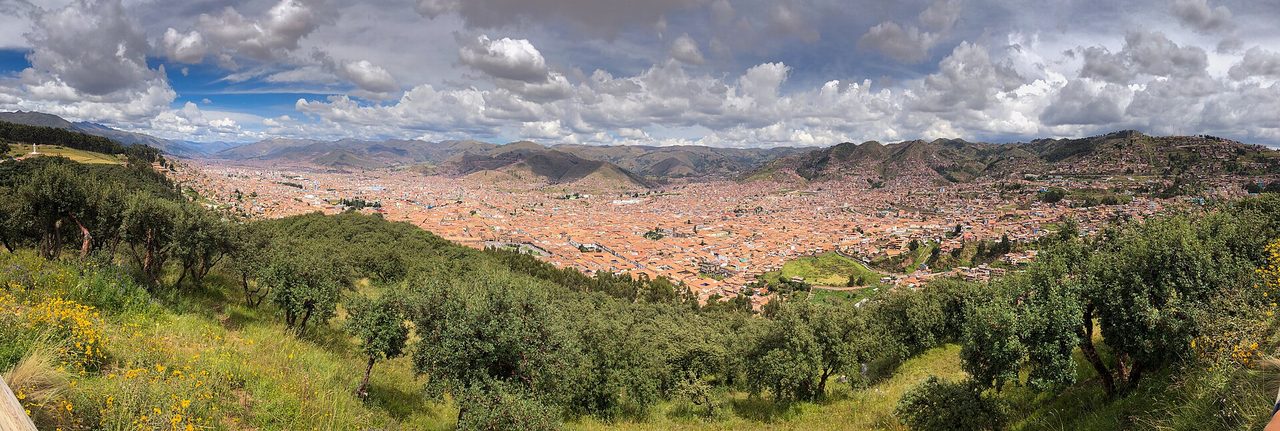
Sacsayhuaman sits about 2 km north of the Plaza de Armas as the crow flies, at roughly 3,700 m — call it 300 m above the city centre, which itself is already at 3,400 m. The site is open daily, usually 7:00 to 18:00, and the last entry is a little before closing.
You have two realistic options.
Walk. From the Plaza, take Suecia or Ataud up past the Iglesia de San Cristobal, then the Resbalosa slope or the Arco Iris path. It takes 30 to 40 minutes and it is genuinely steep — cobbled, uneven, occasionally stepped, and relentlessly uphill. Fit people from sea level who would consider this a nothing walk at home will find themselves stopping every fifty metres with their hands on their knees. That is not a fitness failure. It is 3,700 m.
Taxi. Ten to fifteen minutes from the centre, roughly S/10–20 depending on your Spanish and the time of day, dropping you at the main gate. Agree the price before you get in. Coming back down is easy and pleasant on foot even if you rode up, because gravity does the work and the view over the terracotta roofs of the old town is the best in Cusco.
Now the warning, and I mean it: this is a poor choice for your first day at altitude. A very large number of visitors fly into Cusco from Lima, drop their bags, and go straight up the hill because a city tour was the only thing bookable that afternoon. Lima is at sea level. The flight takes 80 minutes. Your body has had no time at all, and you are about to climb 300 vertical metres on foot to a place higher than most European ski resorts.
Give it a day. Spend your first afternoon flat: the Plaza, San Blas at a crawl, a long lunch, coca tea, water, no alcohol. Read up on how altitude actually behaves in Cusco before you arrive, because the symptoms are easy to mistake for a hangover and the standard advice — ascend slowly, hydrate, do nothing strenuous for 24 to 48 hours — genuinely works. If you have the flexibility, arriving in Cusco via Arequipa at 2,300 m rather than direct from the coast makes an enormous difference.
There is also a scheduling argument. Sacsayhuaman is at 3,700 m. Machu Picchu is at 2,430 m — nearly a kilometre lower than Cusco, which surprises most people. The altitude problem on a Peru trip is Cusco and the ruins above it, not the famous citadel. Plan your Cusco days around that rather than around the train timetable, and think about how many days Cusco really needs before you book anything.
What is actually up there
Having spent all that time on tickets, the site deserves its due. Sacsayhuaman is not a pile of rubble with a fee attached. It is the most impressive piece of stonework in the Cusco region and arguably in the Americas.
The thing you have seen in photographs is the triple line of zigzagging ramparts on the northern edge of the esplanade. Three tiers, each running several hundred metres, built from limestone and diorite blocks that reach five metres high and weigh well over a hundred tonnes. They are fitted without mortar, in irregular polygonal shapes, with joints you cannot get a blade into. Nobody has produced a fully satisfying account of how blocks that size were shaped, moved and seated to that tolerance with the technology available in the 15th century. The honest scholarly position is that we understand the ramping and levering in principle and not the precision in practice.
The zigzag itself is usually explained two ways: militarily, as a design that exposes an attacker’s flank at every angle, and symbolically, as the teeth of a puma, with Cusco laid out below as the animal’s body. Both may be true. Neither is provable. Guides state whichever one they prefer as fact.
Other things worth finding on the site:
- The esplanade. A vast flat green field between the ramparts and the rock outcrop. This is where Inti Raymi is staged. Empty on an ordinary Tuesday, it is oddly moving — a parade ground with nothing on it.
- Muyuqmarka. The circular foundations on the high ground, all that survives of one of three towers. Concentric rings of stonework with the remains of a water channel running to the centre.
- The Rodadero (Suchuna). A natural diorite outcrop polished glassy smooth by glaciation and by several centuries of Cusqueño children sliding down it. Still in use for exactly that purpose at weekends.
- The Chincana. Tunnels and passages in the rock. The small one you can walk through in about a minute; the large one is closed and wreathed in stories about people who went in and never came out.
- Cristo Blanco. The white Christ statue on the adjacent hill, a 1945 gift from Palestinian refugees to the city. Outside the paid area and free to visit. The view over Cusco at sunset from up here costs nothing at all, which puts it on the short list of genuinely good free things to do in Peru.
Give it 90 minutes to two hours to do properly. A standard half-day city tour allots about 45 minutes, which is enough for the ramparts and a photograph and not much else. If you have the Integral and ten days on it, going back a second time on your own, early, is one of the better uses of the ticket.
How much of it is actually left
Less than you are looking at, and far less than there was. After the Spanish took Cusco, and particularly after Manco Inca’s 1536 rebellion used the complex as a stronghold, Sacsayhuaman was systematically quarried for the colonial city below. Its dressed stone went into churches, mansions and civic buildings across Cusco, and stone from the site is generally credited in the fabric of the cathedral itself.
Estimates of what survives vary between roughly a fifth and about 40 per cent of the original complex, which tells you how uncertain the figure is; nobody has a reliable plan of what stood there in 1533. What is certain is the pattern of the loss. The upper structures, built from stones a few men could carry, are gone. The three great ramparts survive precisely because the blocks were too enormous to move. What you are admiring is the part the looters gave up on. The buildings above it, which is where the actual complex was, went into the walls of the town you can see from the esplanade.
If Inca masonry is what draws you to Peru, it is worth understanding how Sacsayhuaman sits alongside the rest of the network — a survey of the country’s major Inca sites makes the scale of the empire much clearer than any single ruin can, and the same is true of the wider list of Peru’s UNESCO-listed places.
Honest verdicts on the other 15 sites
You have paid for all of them. Here is my ranking of which deserve your limited days and which you can skip without regret.
| Site | Circuit | Verdict | Time needed |
|---|---|---|---|
| Sacsayhuaman | I | Essential. The reason the ticket exists. | 1.5–2 hrs |
| Ollantaytambo | III | Essential. A living Inca town plus a steep, spectacular terraced fortress. The best site on the ticket after Sacsayhuaman. | 2–3 hrs |
| Pisac | III | Essential. Terraces down a whole mountainside, a large cliff necropolis, and far fewer people if you go early or walk up from the town. | 2–3 hrs |
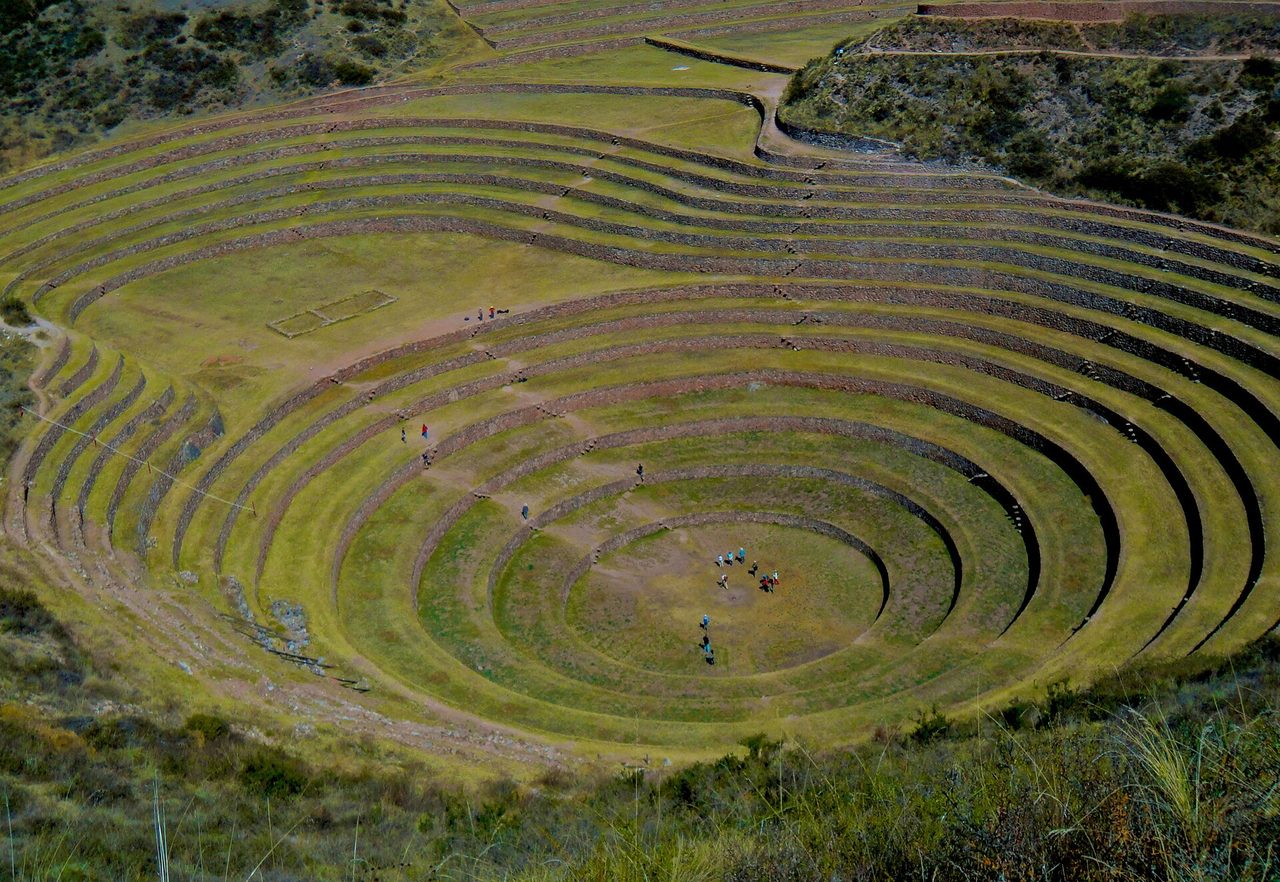
| Moray | III | Worth the detour. Concentric agricultural terraces that look engineered by someone from the future. Small, and quick. | 45 min |
| Tipon | II | Underrated. Inca hydraulic engineering with the water still running through the channels. Almost empty. The best reason to bother with Circuit II. | 1–1.5 hrs |
| Tambomachay | I | Pleasant, small, over in 15 minutes. Fine as part of the loop, not a destination. | 15–20 min |
| Q’enqo | I | Interesting carved limestone outcrop and a subterranean altar. Ten minutes unless you have a good guide, in which case twice that. | 15–30 min |
| Chinchero | III | Mixed. The colonial church on Inca foundations is lovely. The weaving demonstrations are genuine but heavily commercialised. | 1 hr |
| Piquillacta | II | For enthusiasts only. A huge pre-Inca Wari city, archaeologically important, visually a grid of low mud-brick walls. | 1 hr |
| Puka Pukara | I | Shrug. A small red-stone lookout you can see most of from the roadside. | 10–15 min |
| Museo Historico Regional | II | The best of the museums. Colonial-era house of the chronicler Garcilaso de la Vega, decent pre-Columbian collection. | 45 min |
| Centro Qosqo de Arte Nativo | II | A nightly folk dance and music show. Better than it sounds, and it is included, so if you are in town at 18:30 with nothing on, go. | 1.5 hrs |
| Museo de Sitio del Qorikancha | II | Small underground museum. Not the Qorikancha. Twenty minutes. | 20 min |
| Museo de Arte Popular | II | Shrug. Folk art in a basement. Fine on a rainy afternoon. | 30 min |
| Museo de Arte Contemporaneo | II | Skip. Thin collection in a grand building. | 20 min |
| Monumento a Pachacutec | II | Skip unless you like the view. A statue on a roundabout with a climbable tower and a small display inside. | 20 min |
Boiled down: Circuit I and Circuit III carry the whole ticket. Circuit II is a bonus you will probably use twice, and if Tipon does not appeal, possibly not at all. That is fine — just do not let anyone tell you the museums are the value proposition.
If you are assembling a Sacred Valley day, the geography matters as much as the ticket: Pisac and Ollantaytambo sit at opposite ends of the valley, with Moray and Chinchero on the plateau in between. A guide to the Sacred Valley and how to sequence it will save you more time than the ticket saves you money, and it is worth comparing against the other day trips available from Cusco before you fill your calendar.
Inti Raymi on 24 June
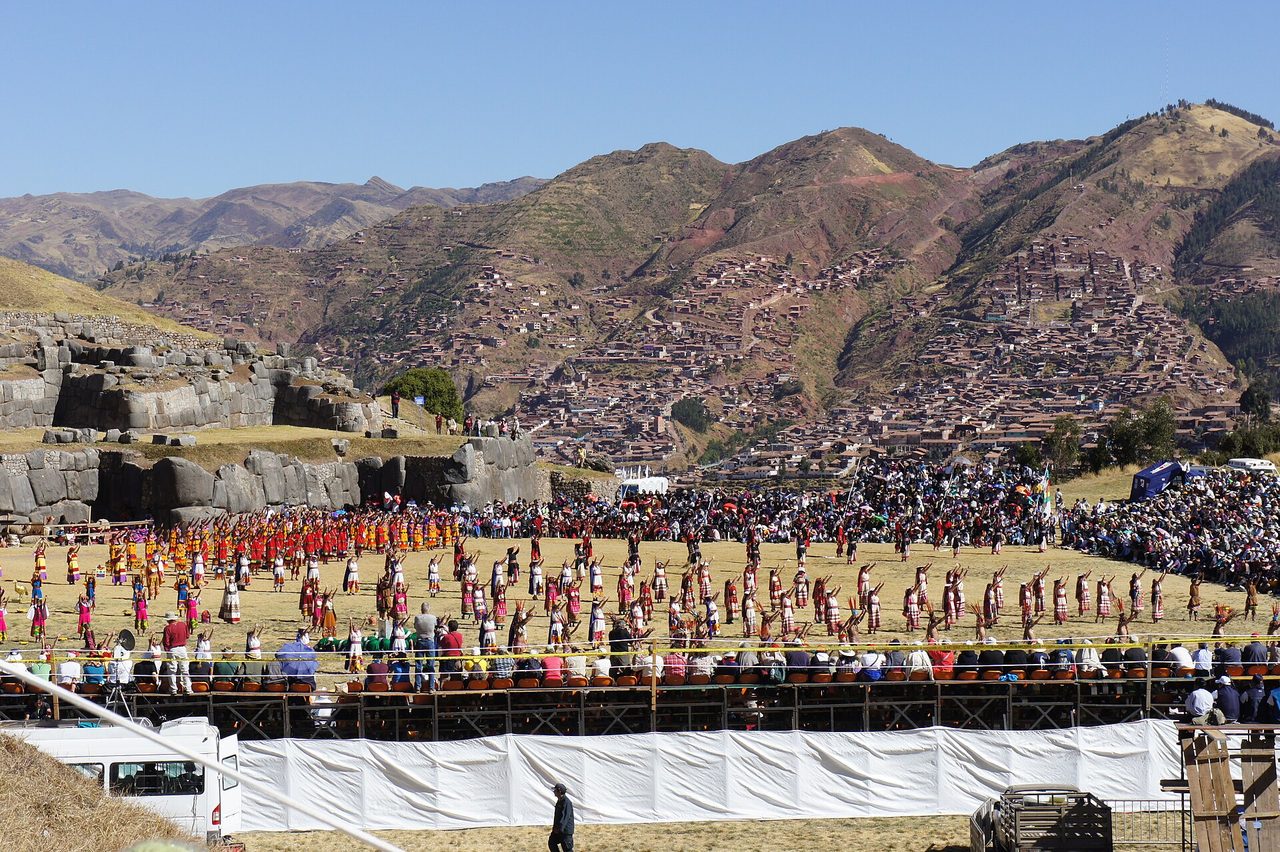
Once a year the esplanade becomes the main stage of the largest festival in the Andes. Inti Raymi, the Festival of the Sun, is a 20th-century reconstruction of the Inca winter-solstice ceremony, first restaged in 1944 and now the anchor of Cusco’s June. It runs across three locations on 24 June: a morning ritual at Qorikancha, a procession through the Plaza de Armas around mid-morning, and the main two-hour spectacle at Sacsayhuaman in the afternoon, with several hundred costumed performers and a llama.
Your viewing options split cleanly.
| Option | Cost | What you get |
|---|---|---|
| Paid grandstands (green, orange, red tribunes) | Roughly US$130–330 per seat depending on tribune and vendor | A numbered seat with a clear sightline. Around 3,500 seats total. Orange is central, green and red are lateral. Sells out weeks ahead. |
| Free hillside | Free | The slopes around the esplanade. No seat, no shade, a distant view, and you need to be in position by mid-morning at the latest. Bring water, sunscreen and a hat. |
| Qorikancha and Plaza de Armas | Free | The morning acts, at close range if you arrive early. Genuinely the best value of the day. |
My honest read: if you are already going to be in Cusco on 24 June, do the free morning ceremonies properly and then decide whether the afternoon is worth a three-figure seat. It is a well-staged pageant rather than a religious event, and the crowd on the hillside is half the experience. If you are travelling specifically for it, buy a tribune seat well in advance and accept the price, because standing at the back for six hours at 3,700 m is a long day.
Either way, book accommodation early — the whole of June is Cusco’s peak, prices roughly double, and the good places in the centre go months ahead. A rundown of which Cusco neighbourhoods actually suit which travellers is worth reading before you book blind, and if you are timing a wider trip around festivals, Inti Raymi is only one of several enormous Peruvian celebrations worth planning around.
Sacsayhuaman also hosts Warachikuy, a reenacted Inca coming-of-age rite, on a Sunday in September, and small Pachamama offerings in early August. Both are free, both are far quieter, and both are more interesting than the June crowd will let Inti Raymi be.
Buying the ticket: the practical bit
Where to buy:
- The COSITUC office, Avenida El Sol 103 (in the Galerias Turisticas, a five-minute walk down from the Plaza). Open roughly Monday to Friday 08:00–17:30 and Saturday mornings. This is the reliable option and the only place selling every variant.
- At the gate of any included site, including Sacsayhuaman itself. Works, but the booth can have a queue in June to August, and it only sells the Integral and the circuit you are standing in.
Bring your passport — it is required to buy and can be asked for at gates. Bring cash in soles. Card machines exist at the main office and are unreliable everywhere else; assume cash and you will never have a problem. Your name is written on the ticket, it is non-transferable and non-refundable, and if you lose it nobody will replace it. It gets a hole punched at each site, which makes it a decent souvenir.
There is no official online sale. Third-party resellers do list it, delivered to your hotel with a surcharge on top, which is legitimate but pointless unless you are landing at midnight before a 5am tour. Ignore anyone selling it on the street.
One more thing that catches people: no organised tour includes the Boleto in its price. Not the S/40 city tour, not the S/120 Sacred Valley day. The tour price buys the transport and the guide; you pay the entry yourself, in cash, on the day. Factor S/130 on top of every quoted tour price in the Cusco region.
On student discounts — COSITUC still asks for an ISIC card for the 18–25 rate, which is worth flagging because Machu Picchu no longer accepts ISIC at all and now wants a university photo ID with an expiry date on it. Two different agencies, two different rules, so carry both if you have them. Under-18s just need ID showing their age.
How I would actually sequence a Cusco visit
Assuming you land from Lima and have four days before the train:
- Day 1: Arrive. Do nothing. The Plaza, a slow wander through San Blas, an early night. Buy nothing yet.
- Day 2: Buy the Integral at the El Sol office in the morning. Walk or taxi up to Sacsayhuaman, then continue along the road to Q’enqo, Puka Pukara and Tambomachay — a taxi will do the whole loop and wait for around S/60–80, which beats the tour bus for pace. Back down for a long lunch. That is Circuit I done in a day.
- Day 3: Sacred Valley. Pisac in the morning, lunch in Urubamba, Ollantaytambo in the afternoon. Or swap Pisac for Moray and Maras if you would rather see the salt pans, remembering the pans are a separate S/20.
- Day 4: Qorikancha and the cathedral, both separate tickets, both genuinely worth it. Tipon in the afternoon if you have energy and a taxi.
That uses six of the 16 sites, two circuits’ worth, and justifies the Integral. Add the free walk up to Cristo Blanco for sunset on whichever evening the weather cooperates. If food is a priority, Cusco punches well above its size and a shortlist of where to eat in Cusco will keep you off the Plaza’s tout-driven tourist menus, which is the other thing this city quietly overcharges for.
For a broader sense of how these days slot into a two-week trip, a worked Peru itinerary is the fastest way to see whether you have allowed enough time, and the general practical advice for travelling in Peru covers the cash, altitude and transport questions that come up around all of this.
Frequently asked questions
Can I buy a ticket just for Sacsayhuaman?
No. There is no standalone entry. The cheapest legal access is the Partial Circuit I ticket at S/70, which also covers Q’enqo, Puka Pukara and Tambomachay and is valid for one calendar day. If your trip also includes the Sacred Valley, buy the S/130 Integral instead.
How much is the Cusco tourist ticket in 2026?
S/130 (about US$35) for the full Integral for foreign adults, valid ten days across 16 sites. Each of the three Partial circuits is S/70. Peruvian adults pay S/70 and S/40. Students aged 18–25 with an ISIC card and children aged 10–17 pay the reduced rates; under-10s are free. Prices are revised periodically, so confirm at the COSITUC office when you arrive.
Is the boleto turistico cusco worth it?
You have no choice if you want to enter the cusco ruins it covers, so the real question is which version. Two circuits or more, buy the Integral — it is cheaper than two Partials. One circuit only, buy that Partial. The pass is not optional, only its size is.
Does the Cusco tourist ticket include Machu Picchu?
No, and this is the most common assumption. Machu Picchu is a separate ticket from the Ministry of Culture, currently S/163 for a foreign adult or S/211 for the circuits including Huayna Picchu or Machu Picchu Mountain, sold through the official portal and best booked well in advance. Our guide to how Machu Picchu ticketing works covers the circuit system, and getting from Cusco to Machu Picchu is a separate logistical problem again.
Is Qorikancha on the Cusco tourist ticket?
Only the Qorikancha site museum, which is a small underground gallery near the gardens on Avenida El Sol. The temple itself, inside the Santo Domingo convent, needs its own ticket bought at its own door for around S/15–25. They are two different places with almost the same name.
How do you pronounce Sacsayhuaman?
Sak-sai-wa-MAN, with the stress on the final syllable. You will also see it written Saqsaywaman or Saksaywaman, which is the modern Quechua spelling and the one used on official signage. The name is usually translated as “satisfied falcon”.
How long does it take to walk up from the Plaza de Armas?
Thirty to forty minutes, steeply uphill on cobbles, gaining about 300 m. At 3,700 m that is harder than the distance suggests. A taxi does it in ten to fifteen minutes for S/10–20. Walking down afterwards is easy and the view is excellent.
Is Sacsayhuaman a good thing to do on your first day in Cusco?
No. It is the classic mistake. You arrive from Lima at sea level, you are at 3,400 m by lunchtime, and a city tour takes you 300 m higher on foot the same afternoon. Give yourself 24 to 48 hours flat before anything strenuous. The gentler things to do in Cusco are the right way to spend day one.
Do I need a guide at Sacsayhuaman?
Not strictly, but it is the one site on the ticket where a guide adds real value, because almost nothing is signposted and the layout only makes sense once someone explains what stood where. Licensed guides wait at the entrance and charge by group size; agree the price and the duration first. Expect roughly S/40–80 for a small group.
Can you see Inti Raymi for free?
Yes. The morning ceremonies at Qorikancha and on the Plaza de Armas are free and open, and the hillsides around the Sacsayhuaman esplanade are free for the afternoon performance if you claim a spot several hours early. Only the three grandstands are ticketed, at roughly US$130–330 a seat.
Are the Maras salt pans on the ticket?
No. The Salineras de Maras are managed by the local salt-farming community and charge their own entry of around S/20 in cash. Moray, three kilometres away and usually visited on the same trip, is on the ticket. People conflate the two constantly.
How much of Sacsayhuaman is left?
Estimates range from about a fifth to roughly 40 per cent of the original complex. The Spanish quarried the site for building stone throughout the colonial period, and the towers and upper buildings went first because their blocks were movable. The three great zigzag ramparts survive because nobody could shift them.
What time does Sacsayhuaman open?
Daily, generally 07:00 to 18:00, with last entry shortly before closing. Going at opening time is the single best decision you can make: the tour buses arrive around 09:30, and the light on the walls is far better early. The site closes or restricts access around Inti Raymi and occasionally during regional strikes.
Is it better to visit Sacsayhuaman independently or on a city tour?
Independently, if you are comfortable negotiating a taxi. A half-day city tour costs around S/40–90 plus the ticket and gives you 45 rushed minutes at the main site. A taxi doing the four-ruin loop with waiting time runs S/60–80 for the car and leaves you in control of the pace. Tours make more sense in the Sacred Valley, where the distances are real and the driving is long. The same logic applies to most transport decisions across Peru.
The short version
Sacsayhuaman has no ticket of its own; entry is via the Boleto Turistico, at S/70 for the one-day Circuit I or S/130 for the ten-day Integral. Buy the Integral the moment your plans include the Sacred Valley, because two Partials cost S/140. Accept that you are paying for 16 sites and will see six. Do not go up on your first day at altitude. Do not expect Machu Picchu, Qorikancha, the cathedral, Rainbow Mountain, Humantay or the salt pans to be included, because none of them are. And go early, before the buses — the walls are worth the whole tangled system, which is more than can be said for the Museo de Arte Contemporaneo.