Maras Salt Mines & Moray Guide
Moray is on the Boleto Turístico. The Maras salt pans are not, and the gate takes cash only. What the two sites actually are, what you can no longer photograph, and how to get there without paying twice.
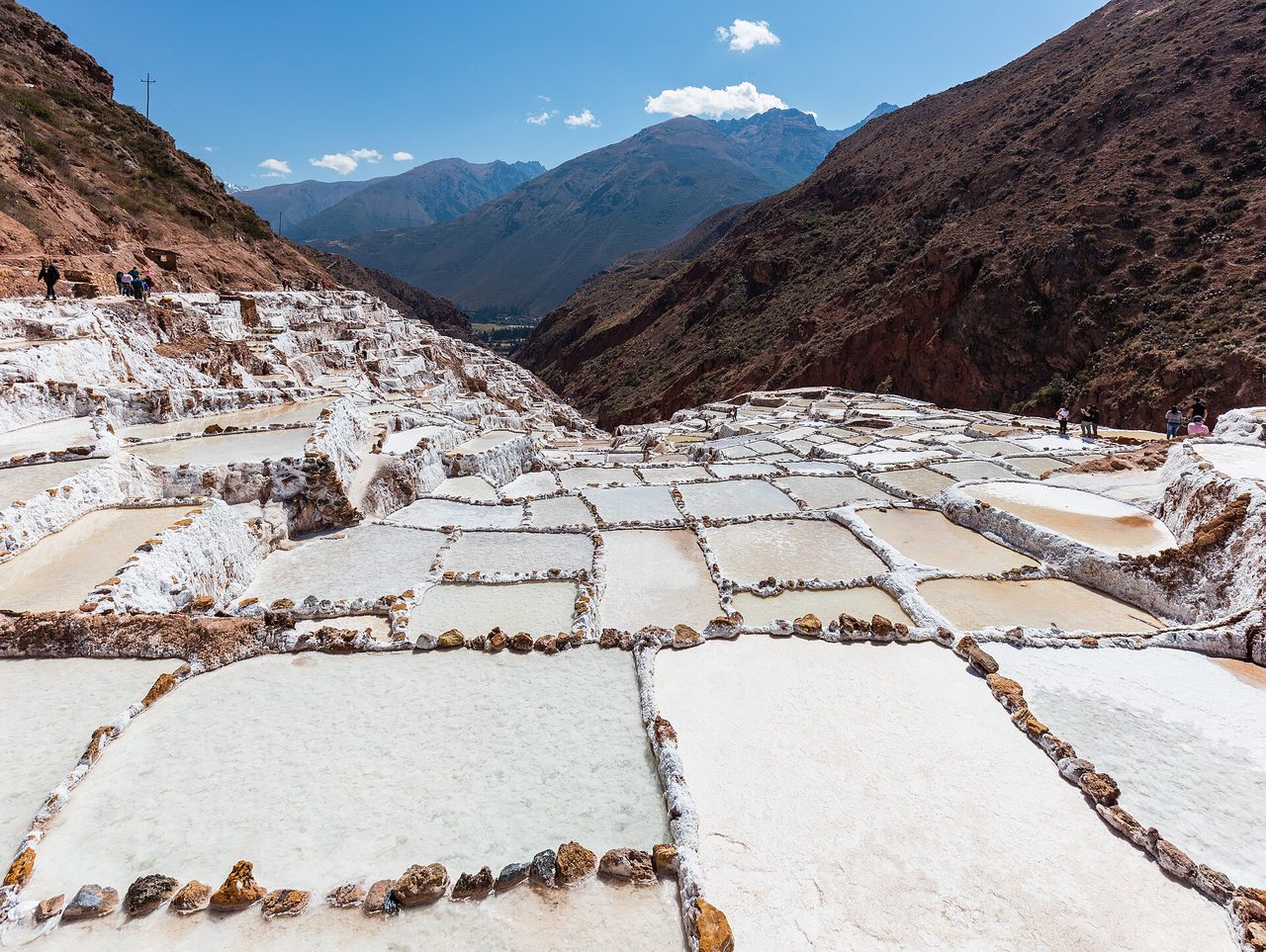
The single most common way to waste money on a Sacred Valley day is to turn up at the Maras salt pans holding a Boleto Turístico and assume you are covered. You are not. A maras moray half-day gets sold as one product, one price, one morning, and almost every operator glosses over the fact that the two sites sit inside two completely unrelated ticketing systems. Moray is a state archaeological site on the Cusco tourist ticket. The salineras are private, community-owned, and the man at the gate wants cash in soles. People get stopped there every single day.
They are also, despite being bundled together forever, not remotely the same kind of place. One is an Inca engineering puzzle that archaeologists still argue about. The other is a working salt business that happens to be a thousand years old and photogenic. Visiting them back to back is genuinely good value, but only if you arrive understanding what each one actually is and what you are now allowed to do at either.
The ticket trap: why maras moray needs two payments
This is the part to get right before anything else, because it is the one that costs money at the gate.
Moray is on the Boleto Turístico del Cusco (BTC), administered by COSITUC. There is no separate window selling a Moray-only ticket. If you do not hold a valid boleto, you do not get in, and buying one on the spot at a rural site entrance is not something to rely on. As of September 2026 the full boleto is S/130 for foreign adults, valid 10 days across 16 sites. Each partial circuit is S/70. Moray sits on Circuit III alongside Pisac, Ollantaytambo and Chinchero, and that partial is valid for 2 days — useful, because it lets you split the valley across two mornings instead of doing the ten-hour death march. COSITUC still accepts an ISIC card for the discounted 18–25 rate, which is worth knowing because the ticketing rules at Machu Picchu no longer recognise it.
Do the arithmetic before you buy. Two partial circuits cost S/140, which is more than the full S/130 boleto. If your plan touches more than one circuit at all, buy the full one.
The Maras salineras are not on the boleto in any version. Not the full one, not Circuit III, not any combination. The pans are owned and run by Marasal S.A., a communal company formed in the 1980s by the campesino communities of Maras Ayllo and Pichingoto, and the entrance fee goes to them rather than to the Ministry of Culture. Reported figures for 2026 cluster between S/10 and S/20 per foreign adult, with Peruvian nationals paying less. Sources genuinely disagree and the community sets it themselves, so carry S/20 in small notes per person and expect change to be a negotiation. Cards are not accepted. Dollars are not accepted. There is no ATM at the site and the nearest reliable one is in Urubamba.
If a tour quotes you a price, ask specifically whether entrances are included, and ask it twice. Cheap half-day tours in the US$20–40 bracket almost never include either the boleto or the Maras fee, which is how a US$25 tour becomes a US$60 morning. Budget for it the same way you would budget for the rest of your trip costs in Peru, as a line item rather than a surprise.
Ticket comparison at a glance
| Moray | Maras salineras | |
|---|---|---|
| Managed by | Ministry of Culture (DDC Cusco), sold via COSITUC | Marasal S.A., community-owned |
| Ticket | Boleto Turístico only — full S/130 or Circuit III partial S/70 | Separate community entry, roughly S/10–20 |
| Sold separately at the gate? | No | Yes, that is the only way to buy it |
| Payment | Buy the boleto in advance in Cusco | Cash in soles at the gate, no cards |
| Validity | 10 days (full) or 2 days (Circuit III) | Single entry, that day |
| Published hours | 07:00–17:00 | Roughly 08:00–16:30, hedge and arrive early |
Moray’s 07:00–17:00 window is published directly by the Dirección Desconcentrada de Cultura de Cusco. The salineras hours are community-set and I have seen four different versions online, which is exactly why nobody should be arriving at 16:00 and hoping.
What the Maras salineras actually are
Calling them “salt mines” is a translation accident that has stuck. Nothing is mined. They are evaporation ponds — roughly 4,000 to 4,500 of them, each about five square metres, packed across a hillside above the Qaqawiñay slope in a dense, irregular honeycomb. MINCETUR’s own inventory sits at the upper end of that range. Anyone quoting a precise figure is quoting somebody else’s guess; the count changes as pans are rebuilt and abandoned.
The water comes from a single hypersaline spring emerging from the mountain at around 11°C. A geologist would tell you it has travelled up from roughly a kilometre underground, dissolving salt out of Mesozoic evaporite beds on the way, which is the same process that produced the sinkholes you will stand on the edge of at Moray later. That connection is the genuinely interesting thing about visiting both in one morning, and I have never once heard a guide mention it.
The operation predates the Inca. The usual attribution is to the Wari, roughly 500–1100 AD, though “pre-Inca’ is doing some heavy lifting there and the archaeology is thinner than the tour scripts suggest. What is well documented is the modern arrangement: around 633 families across the two communities hold rights to individual pans, inherited down generations, and Marasal handles processing and sale with proceeds distributed according to how many pans a family works. It is a cooperative, not a museum. The people you see scraping crystals are running a business.
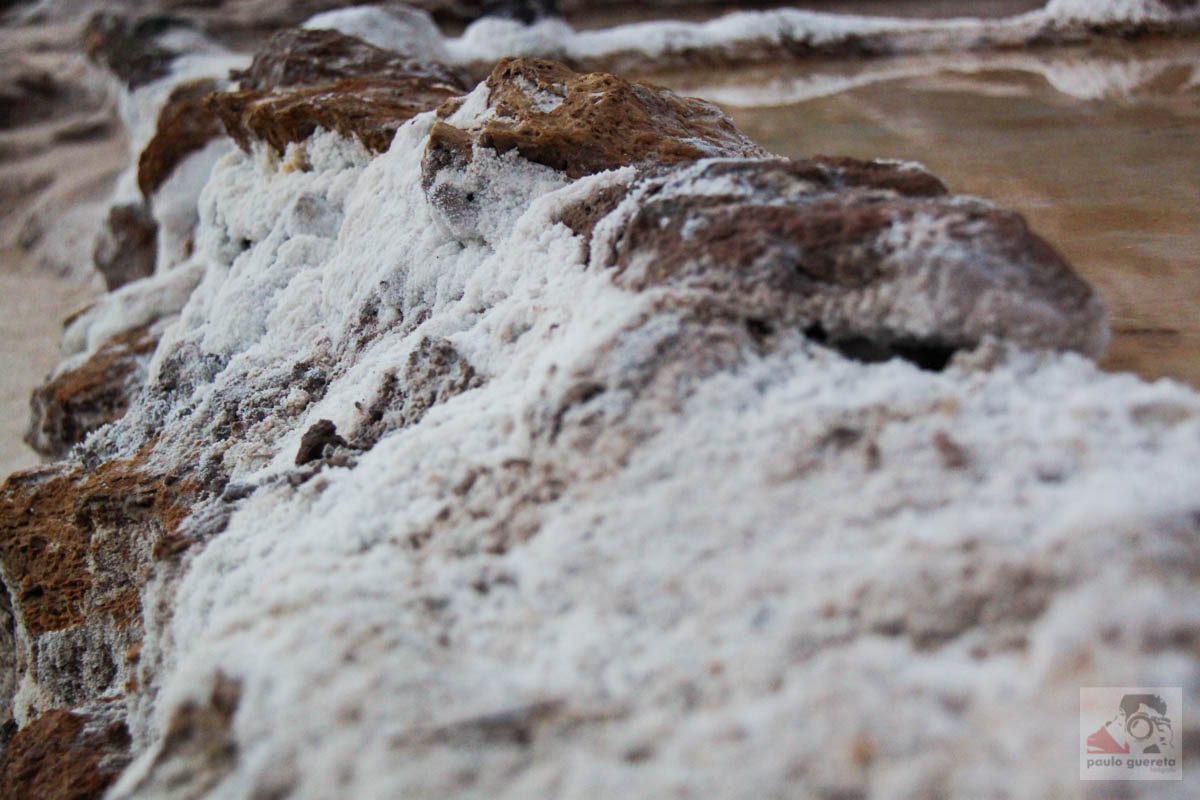
The cycle is simple and entirely dependent on sunshine. A family opens a channel, floods their pan a few centimetres deep, lets it sit while the water evaporates, then scrapes the crust off in layers with a wooden board. Upper layers are the fine white and pinkish table salt; lower layers are coarser and traditionally go to livestock. Each pan turns over roughly monthly in good conditions. This is why the Andean dry season matters so much: from about May to October the pans are working, white and full of crystal. One competitor guide I read claims the harvest peaks in the wet season, which is backwards and would have been caught by anyone who had stood there in February.
What Moray actually is, and what nobody can prove
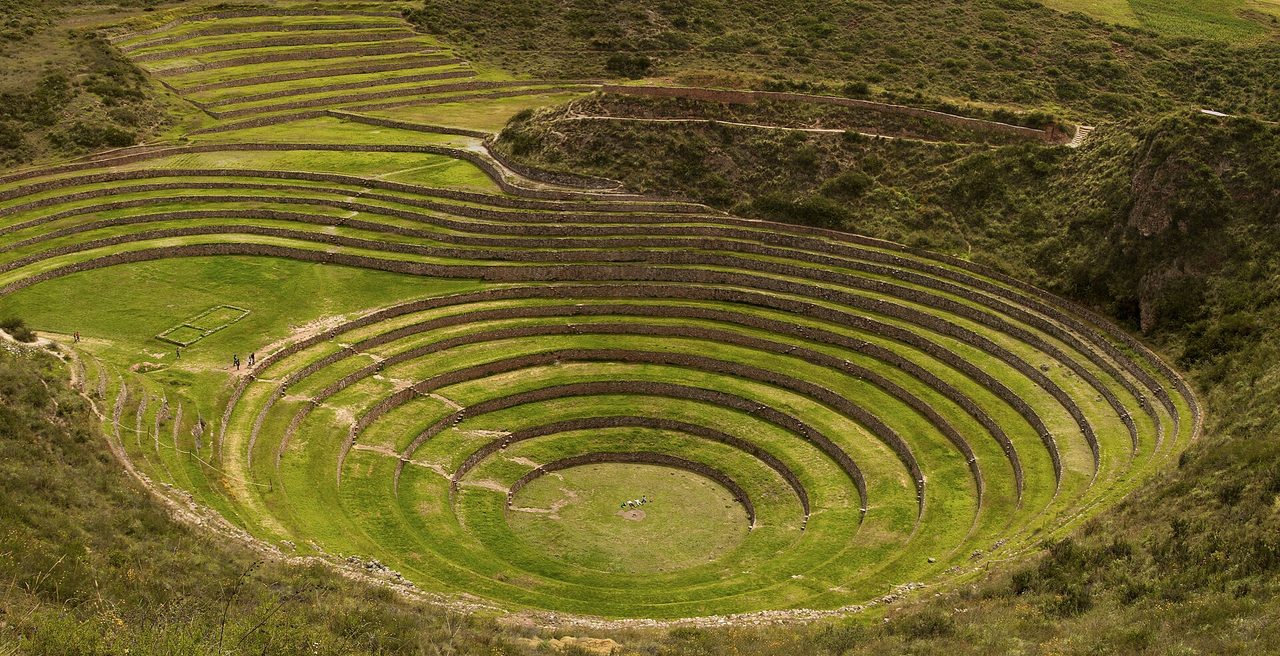
Moray sits at about 3,480 m according to the DDC Cusco file, on a plateau above the valley in the community of Mullak’as Misminay, Urubamba province. The protected zone covers 31.7 hectares. What you see are concentric stone terraces stepping down into several bowl-shaped depressions, the largest around 30 m deep, the rings roughly 45–65 m in radius with individual terrace walls three to five metres high.
The story you will be told is that this was an Inca agricultural laboratory: a stack of artificial microclimates used to acclimatise crops from one altitude to another. It is a wonderful story. It is also a 1970s hypothesis that has taken a serious beating and is still repeated verbatim by most guides on the circuit.
The temperature figure, honestly
You will see “15°C difference between the top and bottom terraces” everywhere. Treat it as a claim with a lineage rather than a measurement.
It originates with the anthropologist John Earls, who worked at Moray in the 1970s and early 1980s and reported roughly one degree of difference per terrace. Wikipedia’s citation for the 15°C number is a 2021 podcast episode. A peer-reviewed paper published in Heritage in February 2026 (Esenarro et al., 9(2):56) gives a range of 12–15°C, and that is the most respectable-looking source you will find — but read the methods. The figure is derived from geometric and solar modelling in AutoCAD and SketchUp combined with ambient weather data from a SENAMHI station in Urubamba, several kilometres away. No sensors were placed in the terraces. The paper proposes installing some as a future conservation measure.
So: the honest position is that a differential of some tens of degrees is physically plausible for a deep, closed basin at this altitude, that the commonly quoted 12–15°C sits at the optimistic end, and that nobody in the public literature appears to have published continuous in-situ measurements. If a guide states 15°C as settled fact, they are repeating a number, not reporting one.
Three problems with the laboratory theory
The bigger issue is not the temperature. It is what the temperature does at night.
Cold air is denser and it drains downhill. In a closed depression it pools at the bottom, which means the lowest terraces are the coldest after dark, not the warmest. That inverts the whole premise of gradually walking a lowland crop up the rings, because nothing tropical survives the bottom of that bowl on a clear June night. Local farmers know this perfectly well and have historically used the lower terraces for the opposite purpose: freeze-drying potatoes, spreading them out to freeze overnight and dry in the day. There is a nice etymological wink here, since one of the proposed origins of the name Moray is moraya, the Quechua word for exactly that freeze-dried potato.
Second, the water. A hydrological study published in 2011 as Moray: Inca Engineering Mystery found there was never enough of it. There is one modest spring and one canal serving one section of the terracing. Irrigating the whole complex as a working experimental farm was not hydrologically possible, then or now.
Third, nobody lived there. A tended agricultural station requires daily labour, and there are no Inca or pre-Inca residential remains in the immediate area — just a single rectangular structure on one of the wider terraces, of a type associated with an isolated ritual specialist. The Cusco archaeologist Óscar Montúfar reads the site as ceremonial. The DDC’s own page hedges toward both, describing a ceremonial function that preceded any use for acclimatising crops.
And the depressions themselves are natural. They are collapsed karst sinkholes, formed when groundwater dissolved those same salt-bearing sediments and the cavern roof fell in. The Inca did not dig them. They found them and terraced them, which is arguably more impressive and definitely more Andean.
None of this makes Moray less worth seeing. It makes it more interesting than the greenhouse story, and it puts it in good company among the Inca sites scattered across Peru whose purpose we have confidently invented and then quietly revised.
Access rules: the photo you have seen is not one you can take
This is the second thing that ruins people’s mornings, and it is worth being blunt about.
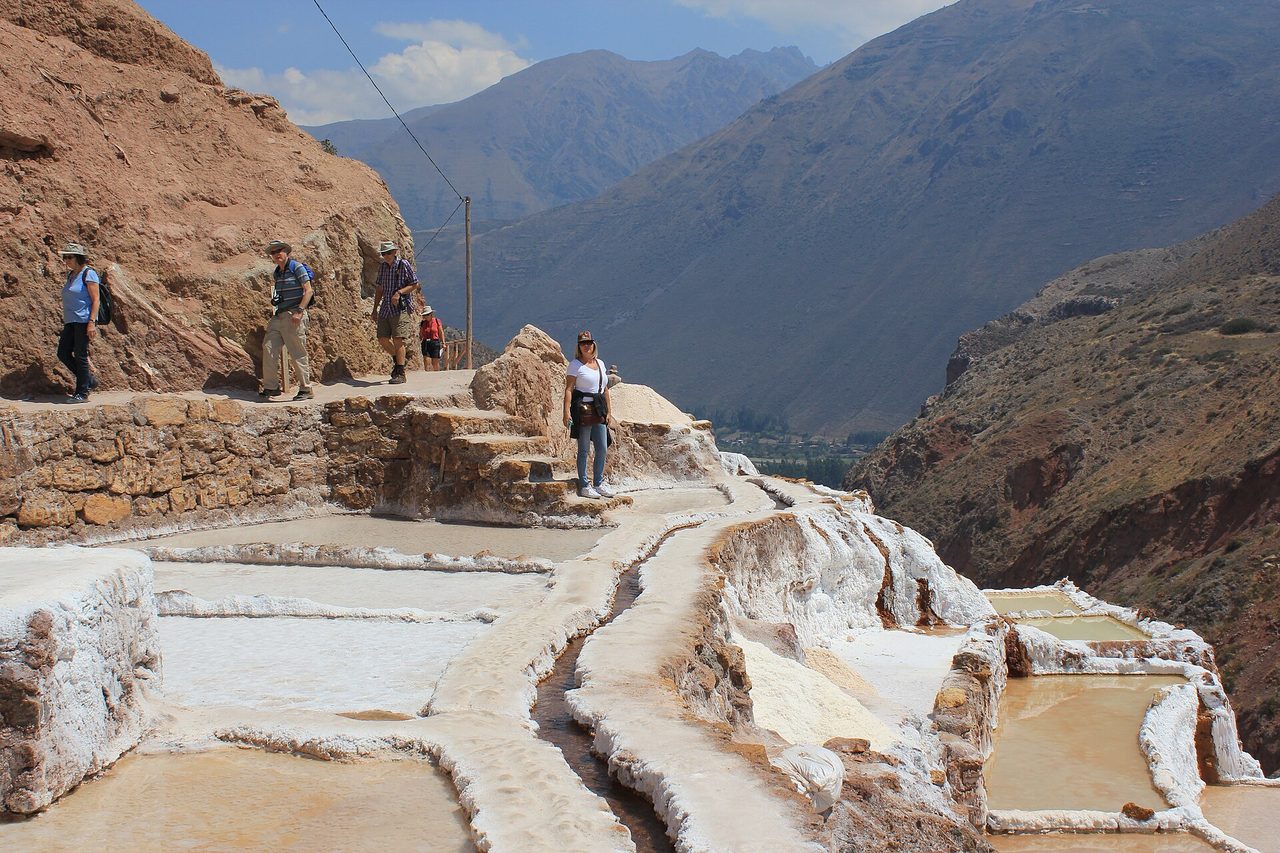
You cannot walk among the Maras salt pools. Access into the working pans has been restricted since 2019. MINCETUR’s official file for the site now states that visitor access is limited to paths and viewpoints specifically to protect product quality and traditional practice. Foot traffic was breaking down the pan walls and contaminating a food product that people sell for a living. You view the site from an overlook path along the upper edge, which still gives you the full sweep of the hillside, but the shot of somebody standing knee-deep in a white geometric maze — the one on every Instagram grid and half the blog posts still ranking on page one — is a pre-2019 photograph. Most of the imagery you have used to decide to come here is now out of date.
At Moray the situation is murkier, and I want to be precise rather than confident. As of September 2026 the DDC Cusco visitor regulations for Moray prohibit climbing on the archaeological walls, entering with food, animals or alcohol, camping, flying drones without authorisation and commercial filming without a permit. They do not publish a blanket ban on descending into the bowl. What the same page does say is that the site has level access to an entry point “from which it is possible to appreciate” the monument — which is the language of a viewpoint, not a walk-through.
In practice the complex is managed as a rim circuit, sections have been fenced or roped during restoration, and the eastern side of the principal circle collapsed in February 2010 after an exceptional wet season, requiring emergency propping and years of repair. Older guides and older blog posts describe descending the zigzag stone stairs between levels; that is not what most groups do now. Plan for a walk around the rim, ask your guide on the day, and do not build your trip around getting to the bottom of the bowl.
The practical consequence for both sites is the same: bring a lens or a phone that handles wide landscape shots well, because everything you photograph will be from above and at distance.
Getting there: five options, honestly compared
The turnoff is at km 65 of the paved Cusco–Urubamba road. From there it is about 7 km to Moray and a similar short hop down to the salineras, on dirt and partly paved roads. Everything below assumes you are starting in Cusco unless stated.
| Option | Rough cost | Time | Suits |
|---|---|---|---|
| Organised half-day tour | US$20–40 per person, entrances usually extra | 5–6 hours door to door | Anyone short on time who wants a guide and no logistics. Verify entrances are excluded. |
| Full-day Sacred Valley tour including both | US$35–60 plus entrances | 10–12 hours | People with exactly one valley day. Punishing pace, minimal time at each stop. |
| Taxi from Urubamba | S/70–120 round trip with waiting | 2.5–3.5 hours | Anyone already staying in the valley. Much the most efficient version of this trip. |
| Private taxi from Cusco | S/100–150, sometimes quoted as US$60–100 | 6–7 hours | Small groups, families, anyone wanting to control the timing and beat the coaches. |
| Colectivo plus moto-taxi | S/7–15 to the turnoff, S/30–50 for a local taxi doing both sites | 7–8 hours | Budget travellers with functional Spanish and patience. Cheapest by a mile. |
| Quad-bike (ATV) half-day tour | US$40–85 plus entrances | 5–6 hours, roughly 50 minutes actual riding | People who want the ride more than the sites. Dusty, loud, fun. |
| Maras–Moray walk | Free once you are at one end | 6–10 km, 2–3.5 hours | Walkers with a spare half-day and sun protection. Almost no shade. |
A few things the price tables elsewhere do not tell you. The colectivo route means asking at Pavitos in Cusco for the Ramal de Maras, getting dropped at the junction on the highway, and negotiating with whoever is waiting there — it works, it is cheap, and it will eat your whole day. If you are already comfortable with Peru’s shared-van system, it is straightforward. If you are not, this is not the trip to learn on.
Staying in the valley changes the maths completely. From Urubamba you are twenty minutes away rather than an hour and a half, which is the strongest single argument for basing yourself in the Sacred Valley rather than commuting from the city. The walk between the two sites is genuinely pleasant on a clear morning, mostly downhill if you go Moray to Maras, and completely exposed — it is high, dry farmland with no trees and no water, so go early and carry more than you think.
Quad bikes deserve one honest note. They are marketed hard as an adventure upgrade and they are fun, but the actual riding is short and the sites are the same sites. If you want that kind of day out, look at what else is on offer among Peru’s adventure options before spending the premium here.
Altitude: both sites are higher than Cusco
This catches people constantly, because the received wisdom is that you go down to the Sacred Valley to acclimatise. That is true of the valley floor at Urubamba and Ollantaytambo, which sit around 2,800–2,900 m. It is not true of this particular day out.
- Moray: ~3,480 m — above Cusco
- Maras town: ~3,380 m — roughly level with Cusco
- The salineras themselves: ~3,000–3,100 m, dropping into the ravine below the town
- Cusco: 3,400 m; valley floor: 2,800–2,900 m
You spend the morning on an exposed high plateau with fierce UV and thin air, then walk back up a slope from the salt pans at the end. It is not hard, but it is not a rest day either. If you flew into Cusco yesterday, this is a poor choice for today — read up on how Cusco’s altitude affects arrivals and give yourself a night or two first. The classic mistake is booking a valley tour for day one on the assumption that lower is automatically easier.
Light, crowds and whether the wet season ruins it
Both sites face roughly east and both photograph best early. Coaches from Cusco start arriving at Moray from about 09:30 and reach the salineras between 10:00 and 11:00, and from then until early afternoon the salt pan viewpoint is genuinely congested — a narrow path, a hundred people, everyone wanting the same frame. If you can be at Moray at opening and at Maras by 09:00, you will have a materially better morning than the group tours, which is the main argument for a taxi over a coach.
Late afternoon works too and is quieter, but the salt loses its glare and the light goes flat behind the ridge earlier than you expect.
On season, here is the straight answer. In the wet months, roughly November to March, many pans hold rainwater rather than brine. They read grey-brown and reflective instead of white and crystalline, harvesting largely stops, and the access tracks get slick. Moray is unaffected in appearance — arguably it is better, since the terraces go bright green — but it does drain badly and the 2010 collapse is a reminder of what heavy rain does to it.
So: if the salt pans are your main reason for coming and you are travelling in February, consider spending the morning somewhere else. If you are visiting anyway, go, but reset your expectations. If you have flexibility, the timing that suits Cusco generally suits this trip too, with May, June and September the sweet spot for white pans and manageable crowds. The shoulder months of April and October are the honest best value: the pans have usually recovered, the crowds have not fully arrived, and prices soften.
Buying salt, and whether to bother
The vendor stalls at the exit are the point of the visit for a lot of people, and this is one souvenir I actually rate. It is a real product, made where you are standing, sold by the people who made it, and the money stays in the community.
Rough prices at the site, which move: fine pink table salt runs about S/5–10 for a 250 g bag, white cooking salt slightly less, and coarse bath salt S/8–15. The same bags in Cusco tourist shops are routinely two to four times that. Marasal has been working toward an Indecopi geographical-indication mark for sal de Maras, which tells you something about how much passing-off there is downstream.
Two practical warnings. The packaging leaks — put the bag inside something sealed before it goes near clothing. And a kilo of salt is a kilo of salt in a carry-on you have already overfilled. Buy 250 g of the pink for cooking, not the novelty block. It genuinely improves things, and it is one of the few edible souvenirs from the Peruvian kitchen that survives the flight intact.
What to bring, and what is actually there
Facilities are thin at both ends. Moray has toilets near the entrance and a small ticket kiosk, and that is roughly it — no cafe, no shelter on the rim, no shade anywhere on the circuit. The salineras have a cluster of vendor stalls at the exit selling salt, snacks and drinks, plus basic toilets you will want small change for. Neither site has an ATM, a pharmacy or anywhere to sit out weather.
The things that actually matter on this particular day out:
- Cash in small soles notes. For the Maras gate, toilets, salt and the taxi. A S/100 note will not be broken at a rural entrance booth.
- Serious sun protection. You are at 3,400 m on open ground with white salt reflecting UV back up at you. Hat, sunglasses, high-factor sunscreen on the underside of your chin and nose. This is the site where people burn.
- Shoes with grip. The overlook path at Maras is dusty, sloped and slick with salt residue in places, and Moray’s rim path is uneven stone and packed earth. Sandals are a bad idea at both.
- Layers. It can be near freezing at 07:00 on the plateau in June and 22°C by 11:00. The wind picks up mid-afternoon.
- Water. A litre each minimum, more if you are walking between the sites.
- Your passport. Boleto checks at Circuit III sites sometimes ask for ID, and a discounted student boleto will definitely be checked against one.
If you have time in hand, the town of Maras itself is worth twenty minutes on the way through. It is a working Andean village rather than a tourist stop, with a seventeenth-century church and a scatter of colonial doorways carrying carved coats of arms from the families the Spanish settled here. Almost every tour drives straight past it. There is also a small artisan chocolate workshop or two on the plateau road, which are exactly as commercial as they sound but do make a decent cup on a cold morning.
A realistic half-day
Do Moray first. It is higher, it takes morning light better, and it puts the geology in your head before you see the salt. From Cusco with a taxi:
- 06:45 leave Cusco. Yes, really.
- 08:00 at Moray for opening. Rim circuit, 45–60 minutes is plenty unless you have a guide worth listening to.
- 09:15 at the salineras, ahead of the coaches. Allow an hour on the overlook path, plus time at the stalls.
- 10:45 down to Urubamba for an early lunch.
- 13:00 back in Cusco with the afternoon intact.
That is around five hours and leaves room for something else. If you are trying to fit the valley into a tight schedule, this pairs far better as a standalone half-day than as the fourth stop on a twelve-hour coach circuit, and it is one of the more rewarding short trips out of Cusco precisely because it is short.
Is it worth it, and who should skip it
Worth it: yes, for most people, and especially if you go independently and early. The salineras are visually unlike anything else in Peru and the industrial-anthropological angle — 633 families, inherited pans, a spring that has been paying wages for a millennium — is more substantial than the average ruin stop. Moray rewards anyone who enjoys an unresolved question.
Skip it if: you have one day in the valley and have not yet seen Ollantaytambo or Pisac, both of which are more significant sites; you are on day one at altitude; you are travelling in the depths of the wet season and came specifically for the white pans; or you are principally interested in Inca architecture, in which case Moray will feel slight next to the masonry at Sacsayhuamán. It is a good half-day, not a headline. Slotting it in as an add-on works better than building a Peru itinerary around it.
Frequently asked questions
Is Maras included in the Boleto Turístico?
No. Not in the full boleto, not in Circuit III, not in any partial. The salineras are community-owned and charge their own entry, cash in soles, at the gate. Moray is the site on the boleto. Assuming otherwise is the single most common mistake on this trip.
How much is entry to the Maras salt pans?
Reported 2026 figures range from about S/10 to S/20 for foreign adults, with a lower national rate. The community sets it and sources genuinely disagree, so bring S/20 per person in small notes and confirm with your accommodation the day before. Cards and dollars are not accepted.
Which boleto circuit covers Moray?
Circuit III, which also covers the ruins and market at Pisac, Ollantaytambo and Chinchero and is valid for two days. The full boleto covers it too. There is no standalone Moray ticket — any guide claiming a S/30–40 gate fee for Moray is wrong.
Can you still walk among the Maras salt pools?
No. Access into the working pans has been restricted since 2019 to protect the salt as a food product and to stop foot traffic damaging the pan walls. You view the site from an overlook path along the top. The widely circulated photos of people standing between the pools predate the restriction.
Can you walk down into the Moray terraces?
Assume not. The published DDC Cusco regulations as of September 2026 prohibit climbing on the walls but do not state an explicit descent ban; in practice the site is run as a rim circuit, restoration work has closed sections since the 2010 collapse of part of the main bowl, and most groups no longer go down. Ask on the day rather than planning around it.
What is the temperature difference between the top and bottom of Moray?
The figure everyone quotes is 15°C, and a 2026 peer-reviewed paper gives 12–15°C. That paper derived the number from geometric and solar modelling plus off-site weather data rather than sensors in the terraces. The original 1970s fieldwork suggested roughly one degree per terrace level. Treat the number as an estimate with a long citation chain, not a measurement.
Was Moray really an Inca agricultural laboratory?
It is the popular explanation and it is under serious challenge. Cold air pools at the bottom of a closed basin overnight, which undermines the idea of acclimatising lowland crops upward; a 2011 hydrological study found there was never enough water to irrigate the whole complex; and there are no residential remains nearby to house the labour a working farm would need. Several Cusco archaeologists read it as ceremonial. The depressions themselves are natural sinkholes that the Inca terraced.
How far apart are Maras and Moray?
About 7 km by road, roughly 20 minutes driving, from the town of Maras. The salineras sit below the town in a ravine; Moray is on the plateau the other side. Walking between them is 6–10 km depending on the route, two to three and a half hours, and completely unshaded.
How long do you need at both?
Forty-five to sixty minutes at Moray and an hour at the salineras is comfortable. With travel from Cusco, allow five to six hours total; from Urubamba, three. Anyone telling you it needs a full day is selling you a full day — usually the standard Pisac-to-Ollantaytambo circuit with Maras bolted on the front.
Are Maras and Moray higher than Cusco?
Moray is, at about 3,480 m against Cusco’s 3,400 m. Maras town is roughly level at about 3,380 m. Only the salt pans themselves, down in the ravine at around 3,000–3,100 m, are meaningfully lower. This is not a descent-to-acclimatise day, whatever the phrase “Sacred Valley” suggests.
Is it worth visiting in the rainy season?
Moray yes, the salt pans with reservations. From November to March many pans hold rainwater rather than brine and read grey rather than white, and harvesting mostly pauses. The site is still striking and the cultural interest is unchanged, but if the classic white-terrace image is why you are going, it will disappoint. Plan around Peru’s seasonal pattern if you can.
Can you visit without a tour?
Easily, if you have a little Spanish. Colectivo from Pavitos in Cusco to the Ramal de Maras junction, then a local or moto-taxi to cover both sites, then flag a return colectivo on the highway. Budget seven to eight hours and around S/50–70 all in, plus entries. A taxi from Urubamba is the low-effort version. This is one of the more distinctive things to do in Peru that genuinely does not need a guide, though a good one adds a lot at Moray.
Should I buy salt at the site or in Cusco?
At the site, every time. It is cheaper by a factor of two to four, it is definitely genuine, and the money goes to the families who produced it. Around S/5–10 for 250 g of the pink table grade. Double-bag it.
The short version
Buy the boleto before you leave Cusco, carry S/20 in cash per person for the salineras gate, go on a dry-season morning, be at Moray by opening, and accept that you will be photographing both sites from above. Adjust your expectations away from the Instagram version and this remains one of the better half-days in the Cusco region — a strange piece of contested archaeology and a thousand-year-old business still being run by hand, seven kilometres apart, connected by a geology neither of them advertises.