Pisac Ruins & Market Guide
There are two Pisacs — the market town and the enormous Inca city on the ridge above it — and most tours do them in the wrong order. Here is how to get the ruins, the Sunday market and the timing right.
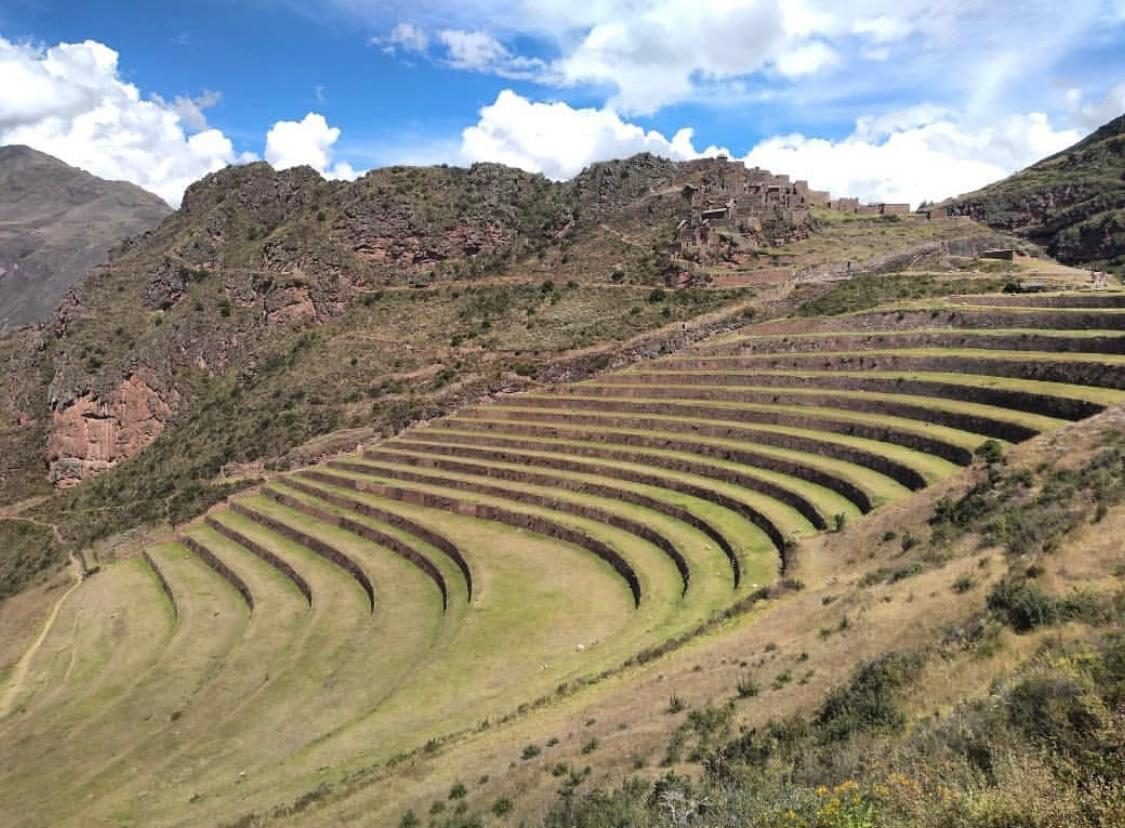
There are two Pisacs, and the standard day tour gets both of them wrong.
One is the town on the valley floor — adobe walls, a plaza with pisonay trees, a bakery smell that hits you before you have crossed the bridge. The other is an enormous ruined Inca city strung along the ridge 400 metres above it, so large that most visitors see perhaps a third of it and leave convinced they have seen the lot. The coach itinerary allocates ninety minutes to the first, forty to the second, arrives at eleven in the morning, and sends everyone uphill in the hottest part of the day.
I have done Pisac four different ways now, including the wrong way. This guide is mostly an argument for doing it in reverse: taxi to the top, walk down, and hit the town when the buses are leaving rather than when they are arriving. Everything else — tickets, market days, altitude, how long to give it — follows from that one decision.
Pisac at a glance
| Thing | Detail |
|---|---|
| Where | Eastern end of the Sacred Valley, where the Urubamba turns west |
| Distance from Cusco | ~33 km by road, 45–60 minutes over the Taray pass |
| Town altitude | ~2,970 m (9,750 ft) |
| Upper ruins entrance | ~3,350 m (11,000 ft) |
| Highest point you can walk to | ~3,510–3,525 m at the Q’allaqasa lookout and mirador — higher than Cusco |
| Ruins ticket | Boleto Turístico only. No standalone ticket. |
| Market ticket | Free. Always has been. |
| Park hours | Roughly 07:00–17:00 daily; ticket booths open later than the gates |
| Big market day | Sunday. Smaller versions Tuesday and Thursday. Craft stalls daily. |
| Minimum sensible visit | Half a day. A full day is better. A night is better still. |
The ruins are a city, not a viewpoint
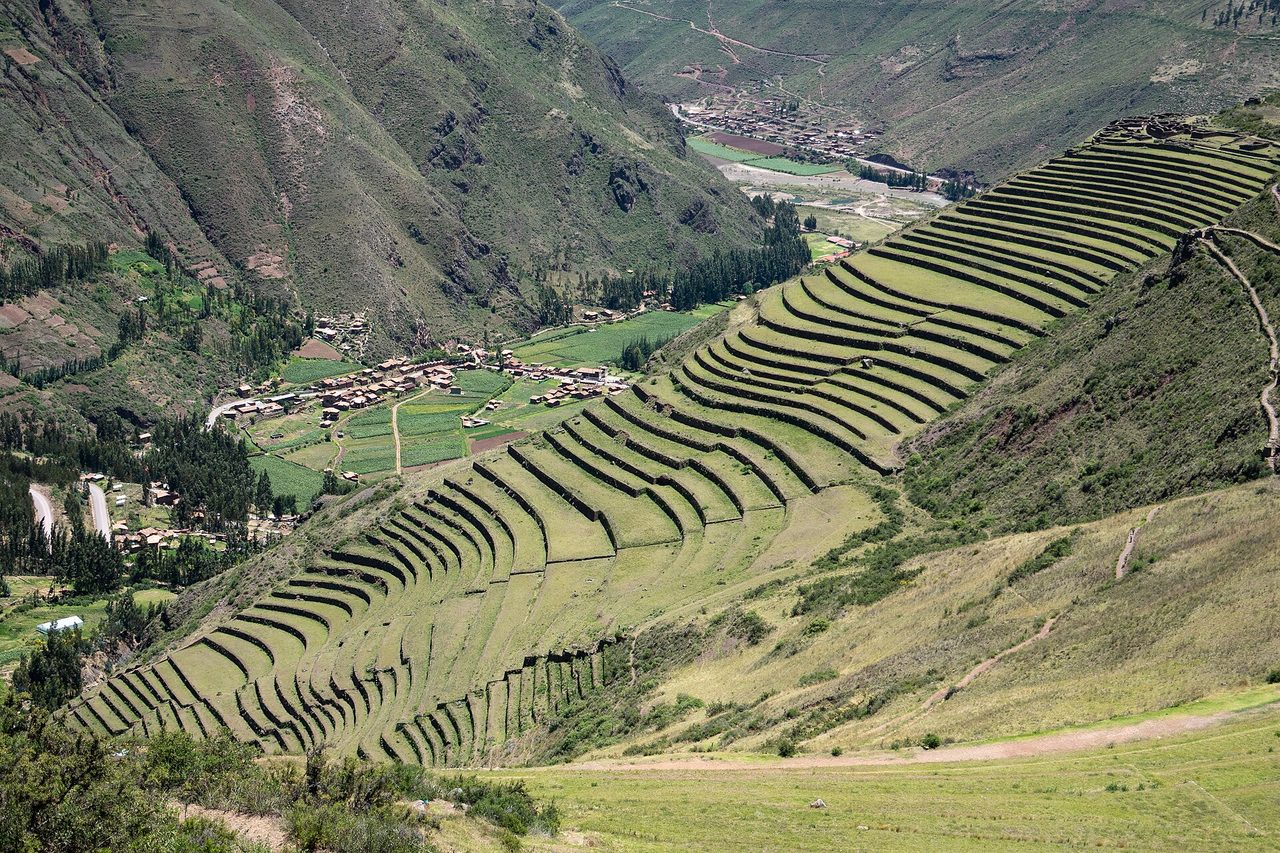
This is the part almost every guide underplays. Search for Pisac and you get one photograph — the fan of curved terraces — and a sentence about how the Incas built a fortress here. What you actually get on the ground is a settlement that runs for something like four kilometres along a knife-edge ridge, in at least four distinct sectors, connected by staircases cut into cliffs, with a burial ground of thousands of tombs facing it across the gorge.
Among the Inca sites you can still walk through in Peru, only Machu Picchu and Choquequirao give you this much intact urban fabric in one place, and Pisac has something neither of them has: you can see the whole thing at once from the road above it. Give it two hours and you will feel short-changed. Give it four and you will understand why the Inca bothered.
The sectors, and what each one actually is
Spellings vary wildly between signs, maps and blogs — Q’allaqasa, K’allaq’asa and Kallaqasa are the same place. Here is the layout as you meet it walking down from the upper entrance.
Qanchisracay (also Qantus Raqay, Kanchisracay) is the first thing you reach: a scatter of rough-walled compounds on a shoulder of the mountain. The stonework here is deliberately coarse — field stone and mud mortar rather than fitted blocks. Best current reading is that this was garrison and service accommodation, and possibly a refuge for valley farmers if the ridge came under attack. It is not architecturally exciting. It is, however, where you get your first proper look down the valley, and the moment when the scale of the place lands.
The terraces. Below and ahead of you, the andenes sweep round the head of a side valley in concentric arcs that follow the contour instead of cutting across it. There are roughly 500 terrace platforms across the site. Look at the retaining walls: they lean back into the slope by a few degrees, they are wider at the base, and every one has a drainage layer of gravel behind it. That is why they are still standing after five hundred years of rainy seasons while the modern road above them washes out most Januaries. Sets of protruding stones — saruna — project from the walls as flying staircases so farmers could climb without eroding the beds.
The ceremonial fountains. Partway along the terrace path a set of stone baths still runs with water fed by a channel from a spring higher on the mountain. There are usually four with live flow. This is the giveaway that Pisac was never primarily a fort: nobody plumbs a fortress for ritual bathing.
Q’allaqasa is the big one — the sector people mean when they say “the citadel.” It sits on the crest, built directly onto and around outcrops of living bedrock, with a circular lookout platform at the top that has ten niches in its inner wall. This is the highest point of the whole visit and, at roughly 3,510 m, it is above Cusco. If you are going to feel the altitude anywhere at Pisac, it is on the last hundred metres of that climb.
Amaru Punku, the serpent gate, is the ceremonial entrance on the far side — a doorway that framed the approach for anyone arriving the proper way. Read the section below about the tunnel before you plan a route through here, because the old path beyond it is closed.
Intihuatana: the reason to come
The ceremonial core, sometimes signposted simply as Intihuatana, is the finest stonework at Pisac and genuinely belongs in the same conversation as Machu Picchu’s. Same technique: coursed ashlar, blocks dressed to a slight pillow face, joints you cannot get a fingernail into, walls that batter inwards as they rise. Trapezoidal doorways and niches everywhere. At the centre, inside a curved enclosure wall, is the carved bedrock outcrop itself — a shaped stone with a projecting gnomon, the same family of object as the one at Machu Picchu, and one of relatively few to survive the colonial campaign against Andean shrines.
Worth knowing: Pisac’s Intihuatana was documented before Machu Picchu’s was known to the outside world. The Quechua-derived name is usually glossed as something like “hitching post of the sun,” which is a translation with more romance in it than evidence, and the astronomical claims made for these stones range from carefully argued to complete invention. What is not in doubt is the quality of the masonry, which is the sort of thing that stops conversation. Nearby stand a solitary free-standing doorway, the ruins of several enclosures, and a rock formation with a two-person seat carved from a single block.
You are not allowed to climb on the walls, and there is usually a guard stationed here who will tell you so. Fair enough.
The tunnel, and a route change you need to know about. Older guidebooks, and a depressing number of blog posts still ranking in 2026, route you from Amaru Punku along the mountain flank and through a rock tunnel to reach Intihuatana. That path was damaged by a landslide several years ago and is roped off a few minutes past the serpent gate. The replacement route climbs over the top of the mountain instead, dropping down the back of the Q’allaqasa lookout — look for stairs behind the platform and a sign for Intihuatana. That over-the-mountain path was itself shut for a while and reopened in 2025. There is still a tunnel on it, a very narrow one, so you do not miss out. Check the coloured route map at the entrance gate on the day: green lines are open, red are closed, and they change often. Do not trust a printed itinerary on this point, including this one.
Pisaqa and the storehouses
Lower down the ridge, Pisaqa is a residential quarter of around thirty structures arranged around courtyards, with better masonry than Qanchisracay and worse than Intihuatana — the built equivalent of a middle-class neighbourhood. Above it sit colcas, the storehouses, positioned high and exposed exactly where the wind runs strongest. Inca storehouses were sited for ventilation, not convenience; grain and freeze-dried potato kept for years in them. There is also a two-storey building on this stretch, which is unusual enough in Inca architecture to be worth stopping for.
T’antana Marka: the cemetery nobody mentions
Turn and look at the cliff on the opposite side of the Kitamayo gorge. What appear to be shadows or erosion pockets in the rock face are burial niches — thousands of them, cut into a near-vertical wall. This is T’antana Marka, and it is generally described as the largest known Inca cemetery anywhere. Figures vary and I would treat all of them as soft, but the numbers cited in the archaeological literature run into thousands of tombs and, by some accounts, more than ten thousand sets of human remains recovered.
Almost all of it was looted. Grave robbing here began in the colonial period and continued into living memory, and what the huaqueros did not take, weather and rockfall have. The niches you are looking at are empty. It is not a pretty story and the site interpretation does not tell it, which is precisely why it is worth stopping to look. Access to the cliff face itself is not permitted and you should not go looking for a way over; the view from the Q’allaqasa side is the whole point.
Walk down, not up
Here is the practical core of this guide. Pisac town sits at about 2,970 m. The upper entrance to the archaeological park is at about 3,350 m, reached by a switchback road that takes 15–20 minutes to drive. The vertical difference is roughly 380 m, which does not sound like much until you are doing it on foot at altitude in full afternoon sun on an exposed south-facing slope with no shade and no water for sale anywhere on the mountain.
Walking up from town takes most people between two and three hours to reach the upper sectors — roughly an hour to the first ruins and another hour or more to the top, longer if you are newly arrived and pausing every few minutes. Walking the same ground downhill, with time to actually stop and look at things, takes two to three hours end to end, and the final descent through the terraces to town is about 45 minutes of it. The gradient is identical. The experience is not remotely comparable.
Take a taxi to the upper entrance. Walk down. You get the same ruins, the same photographs and the same distance, and you arrive in town with legs that still work, in time to eat. The one caveat is knees: this is sustained descent on uneven Inca stairs, and if you have dodgy knees, poles are not optional.
| Option | Cost | Time on foot | Honest verdict |
|---|---|---|---|
| Taxi up, walk down | ~S/30–40 one way, split between passengers | 2–3 hours | What I would do every time. Best ratio of ruins seen to effort spent. |
| Taxi up, taxi down (driver waits) | ~S/50–70 with roughly an hour’s wait | 1–2 hours | Fine if you are short on time or travelling with someone who cannot walk far. You will see the upper sectors and miss Intihuatana and the terraces. |
| Walk up and back down | Free | 4–5 hours | Only if you are properly acclimatised and enjoy the climb for its own sake. Start by 8am. |
| Walk up, taxi down | ~S/30–40 | 2–3 hours | The worst of both. You do the hard half and pay for the easy half. |
Prices for the taxi shuttle have crept up; S/25 was the settled rate for years, S/30–40 is now normal, and drivers quote per car rather than per person, so a group of four makes it trivial. You will find them near the bridge where the colectivos drop you. Haggling is expected but do it lightly — this is a short, steep, clutch-destroying run.
If you would rather have the whole thing organised, a standard Sacred Valley coach tour does include Pisac, and you should read that comparison before booking, because most of them handle Pisac exactly as described at the top of this article. Pisac is also the easiest and cheapest of the day trips out of Cusco to do entirely under your own steam.
Boleto Turístico: what you need and what you do not
The ruins are inside the Parque Arqueológico de Pisac and there is no standalone ticket. You need the Boleto Turístico del Cusco, and a guard checks it at whichever gate you enter. The market, the town, the church and the plaza are all free, and always have been — if anyone tells you otherwise, they are inventing it.
| Ticket | Price | Validity | Covers |
|---|---|---|---|
| Full boleto (BTG) | S/130 | 10 days | 16 sites including Pisac, Sacsayhuamán, Ollantaytambo, Chinchero, Moray, plus the Cusco museums |
| Partial Circuit III | S/70 | 2 days | Pisac, Ollantaytambo, Chinchero, Moray |
| Partial Circuit I | S/70 | 1 day | Sacsayhuamán, Q’enqo, Puka Pukara, Tambomachay |
The arithmetic that catches people out: two partial circuits cost S/140, which is more than the full S/130 ticket that covers everything. If you intend to see Pisac and also want to walk up to the great terraced walls above Cusco, buy the full boleto. Circuit III’s two-day window is generous enough to do Pisac one day and the western valley the next, which is a genuinely good way to structure things.
Two more details that are easy to get wrong. Moray is on the boleto; the Maras salt pans are not — those are a separate community-run cash entry, roughly S/10–20 depending on which source you believe. And COSITUC still accepts an ISIC card for the discounted 18–25 rate on the boleto, which is worth knowing because Machu Picchu no longer does; for Machu Picchu entry tickets you now need a university photo ID with an expiry date, and the current adult foreign price there is S/163, or S/211 with a mountain circuit. Do not assume the rules that apply at one site apply at the other. Prices move; check the official portal before you count on any of them.
Buy the boleto at the COSITUC office on Avenida El Sol in Cusco, or at the Pisac gates themselves. Cash is safest. The ticket booths at both the upper and lower Pisac gates open later than the site does, which produces a well-known gap in the morning that I will simply note exists rather than recommend you exploit.
The market, honestly
Pisac’s market has a reputation that runs slightly ahead of the reality, and it is worth separating the two things going on in the plaza.
The craft market: daily, and aimed at you
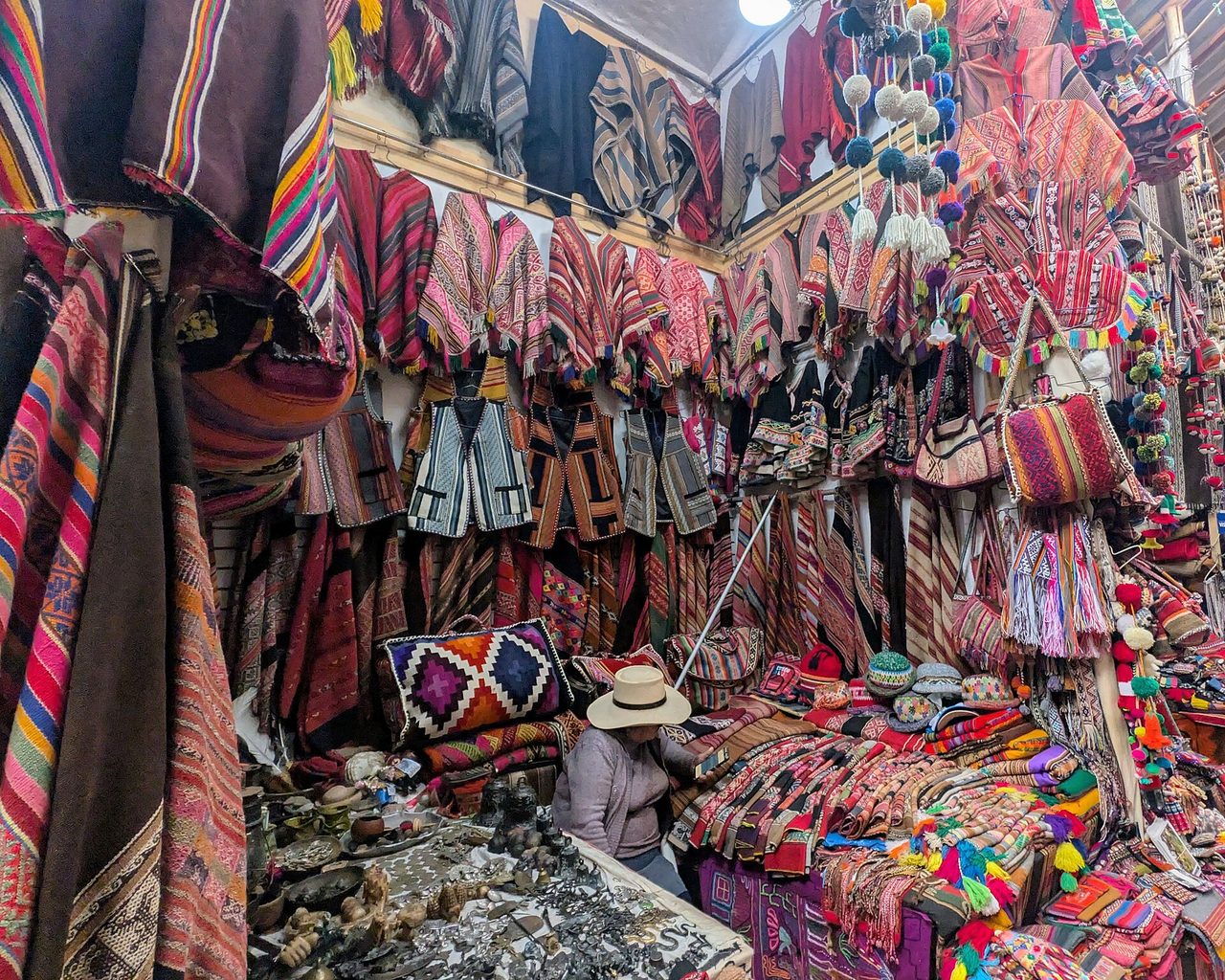
The artisan market fills the plaza and the surrounding streets seven days a week and exists because forty coaches a day stop here. Ponchos, chullos, alpaca blend scarves, silver, painted ceramics, keyrings, the same little standing-stone chess sets you will see in every Cusco souvenir shop. Much of it is decent. Some of it is genuinely handmade by the woman selling it, and you can watch her working a backstrap loom while she waits for customers. A good deal more of it is machine-knitted acrylic, and a slice arrives from workshops in Cusco, Juliaca or across the Bolivian border.
How to tell: real alpaca is cool to the touch and does not squeak when you rub it; acrylic does both the opposite. A hand-woven textile has small irregularities and the reverse side looks like the front only messier — if the back is a smooth mat of floats, it came off a machine. Natural dyes go muddy-rich rather than fluorescent. None of this means you should not buy the acrylic scarf; it means you should not pay alpaca money for it.
On price, the received wisdom that Pisac is cheaper than Cusco is half true. Comparable items generally do start lower here than in San Blas or around the Plaza de Armas, but the spread has narrowed a lot, and on a Sunday with four coaches in the square the opening quote will be a Cusco quote. Expect to settle somewhere between 60 and 80 per cent of the first number. Haggle, but stop haggling well before you have won. Fifteen soles is a coffee to you.
The real market: essentially Sunday
Underneath the craft stalls there is still a functioning highland produce market, and it is a different thing entirely. Families come down from the communities above the valley — Amaru, Chahuaytire, Viacha, Cuyo Grande, Paru Paru and others — with potatoes in varieties you have never seen, oca, tarwi, freeze-dried chuño, herbs, cheese, and there is still some straightforward exchange of goods going on rather than cash sales. That happens properly on Sunday. Tuesday and Thursday are the secondary market days and get a real but much smaller version of it. Monday, Wednesday, Friday and Saturday give you the craft stalls and very little else.
So: if the living market is what you came for, it is Sunday or it is nothing much. If you want the ruins without the crush, come on any other day and accept that the plaza will be a souvenir arcade. Both are legitimate choices and most guides refuse to say so.
Sunday mass and the varayoc
The thing actually worth arranging your week around is not the stalls. On Sunday morning there is a mass in Quechua at the church on the plaza, attended by the varayoc — traditional community authorities from the surrounding villages, each carrying a silver-mounted staff of office that is the physical symbol of their year’s mandate. It typically starts around 11am. When it ends, somewhere around midday to half past, they process out of the church across the square in full regalia, sometimes with a pututu conch trumpet sounding.
It lasts a few minutes. It is not staged for tourists, which is exactly why you should keep your distance, not block the doorway, and ask before photographing anyone up close. Of everything at Pisac, this is the piece that has most stubbornly survived the coach trade, and it is a live piece of the same syncretic tradition you see in Peru’s bigger Andean festivals, just without the audience.
Timing your day around the convoy
Pisac is the first stop on the standard Sacred Valley circuit out of Cusco, which means the arrival pattern is extremely predictable. Coaches begin landing around 09:30, peak between 10:00 and 12:00, and are largely gone by 13:30 as they push on toward lunch in Urubamba and the afternoon at Ollantaytambo.
Two workable plans fall out of that.
The early plan. First colectivo out of Cusco around 07:00, in Pisac by 08:00, taxi straight to the upper entrance, and you have the citadel almost entirely to yourself for an hour or more before anything arrives. Walk down through the site, reach the terraces around the time the first groups are being marched along them, and be in the plaza for a late lunch as the coaches leave. This is the best version of the day and it costs you one early alarm.
The late plan. Reverse it. Arrive around 13:00, do the market while it is emptying, taxi up at 14:30, and walk down in the long afternoon light with the site to yourself again. You lose the morning light on the terraces and gain the best light on the valley. Just make sure you are through the lower gate before the park closes and off the mountain before dark, which in this latitude means before about 18:00 year round.
The one plan that does not work is the one everybody does: arrive at 11:00 with the pack.
How long to give Pisac
| Time budget | What you get | What you miss |
|---|---|---|
| Half day (4–5 hrs) | Taxi to the upper gate, walk down through Q’allaqasa, Intihuatana and the terraces, an hour in the market | The town beyond the plaza, the botanical garden, any sense of Pisac after the buses leave |
| Full day (8–9 hrs) | All of the above unhurried, plus lunch properly, the back streets, the garden, and the option of walking the whole descent slowly | Sunrise and the evening, which are the two best hours here |
| Overnight | The town empties around 16:00 and becomes a different, quieter place. Early start at the ruins with nobody there. Sunday mass without a rushed return. | Nothing, other than a night you could have spent in Cusco or Ollantaytambo |
| Two nights | Pisac as a valley base: day trips west, proper acclimatisation at 2,970 m, time in the surrounding weaving communities | Cusco’s restaurants and museums, if your total trip is short |
My honest read: half a day is enough for most people and a full day is better for anyone who likes ruins. Staying the night is a real upgrade but only if your itinerary has slack — and if you are working out how many days to give the Cusco region, a night in Pisac competes directly with a night in Ollantaytambo, which is closer to the train and has ruins of its own. If you can only do one valley night, most people should choose Ollantaytambo. If you specifically want the market and the mass, choose Pisac and make it a Saturday night.
The town, beyond the stalls
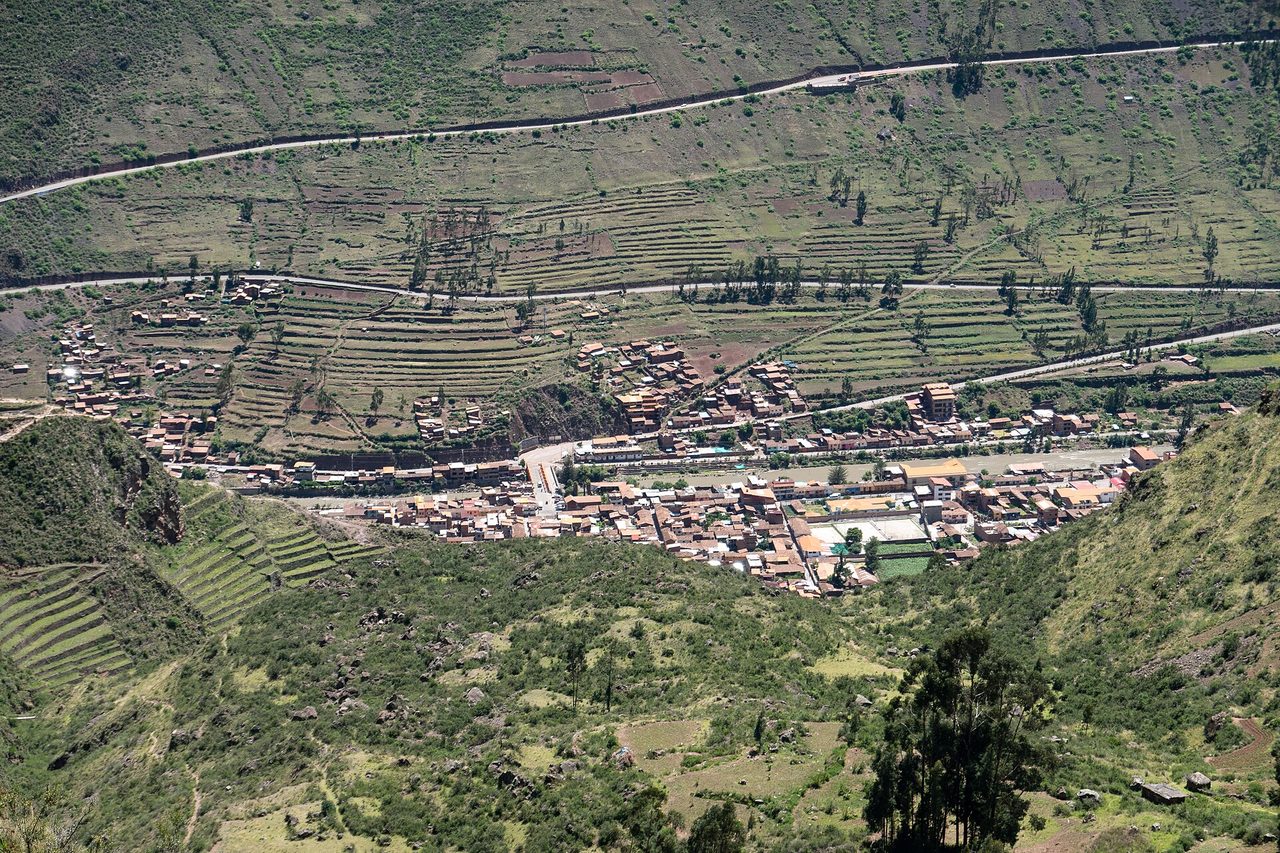
Walk three blocks off the plaza in any direction and the souvenir economy stops abruptly. Pisac is a working district capital of a few thousand people with agricultural streets, a school run, dogs asleep in the road and a river you can walk along.
Clay ovens and empanadas
The thing to eat here is bread. Several bakeries around the plaza and the streets behind it still fire wood-burning clay domes — the loading mouth opens straight onto the street, and if you time it right you can watch the peel go in. Empanadas come out cheap, blistered and slightly smoky; the cheese ones are the standard and there is usually a savoury meat version. There is also a big round of chuta bread, which is a genuine Cusco-region product rather than a tourist invention, and a guinea pig roasted whole in the same oven if you want to make that decision on holiday. Beyond the bakeries, a menú del día away from the plaza runs S/10–20 for soup, a main and a drink, which is the same arithmetic that makes eating in Peru such good value once you step off the tourist strip. The restaurants directly on the square charge two to three times that for food that is not two to three times better.
The botanical garden
A short walk from the plaza there is a private botanical garden begun in the early twentieth century by a Peruvian botanist and still run by his family. Entry is a few soles — around S/6 last time I checked — and it is open daytime hours, though there is not always anyone at the gate and you may need to ring and wait. Inside there are a large collection of cacti, a startling number of Andean potato varieties, and a small, cheerfully idiosyncratic museum of potatoes and insects. It takes half an hour. It is the single most charming thing in Pisac and almost nobody on a coach tour has any idea it exists. There is also a small community museum in town.
The retreat scene, even-handedly
Over the past fifteen years Pisac has acquired a substantial foreign wellness community: ayahuasca and San Pedro retreats, yoga schools, permaculture projects, raw food cafes, a noticeboard economy of sound baths and cacao ceremonies. On a weekday afternoon a decent fraction of the people in the plaza are long-stay foreigners rather than day visitors, and the town’s restaurant scene — which is genuinely good for a place this size — exists largely because of them.
An honest assessment cuts both ways. It has brought money, employment and a level of infrastructure a town of this size would not otherwise have, and some of the projects are serious, long-term and locally partnered. It has also brought a parallel economy that many Pisaceños are not part of, pushed property prices up, and produced a supply of ceremonies run by people with no lineage, no medical screening and no accountability. Plant medicine in Peru is essentially unregulated. There have been deaths in the wider retreat industry, several involving pre-existing conditions or drug interactions that basic screening would have caught. If you are considering it, that is a decision that deserves far more research than a plaza flyer and a stranger’s recommendation, and it is not one this site is going to make for you. If you are not considering it, none of it will intrude on your day beyond a slightly unusual density of tie-dye.
Altitude: read this if you have just landed
There is a persistent line that you should go straight to the Sacred Valley from Cusco airport because it is lower. For the valley floor that is fair — Pisac town at ~2,970 m, Urubamba and Ollantaytambo at ~2,800–2,900 m, all meaningfully below Cusco’s 3,400 m. But a day at Pisac is not a day at 2,970 m. The upper entrance is 3,350 m and the Q’allaqasa lookout is above Cusco. You will spend the afternoon higher than the city you came to avoid, doing sustained exertion.
Sleeping low in Pisac and day-tripping is a legitimately good acclimatisation strategy. Landing at Cusco at 10am and hiking the citadel at 2pm on day one is not, and it is how a lot of people acquire the headache that ruins their next three days. Give it 48 hours if you can; if you want the physiology and the practical fixes, our piece on coping with the altitude around Cusco goes into detail. Water, slow walking, no alcohol the first night, and coca tea for whatever placebo it is worth.
Getting to Pisac, and onward
Colectivo from Cusco. Minibuses to Pisac, Calca and Urubamba leave from Calle Puputi, a 20–30 minute walk or a short taxi ride from the historic centre. They go when full, which in daylight means every few minutes. The fare is around S/5–10 and the trip takes 45–60 minutes over a pass with a viewpoint most drivers will not stop at. You are dropped at the bridge; cross it and you are in town. It is the single easiest piece of independent transport in Peru.
Coming back is the same in reverse: wait on the Cusco-bound side of the road near the bridge and flag one down. On a Sunday afternoon you may wait a while and you may end up standing. After dark, take a taxi from the drop-off point to your accommodation rather than walking.
Private taxi from Cusco runs roughly S/60–90 one way, more if your hotel books it. Sensible for three or four people, or with luggage.
Onward into the valley. This is the underused move. Rather than returning to Cusco, flag a Urubamba-bound colectivo from Pisac and continue west — Calca, Yucay, Urubamba, then Ollantaytambo. It costs a few soles, takes about an hour and a half in stages, and puts you where the trains leave from. Doing Pisac in the morning and continuing to Ollantaytambo in the afternoon is a far better day than the coach loop, and it slots neatly into the standard Cusco and Machu Picchu run without adding a day. If you are still assembling the whole trip, our ten-day Peru itinerary puts the valley in the right place in the sequence, and there is a first-timer’s version if this is your opening trip to the country.
When to come
The dry season, roughly May to September, gives you reliable sun, clear ridge views and hard ground on the descent, along with the largest crowds and the highest prices. The wet months, December to March, give you a green valley, dramatic cloud and far fewer people, with the trade-off that the terrace paths turn slick and afternoon rain is close to a daily event. The shoulder months of April and October are the sweet spot for Pisac specifically, because the descent is dry, the terraces are still green from the rains, and you can have Q’allaqasa to yourself.
For the wider picture on what each month does to the whole southern highlands, our breakdown of the best time to visit Peru and the more granular guide to the Cusco region month by month are worth reading before you lock in dates. Note that whatever the season, mornings at 3,350 m are cold and midday is fierce — the UV at this altitude burns people who never burn.
What to take up the mountain
- More water than you think. Two litres per person. There is nowhere to buy any on the mountain.
- Sun hat, high-factor sunscreen, sunglasses. The terraces are entirely unshaded.
- A layer for the top and something you can strip to for the descent. Twenty degrees of felt difference between a windy lookout and a sheltered staircase is normal.
- Proper shoes with grip. Not trainers with worn soles, which is what I wore the first time and regretted continuously.
- Trekking poles if your knees are at all suspect.
- Small notes in soles. Card acceptance at market stalls is patchy and the taxi drivers want cash.
- Your passport is not needed at Pisac, but carry it if you plan to buy a boleto with a student rate.
Do you need a guide?
The site is signposted well enough to navigate without one, and I have done it both ways without feeling short-changed either time. What a guide adds at Pisac is interpretation: which sector is which, why the masonry quality changes as you move down the ridge, what the cemetery opposite actually was. That is more valuable here than at most sites because the signage is thin on exactly those points. Guides can be hired at the upper entrance in Spanish and English; agree the price and the duration before you set off. If you are on an organised tour a guide is included, though you will get the forty-minute version.
Is Pisac worth it?
Yes, and specifically it is worth more than the itinerary gives it. If you only see one Sacred Valley site and you care about Inca architecture, Ollantaytambo is arguably the more complete experience because the town itself is still built on Inca foundations and you can walk the original street grid. If you care about scale, setting and the feeling of having a large ancient site substantially to yourself, Pisac wins outright, and it is the better half-day.
Who it is not for: anyone who cannot manage two to three hours of uneven descent, anyone arriving in the Cusco region that same morning, and anyone whose main interest is shopping, who will find better prices and better selection with more patience in Cusco. And if you are travelling with limited time and trying to decide whether the valley earns a whole day at all, it does — Pisac is among the places in Peru that reward the extra day more than almost anything else within an hour of Cusco. It also holds up for anyone building a trip that skips Machu Picchu entirely, which is a more viable plan than most people assume.
Frequently asked questions
How long do you need at the Pisac ruins?
Two hours if you taxi up and back and stay in the upper sectors. Three to four hours if you walk down through the whole site to town, which is what I would recommend. Four to five hours if you also walk up.
What day is the Pisac market?
Craft stalls run daily. The genuine produce and barter market is essentially Sunday, with smaller versions on Tuesday and Thursday. Sunday is also when the Quechua mass and the varayoc procession happen.
Do I need the Boleto Turístico for Pisac?
For the ruins, yes — there is no separate ticket. For the market, the town and the church, no. The full boleto is S/130 for 10 days and 16 sites; Circuit III is S/70 for 2 days and includes Pisac, Ollantaytambo, Chinchero and Moray. Verify current prices with COSITUC before you travel.
How much is a taxi from Pisac town to the ruins?
Around S/30–40 one way per vehicle, or S/50–70 for a return with the driver waiting. The old S/25 rate has largely gone. Split between four it is negligible.
Can you walk up to the Pisac ruins?
Yes. The trail starts at the top of Calle Manuel Prado in town and takes two to three hours up, depending on fitness and acclimatisation. It is steep, exposed and hot. Downhill on the same path is a much better use of the effort.
How high is Pisac?
The town is about 2,970 m. The upper ruins entrance is about 3,350 m and the highest walkable points are around 3,510–3,525 m — higher than Cusco. Do not treat a Pisac day as a low-altitude day.
Is Pisac better than Ollantaytambo?
Different. Ollantaytambo gives you a living Inca town and the most impressive single wall of stonework in the valley. Pisac gives you far more ground to cover, a better sense of an entire Inca settlement, and fewer people once you are past the terraces. If you have one day, do both; they are 90 minutes apart.
Can you visit Pisac without a tour?
Easily, and it is cheaper and better. Colectivo from Calle Puputi in Cusco, taxi up to the ruins, walk down. Total transport cost is well under S/60 per person including the return.
Is the Pisac market cheaper than Cusco?
Slightly, and less than it used to be. Opening quotes on a busy Sunday are close to Cusco prices. The advantage at Pisac is selection and the chance of buying directly from the maker rather than a reseller.
What time does the Pisac market start?
Stalls are setting up by 08:00 and fully open by 09:00. On a Sunday the produce section is busiest early, before the coaches, and the craft section is busiest from about 10:00.
Are the Pisac ruins bigger than Machu Picchu?
In footprint, the Pisac archaeological park covers a comparable or larger area, though it is strung out along a ridge rather than concentrated. Machu Picchu has far more intact buildings in one place. What Pisac has that Machu Picchu does not is space to yourself and no ticketed time slot.
Can you see Pisac and Machu Picchu on the same trip easily?
Yes — Pisac sits at the eastern end of the valley and the trains leave from the western end, so the natural sequence is Pisac, then west through the valley, then the train from Ollantaytambo. Doing Pisac on the day before a Machu Picchu day works well and gets you acclimatised.
Is there anywhere to eat inside the archaeological park?
No. There is no food or water for sale anywhere on the mountain and only basic toilets near the ceremonial fountains and at the lower gate. Carry what you need and eat in town afterwards.