Humantay Lake Day Trip from Cusco
Every tour listing quotes the distance and skips the vertical. Humantay Lake is a 300-metre climb finishing at 4,200 metres, and that one number changes how you should plan the whole day.
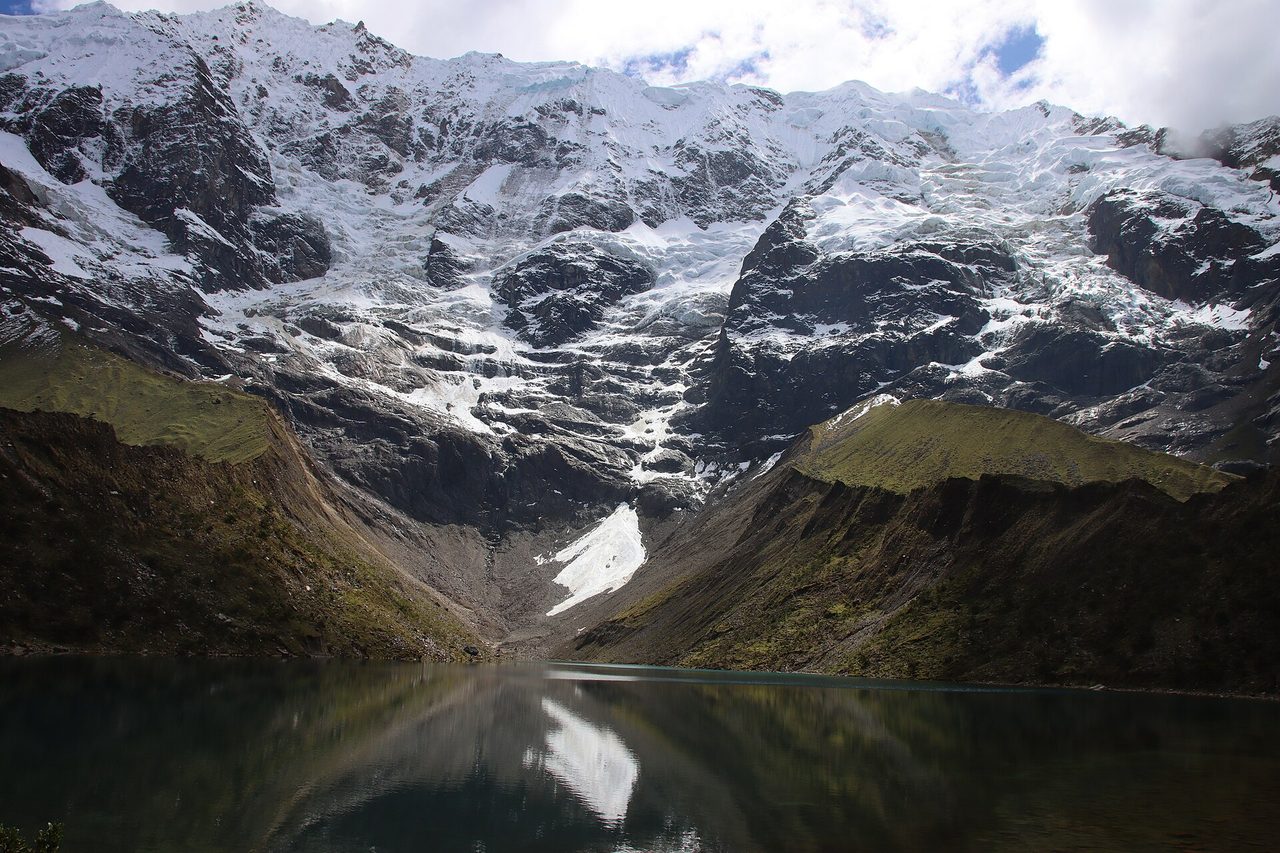
Every tour listing for Humantay Lake quotes the distance and quietly leaves out the vertical. Two to three kilometres each way, they say, as though that settles the question. What the listing does not tell you is that roughly 300 metres of that walk is straight up, almost all of it packed into the second half, on loose moraine grit at 4,200 metres where the air carries about 60 per cent of the oxygen you get at sea level. That is the whole story of this hike in one sentence. It is short. It is also steep enough that fit people in their twenties end up stopping every forty paces, hands on knees, wondering what happened.
Humantay gets sold as the easy one. Among all the things people line up to do out of Cusco, it is the one marketed as a gentle stroll to a turquoise lake: easier than Rainbow Mountain, easier than any of the multi-day treks, something you can knock off in a day between the Sacred Valley and Machu Picchu. That framing is wrong, and it is the reason the trail is littered with people who have quietly given up and are negotiating with a horse handler halfway up. This guide is the version I wish I had read first: the real gradient, the real times, the real prices in soles, an honest verdict on whether the colour lives up to the photographs, and a straight answer on how it compares with the other big day hikes out of Cusco.
Humantay Lake at a glance
The numbers first, because almost nobody publishes them all in one place.
| Detail | The number |
|---|---|
| Lake elevation | 4,200 m (13,780 ft) |
| Trailhead (Soraypampa) | ~3,900 m (12,800 ft) |
| Net vertical gain | ~300 m; GPS tracks usually log 380–470 m with undulation and the moraine viewpoint |
| Distance | ~2.5–3.5 km each way, depending where the van drops you |
| Time up | 60–90 minutes for most people; 2 hours if the altitude bites |
| Time down | 45–60 minutes |
| Drive from Cusco | ~3 hours to Mollepata, then 30–40 minutes of rough road to Soraypampa |
| Typical pickup | 3:30–4:30 am |
| Back in Cusco | 5–7 pm, so a 13–15 hour day door to door |
| Entrance fee (2026) | S/30 foreign visitors, S/20 Peruvians, cash in soles |
| Group tour | S/50–120 (about $14–33) booked in Cusco |
| Horse hire | S/80–100, covers roughly the first 80 per cent of the climb |
| The peak above the lake | Nevado Humantay, 5,473 m; Salkantay behind it at 6,271 m |
Prices below use roughly S/3.70 to the US dollar, which is where the sol has sat for a while. Entrance fees in this part of Peru are set by district municipalities and communities rather than a national body, and they move without warning, so treat every figure here as the number to budget for rather than a promise.
The gradient nobody quotes
Here is the arithmetic that makes Humantay hard. From the drop-off point at Soraypampa the first 1.1 to 1.5 kilometres is essentially a service road: flat, wide, gently rising, past a couple of small restaurants and a field of horses. It is pleasant and it lulls you. Then you turn left through a gate, and everything the trail owes you comes due at once.
What is left is roughly 300 metres of climbing in something like 1.5 to 2 kilometres of ground. That is an average grade near one in six, sustained, with steeper pitches near the top and no switchbacks generous enough to take the sting out. At sea level that is a brisk forty minutes and a slightly elevated heart rate. At 4,000 metres it is a different physiological event entirely. You are not unfit. You are working at partial pressure.
The surface does not help. The lower half is a grass slope worn into a wide braid of paths, and the upper half is gravel and small loose rock over compacted dirt. Going up, the footing is fine. Coming down is where people slip, particularly in the wet season when the same gravel becomes a slurry. A pair of poles is worth more here than any other single item you can carry.
One more thing that surprises people: there are two or three false summits. You round a shoulder expecting water and get more slope. It is a small psychological cruelty and it is worth knowing about in advance, because the moment you stop believing the lake is close is the moment the climb gets genuinely miserable.
What the day actually looks like, hour by hour
This is a standard group tour, the sort you buy from an agency window around the Plaza de Armas. Independent timings are further down.
- 3:30–4:30 am – hotel pickup. The van collects six or eight other people from six or eight other hotels, which is why a 4 am pickup often means 4:50 am before you actually leave Cusco.
- ~6:45 am – Mollepata, roughly three hours out, for breakfast in a roadside comedor. Bread, jam, eggs if you are lucky, coca tea. Basic and welcome.
- ~7:45 am – the last 30 to 40 minutes up a narrow gravel road to Soraypampa. Single lane in places, unfenced drops, and slow. This is the part of the day where you understand why nobody drives themselves in the rain.
- 8:15–10:00 am – the hike. The group splits within ten minutes and stays split. Guides usually wait at the top for stragglers.
- ~10:00–10:45 am – time at the lake. Most tours give you 40 to 45 minutes. It sounds short and it feels short.
- ~11:30 am – back at the trailhead.
- ~1:00 pm – buffet lunch back near Mollepata, usually a large shared spread of soup, rice, quinoa, potatoes, a stewed meat, salad and fruit. It is generally better than it needs to be, and if you want a proper introduction to what Andean home cooking actually tastes like, this is more representative than most restaurants in Cusco. Our guide to the dishes worth ordering across Peru covers what you are looking at.
- ~2:00 pm – the three-hour drive back.
- 5:00–7:00 pm – dropped in Cusco, often at the Plaza rather than your hotel.
Add it up and you are committing thirteen to fifteen hours to about forty minutes of standing beside a lake. That ratio is the honest cost of the trip and it deserves to be stated plainly before you book. It also explains why Humantay sits awkwardly in a tight schedule: it eats a full day, and the day after it you will not want to do anything demanding. If you are still shaping your route, our day-by-day Peru itinerary planner shows where a burner day like this fits without wrecking the rest of the trip.
An honest verdict on the colour
The photographs are real. They are also, almost without exception, taken in direct mid-morning sun between about 9:30 am and noon, in the dry season, with a polarising filter, and often from the moraine ridge rather than the shore.
The colour comes from rock flour: ultra-fine sediment ground out of the bedrock by the glacier above and held in suspension in the meltwater. Those particles scatter short-wavelength light, which is what produces the milky blue-green. The effect is a light trick, and it depends entirely on light. Arrive under cloud and the lake reads slate grey with a green cast. Arrive at 7 am in September and the whole basin is still in the shadow of Nevado Humantay, and you get the same grey-green until the sun climbs over the ridge. Wind matters too. A ruffled surface scatters light in every direction and flattens the colour out.
So the trade-off is sharper than most guides admit. Arrive early and you get the lake to yourself in mediocre light. Arrive at 9:30 or 10 and you get the postcard colour and about two hundred other people. There is no time slot that gives you both, and anyone who tells you otherwise is selling a tour.
My own view: the colour is worth the climb on a clear day, and on a grey day the setting still is – the basin, the moraine walls, the ice hanging above the far shore – but you should book knowing there is maybe a one-in-three chance in the wet season that you walk up for a flat grey lake and a cloud where the mountain should be.
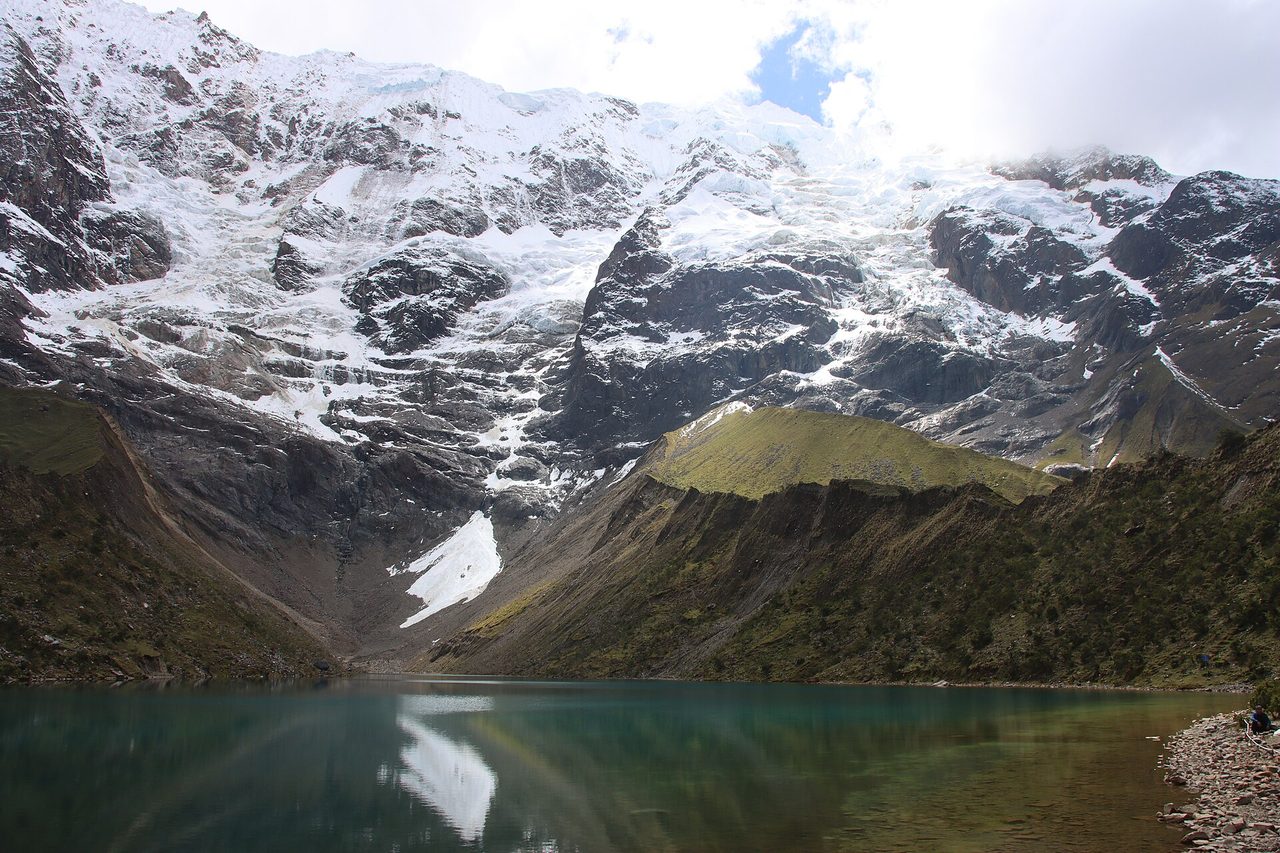
The glacier above the lake, and why it is shrinking
Humantay Lake exists because ice retreated. The basin was carved by a much larger glacier; the lake now fills the hollow between the lateral and terminal moraines that the ice left behind, and it is fed by meltwater from what remains of the Humantay glacier on the slope above.
That remnant is going. The Cordillera Vilcabamba, the range Humantay and Salkantay belong to, has lost roughly 56 per cent of its glaciated area since the 1970s. Across Peru as a whole, the national glacier institute puts total losses at more than 40 per cent, with a large share of that occurring since 2000. Peru holds the great majority of the world’s tropical glaciers, which makes it one of the places where the arithmetic is most visible.
This is not an abstraction you have to take on trust. Stand on the moraine and you can see the trimline: a pale, unvegetated band of scoured rock high above the current ice margin, marking where the glacier surface used to be. Guides who have worked the trail for fifteen years will point to where the snout sat when they started. The lake is, in a real sense, a byproduct of that loss, and it will keep changing shape as the ice above it keeps going.
I mention it not to moralise but because it changes how you look at the place, and because it is one of the few things about Humantay you cannot get from a photograph.
Do not swim, and do not walk onto the shore ice
Swimming is prohibited and there are rope barriers along the accessible shoreline with wardens who will whistle at you long before you reach the water. People still try it. There are three separate reasons not to, and they stack.
The water is a few degrees above freezing. Measurements at the surface come in at or below about 4°C, and it is colder than that a metre down. Cold-water shock is an involuntary gasp reflex that hits within seconds of immersion at those temperatures. You are at 4,200 metres, already hypoxic, an hour of hard walking from the trailhead and several hours from a hospital. There is no realistic rescue scenario. This is not a bracing dip; it is the kind of decision that turns into a consular case.
It is a sacred site with active ritual use. Salkantay is one of the most important apus in the Cusco region, and the lake beneath it is treated accordingly. The small stacked stone cairns along the shore are apachetas – offerings, not decoration, and not photo props to rearrange. Guides frequently lead a short coca-leaf ceremony at the top, and it is a living practice rather than something invented for visitors. Getting in the water is read the way you would expect wading into a font to be read.
There is genuine rockfall and ice-calving hazard. On a sunny morning you will hear the mountain working: cracks like distant gunshots, then small avalanches sliding off the hanging ice. Most of it lands nowhere near the shore. Some of it does not. The far end of the lake, the photogenic end nearest the glacier, is exactly where debris arrives, and the shelf of shore ice that forms in the cold months sits over deep water and will not hold you. Stay on the near shore and the moraine, which is where the good angles are anyway.
Drones are also banned. This is newer than most blog posts on the subject – older guides from 2019 show drone footage – and it is now enforced, with fines and confiscation as the stated consequence. Permission has to be requested in advance from the municipality in Mollepata. Do not assume the guy who flew one last year is a precedent.
Humantay vs Rainbow Mountain vs Salkantay
Almost everybody who searches for Humantay is really asking which of the big Cusco day hikes to spend their one spare day on. Here they are side by side, with the multi-day Salkantay Trek included because it is the natural upgrade rather than a competitor.
| Humantay Lake | Rainbow Mountain (Vinicunca) | Salkantay Trek | |
|---|---|---|---|
| Highest point | 4,200 m | 5,036 m | 4,630 m (Salkantay Pass) |
| Trailhead | ~3,900 m | ~4,600 m | 3,900 m (Soraypampa) |
| Vertical gain | ~300 m | ~400 m | ~730 m on the pass day, cumulative over 5 days |
| Distance | ~5–7 km round trip | ~7 km round trip | ~60–70 km |
| Time on foot | 2–3 hours | 3–4 hours | 4–5 days |
| Total day length | 13–15 hours | 13–15 hours | n/a |
| Typical cost | S/50–120 + S/30 entry | S/60–150 + S/30 entry | $400–750 all in |
| Crowds | Heavy 9:30 am–noon, empty by 1 pm | Heavier, and concentrated on one narrow ridge | Busy at camps, quiet on the trail |
| Hardest thing about it | The gradient | The altitude | The duration and the cold nights |
| Verdict | Shorter, steeper, prettier, and a lower ceiling on altitude risk | Higher, longer, more exposed, and more likely to make you ill | The one that actually gets under your skin |
The decision rule, if you only have one day: if you are on day two or three in Cusco and altitude is an unknown quantity for you, do Humantay. The 800-metre difference in ceiling is significant, and the escape route is shorter. If you are properly acclimatised, have a week at altitude behind you, and want the more famous photograph, Rainbow Mountain earns its place – but understand that you are paying for it in oxygen, not in effort. Several people I have compared notes with, including bloggers who did both back to back, rate Humantay as the physically harder walk despite being 800 metres lower, purely because of the slope.
One thing neither comparison captures: Humantay has a single, coherent payoff at the end. Rainbow Mountain has a viewpoint on a ridge with a queue for the photo spot and a strip of vendors. If crowd texture matters to you, that is the real difference. Both sit at the demanding end of the full range of day trips out of Cusco.
If you are doing the Salkantay Trek, do not book this separately
This is the single most common way people waste a day and S/100 in Cusco.
Soraypampa – the Humantay trailhead – is the first camp on the classic five-day Salkantay Trek to Machu Picchu. Every standard itinerary drives you there on day one, has lunch, and then sends you up to the lake in the afternoon as an acclimatisation walk before the pass the following morning. The lake is included. You will hike it either way.
So if the Salkantay is on your list at all, book the trek and skip the day trip entirely. You will see the lake in afternoon light rather than mid-morning light, which is arguably better and certainly quieter, and you will not have burned a fifteen-hour day and a night of sleep for the privilege of seeing it twice. Our roundup of the best multi-day treks in Peru sets out how Salkantay stacks up against the alternatives on cost, difficulty and scenery.
The reverse also holds. If Humantay is the only Andean walking you are going to do, and it lights something up in you, Salkantay is the natural next step: five days, one serious pass, cloud forest on the descent, and Machu Picchu at the end without the permit lottery that governs the classic Inca Trail. Salkantay permits are unlimited, which is why it books out less brutally, and it arrives at Machu Picchu by a much wilder route.
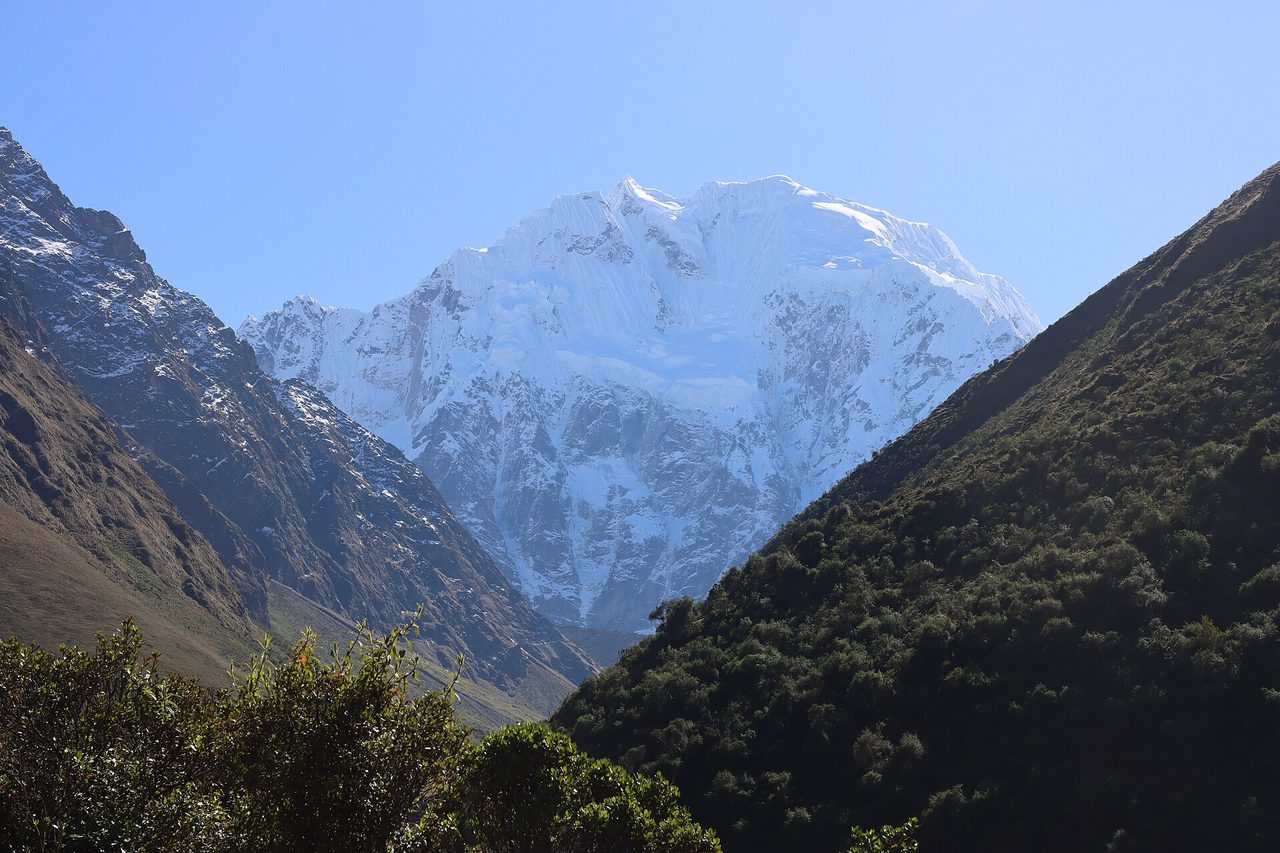
Acclimatisation: how many days in Cusco first
The lake is 800 metres higher than Cusco. Cusco is already 3,400 metres. If you have flown in from Lima, which is at sea level, you have gained more altitude in ninety minutes than a body is designed to handle, and the standard advice not to ascend more than about 500 metres of sleeping altitude per day has already been comprehensively ignored on your behalf.
Minimum: two full days in Cusco before you attempt this. Three is better. Doing Humantay on arrival day is a genuinely bad idea, and it is the single most common cause of the miserable, headachy, vomiting-in-the-van stories you read in reviews. Altitude sickness does not care how fit you are. It correlates with rate of ascent and, to some extent, with genetics, and not at all with your gym attendance.
A better shape for the first days: land in Cusco, do nothing demanding, then drop down to the Sacred Valley at around 2,800 metres for a night or two, which is lower and helps more than another day in Cusco does. Come back up, do Humantay, then go on to whatever is next. Travellers arriving overland from the south often have an easier time of it, since a few nights around Lake Titicaca at 3,810 metres or a stop in Arequipa and the Colca canyon does most of the acclimatising for you.
Coca tea helps with the headache and does nothing for the underlying physiology. Acetazolamide, prescribed in advance by your own doctor, does help, and needs to be started a day before ascent. Our broader practical advice for travelling in Peru goes into altitude, water, stomach trouble and the other things that quietly ruin trips.
Crowds and timing: what an early arrival actually buys you
The entire group-tour fleet leaves Cusco within an hour of each other and arrives at Soraypampa within an hour of each other. That produces a very predictable curve at the lake.
- Before 8:30 am – a handful of independent hikers and Salkantay trekkers who slept at Soraypampa. Effectively empty. Light is poor and the basin may still be in shadow.
- 9:00–9:30 am – the first day-trip groups top out. Perhaps thirty or forty people spread around the shore. Colour starting to come up.
- 10:00 am–noon – peak. Several hundred people, a queue at the two or three obvious photo positions, guides running ceremonies simultaneously within earshot of each other, and a steady stream of people asking you to move out of frame.
- After 1:00 pm – it empties fast, and by mid-afternoon it is quiet again. The catch is that winds routinely pick up after midday and the lake starts falling into shadow.
The difference between arriving at 9 am and arriving at 10 am is roughly the difference between forty people and three hundred. That single hour is the highest-leverage decision you make about this trip, and it is decided entirely by which agency you book and how many hotel pickups are ahead of yours. When you buy the tour, ask two questions: what time is the first pickup, and how many people are in the van. Anything over twelve and you will be waiting for people at every stage.
The photo queue at the moraine viewpoint is a real phenomenon. There is one large rock about ten minutes up the moraine on the left as you face the lake, and by 10:30 am there is an orderly line for it. Ten minutes further up and to the side there are angles nobody is using. Walk the extra ten minutes.
What it costs in 2026
| Item | Soles | Approx USD |
|---|---|---|
| Group day tour booked in Cusco | S/50–120 | $14–33 |
| Same tour booked online in advance | S/150–220 | $40–60 |
| Entrance fee, foreign visitor | S/30 | ~$8 |
| Entrance fee, Peruvian | S/20 | ~$5.50 |
| Horse hire at the trailhead | S/80–100 | $22–27 |
| Trekking pole rental | S/10–20 | $3–5 |
| Toilets at the trailhead | S/2 | ~$0.55 |
| Colectivo, Arcopata terminal to Mollepata | S/15–20 | $4–5.50 |
| Shared taxi, Mollepata to Soraypampa | S/10 | ~$2.70 |
| Private taxi, Cusco return with waiting time | S/300–400 | $80–110 |
| Guide tip, if you are happy | S/20–30 | $5–8 |
A note on the entrance fee, because it is the most confused number on the internet. Older guides quote S/10, and slightly newer ones quote S/20. The figure operators are publishing for 2026 is S/30 for foreign visitors and S/20 for Peruvians, collected at the checkpoint on the road up rather than in Mollepata itself. Most tours do not include it. Carry small notes; nobody up there is breaking a hundred-sol bill, and there is no card machine and no ATM between Cusco and the trailhead.
The cheap end of the tour range is cheap for reasons. Under about S/60 you are typically getting a bigger group, an older van, a rushed schedule, a guide who stays with the fastest walkers, and a lunch that is technically a buffet. The S/90 to S/120 band is where the day gets noticeably better. That difference is worth spending, and it is small in the context of what a trip to this part of Peru costs overall – our breakdown of what a Peru trip actually costs puts a S/100 day tour in perspective next to the S/163 Machu Picchu ticket and the trains.
What to wear and carry
The range of conditions in a single day here is wider than almost anything else you will do in Peru. It can be below freezing in the van at 4 am and 20°C with brutal UV on the slope at 10 am, and it will be windy and cold again at the lake.
- Three layers on top: a merino or synthetic base, a fleece or light down mid-layer, and a windproof shell. You will use all three and you will take two of them off during the climb.
- Hat and gloves. Not optional. The wind coming off the ice is the thing that catches people out, because they dressed for the hike rather than for standing still afterwards.
- Sun protection, seriously. UV at 4,200 metres in the tropics is savage even at 5°C. High-factor sunscreen, reapplied, sunglasses, and a brimmed hat. Sunburn on the underside of the nose from reflected light off the lake is a real thing.
- Proper footwear with an aggressive sole. Trail runners are fine in the dry season. In the wet, boots with ankle support and real lugs, because the descent turns greasy.
- Trekking poles. The single best piece of kit for this specific trail. Rentable in Cusco for a few soles.
- Waterproof shell and a pack cover between November and March. Afternoon rain is close to a daily event.
- 1.5 litres of water minimum, plus salty snacks. You dehydrate faster than you notice at altitude in dry air.
- Cash in small soles notes for the entrance, the toilets, the horse and the tip.
The layering logic is the same one that governs any high Andean day out; if you are also planning the citadel, our notes on what to wear at Machu Picchu cover the warmer, wetter end of the same problem.
Doing it independently
It is possible, and for two or more people it is not much more expensive than the tour once you count everything.
The public-transport route runs from the Arcopata terminal in Cusco to Mollepata for S/15 to S/20, roughly two and a half hours, then a shared taxi onward to Soraypampa for around S/10 a head, or about S/50 for the car if you cannot fill it. Both legs are straightforward in daylight and awkward before dawn, which is the whole problem: the early departures that get you to the lake ahead of the crowds do not exist on public transport.
A private taxi from Cusco with waiting time runs S/300 to S/400 return and solves the timing entirely. That is the option that actually buys you something the tours cannot sell: arriving at 8 am, or arriving at 1 pm when everyone else is leaving and the lake is yours. Split three or four ways it is competitive with the mid-range tour price. Our guide to getting around Peru by bus, colectivo and taxi covers how to negotiate this kind of hire without getting stung.
The road itself has a worse reputation than it deserves. It is gravel, narrow, single-lane in places, and unfenced above some genuine drops for the last 25 kilometres, but an ordinary car with a bit of clearance manages it in the dry season. In the wet I would not drive it myself, and I would not drive it against the flow of tour vans at either end of the day.
You do not need a guide to find the lake. There is one path and several hundred people on it. What you lose going independently is the breakfast, the lunch, the ceremony at the top, and someone carrying oxygen. What you gain is control of the clock, which on this particular trip is worth more than it usually is.
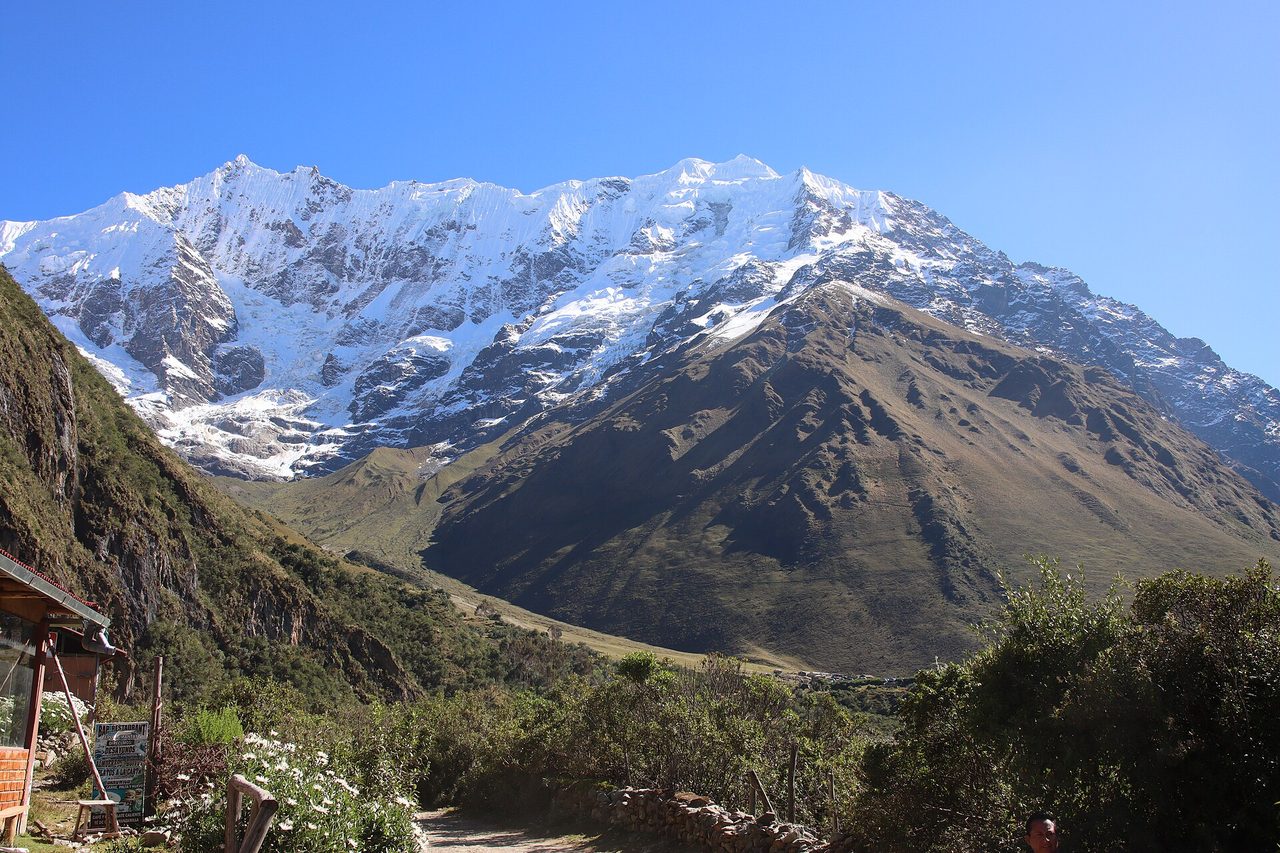
When to go
The dry season runs roughly May to September. Firm trail, clear mornings, the best odds of the colour, and the coldest dawns of the year – sub-zero at the trailhead in June and July is normal. It is also when every tour van is full.
The wet season, November to March, gives you green hillsides, dramatic cloud and far fewer people, in exchange for a muddy trail, a slippery descent, a real chance of the lake being invisible under cloud, and occasional road closures from landslides. April and October are the shoulder months and are frequently the best compromise: the trail has dried out or not yet turned, and the crowds have thinned.
If your dates are still flexible, our month-by-month view of when to visit Peru weighs the same trade-off across the whole country, since the Andean dry season is also the Amazon’s wettest stretch and the coast’s greyest.
Who should skip Humantay Lake
Being direct about this, because most pages will not be.
Skip it if you arrived in Cusco yesterday. No exceptions worth making. Push it later in your stay or drop it.
Skip it if you have a significant heart or respiratory condition and have not cleared high-altitude exertion with your doctor. This is a strenuous effort above 4,000 metres, several hours from definitive care.
Skip it if you are already doing the Salkantay Trek. You get the lake for free on day one.
Skip it if a 4 am start followed by six hours in a van sounds worse than the payoff. That is a legitimate assessment, not a failure of adventurousness. Some people will not enjoy a single minute of the logistics, and there are gentler ways to spend a day out of Cusco – the Sacred Valley circuit, Maras and Moray, or a well-planned day trip to Machu Picchu itself.
Think hard if you are travelling with young children or anyone with mobility limits. The gradient is unrelenting and the horses only cover part of it; the last stretch to the shore has to be walked.
And for everyone else: it is worth doing, and it is one of the few sights around Cusco that is not another Inca site, which by day four or five of a Cusco stay is a genuine relief. Just go in knowing which forty minutes of a fifteen-hour day you are buying.
Frequently asked questions
How hard is the hike to Humantay Lake, really?
Moderate to hard, and harder than the distance suggests. The climbing is about 300 metres, but nearly all of it comes in the second half, on loose ground, finishing at 4,200 metres. A reasonably fit and acclimatised person takes 60 to 90 minutes up with breaks. An unacclimatised person can take well over two hours or not make it at all. It is not technical – no scrambling, no exposure – the difficulty is entirely gradient plus thin air.
What is the altitude of Humantay Lake?
4,200 metres, or 13,780 feet. The Soraypampa trailhead is around 3,900 metres and Cusco is 3,400 metres, so the lake sits about 800 metres above the city you slept in. The peak directly above it, Nevado Humantay, reaches 5,473 metres, and Salkantay behind it tops out at 6,271 metres.
Can you swim in Humantay Lake?
No. It is prohibited, physically enforced with rope barriers and wardens, and a bad idea on its own merits. The water sits at roughly 4°C or below, cold enough to trigger involuntary gasping within seconds. The lake is also a sacred site with active ritual use, and the shore ice near the glacier end conceals deep water.
Can you hire a horse to Humantay Lake?
Yes, from local handlers at the trailhead, for around S/80 to S/100, cash in soles, first come first served – you cannot book ahead. The horse takes you roughly 80 per cent of the way; the last stretch to the shore is on foot for everyone. Look at the animal’s condition before you commit, and be aware that some of the handlers work these horses hard.
How much time do you get at the lake on a group tour?
Usually 40 to 45 minutes, and it goes quickly once you have walked a bit of the shoreline and taken photographs. If you want an hour or more at the top, either walk fast enough to arrive well ahead of your group, or go independently.
Is Humantay Lake better than Rainbow Mountain?
For most first-time visitors, yes, and mainly because it is 800 metres lower. Rainbow Mountain reaches 5,036 metres, which is high enough to make otherwise healthy people ill, and the viewpoint is a busier, narrower space. Humantay is the steeper walk but the more forgiving day, and the scene at the top holds together better. If you are well acclimatised and the striped ridge is the image you came for, Rainbow Mountain is defensible – just not as the easier option, because it is not.
Are drones allowed at Humantay Lake?
No. Flying is banned and the ban is enforced, with fines and confiscation. Permission has to be applied for in advance through the municipality in Mollepata. Blog posts and YouTube videos showing drone footage generally predate the restriction.
Is Humantay Lake worth it in the rainy season?
It is a gamble. Between November and March you get far fewer people and a greener landscape, but a real chance of arriving to cloud, no view of the glacier, and a grey lake. If you have a spare day to re-book, go. If it is your only shot and the photograph is the point, weight your trip toward the dry months instead.
Can you visit Humantay Lake without a tour?
Yes. Colectivo from Arcopata in Cusco to Mollepata (S/15–20), then a shared taxi to Soraypampa (about S/10), then walk. The trail is obvious and needs no guide. The complication is timing: public transport will not get you there early enough to beat the vans, so a private taxi at S/300–400 return is the option that actually pays off, especially split between three or four people.
Do I need to book Humantay Lake in advance?
No. Agencies around the Plaza de Armas sell it daily and walk-in prices are consistently lower than online ones. Book a day or two ahead in Cusco, ask about pickup time and group size, and pay in cash. Booking online from home costs roughly three times as much for the same van. If you are still deciding where to base yourself, our overview of where to stay across Peru covers which Cusco neighbourhoods make early pickups least painful.
Where does Humantay Lake rank among Peru’s big sights?
Honestly, mid-table – spectacular, but a single view rather than a place you explore, and one that depends heavily on weather. It would not make my top five, and it does not belong in the same conversation as the citadel or the Amazon. It is a very good half-day inside a long day. Our ranked list of the places in Peru most worth your time puts it in context, and if you are trying to work out how much of your trip to give to the Cusco region at all, how many days you need around Machu Picchu is the more useful question to answer first.