Ollantaytambo Guide
Most people give Ollantaytambo ninety minutes and miss the two best things in it: the free hillside opposite, and the abandoned temple stones nobody points out.
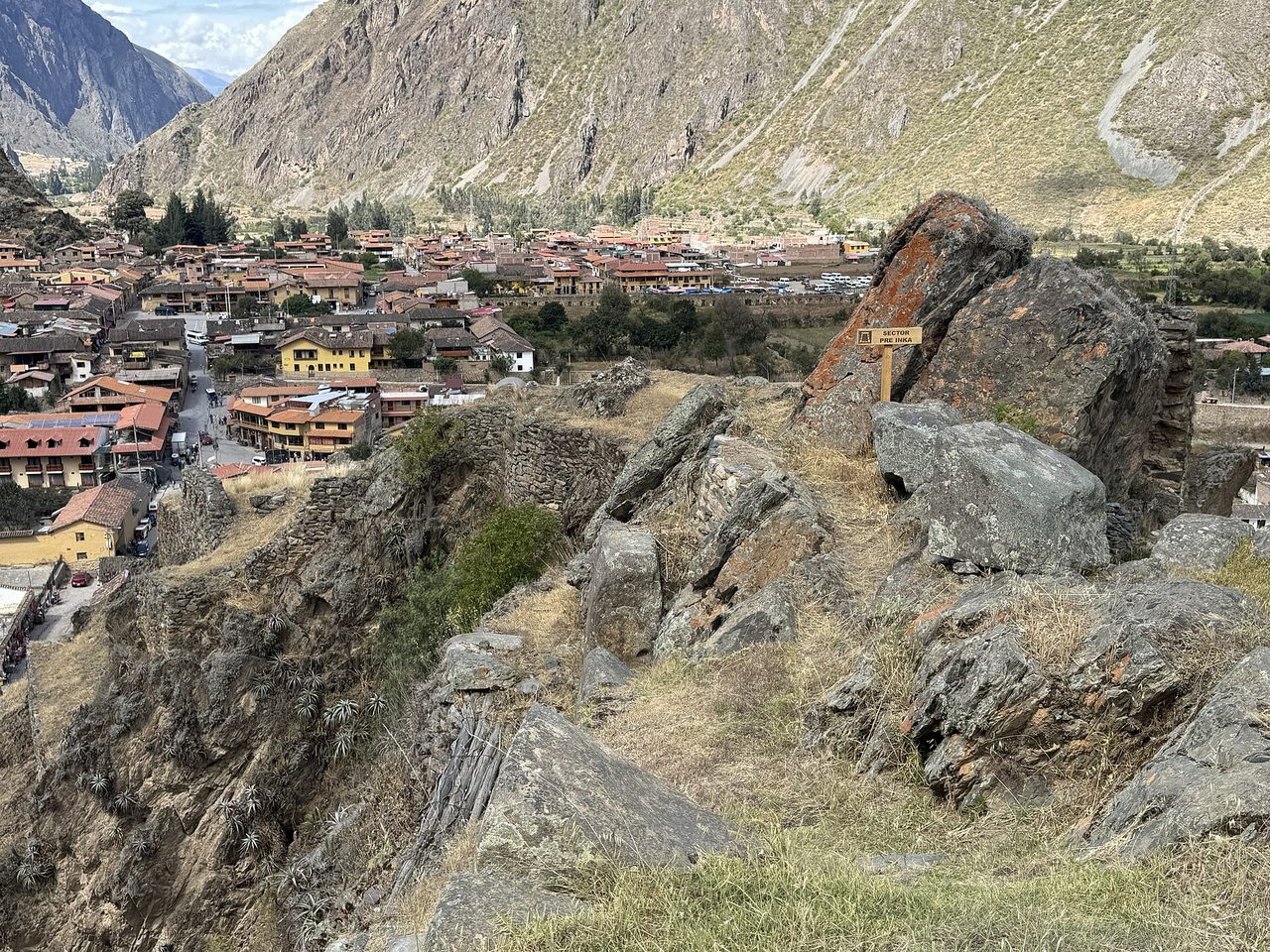
The average visit to Ollantaytambo lasts about ninety minutes. A coach pulls into the car park below the terraces, a guide walks forty people up the stone stairs, everyone photographs the same view down over the rooftops, and by the time the group reboards nobody has crossed the river, looked up at the opposite hillside, or walked five minutes into the old town. That is a shame, because the terraces are the least interesting thing here.
What you are actually standing in is two separate sites stacked on top of each other. One is a temple complex that was never finished. The other is a town that has been continuously lived in since the fifteenth century, with the original Inca street grid, the original doorways, and water still running down the same channels. Most guides tell you about neither. They tell you it is a fortress, which is the one thing it was not built to be.
What Ollantaytambo actually is (and why “fortress” is wrong)
Pachacuti, the ninth Inca and the ruler behind the citadel at Machu Picchu, took this stretch of the valley in the mid-fifteenth century and made it a royal estate. He razed what was there, laid out a new town on a grid, and began building a ceremonial complex on the shoulder of the mountain above it. The terraces you climb are agricultural and structural, not defensive. The thing at the top is a temple.
The “fortress” label comes from one week in January 1537, when the site was used defensively and used well. That is a single incident in a building’s life, and it has ended up as the headline on every tour brochure. Compare it with the walls above Cusco at Sacsayhuamán, which has exactly the same problem: an enormous ceremonial site that gets described as a citadel because of what happened during the rebellion rather than what it was for.
Here is the framing that makes the visit worth a full day rather than an hour and a half:
- The lower town is the best-preserved living Inca settlement anywhere. Not a reconstruction, not a museum. People do their laundry in it.
- The upper site is an unfinished temple — a construction project caught mid-sentence, with the stones still lying where they were abandoned on the slope.
- Pinkuylluna, the hillside opposite, is free, ticketless, and gives you a better view of both than the ticketed site does.
The living town: canchas, water channels and Qosqo Ayllu
Walk north from the Plaza de Armas and within two blocks the street narrows, the paving changes, and a channel of clear water starts running along the gutter beside you. This is Qosqo Ayllu, the old quarter, and the layout underfoot is Inca. Rectangular blocks. Each block a cancha — a walled compound with a single trapezoidal doorway onto the street and several buildings around an interior courtyard. Push the framing aside in your head and you can read the plan: one door, one yard, four families.
The doorways are the tell. They are trapezoidal, wider at the base than the lintel, and about half of them still have people living behind them. Some have a modern wooden door hung inside a six-hundred-year-old stone frame. Some have a dog asleep across the threshold. It is an odd thing to stand in front of, and it is completely free.
The water channels are the other thing worth slowing down for. The Inca hydraulic system that fed this town is still in service. Water comes off the Patacancha, runs through carved stone channels along the street edges, and disappears under buildings. In the ceremonial fountain area inside the archaeological site you can see the same engineering doing decorative work — two spouts carved to split one flow into two identical falls, still splitting it identically six centuries later.
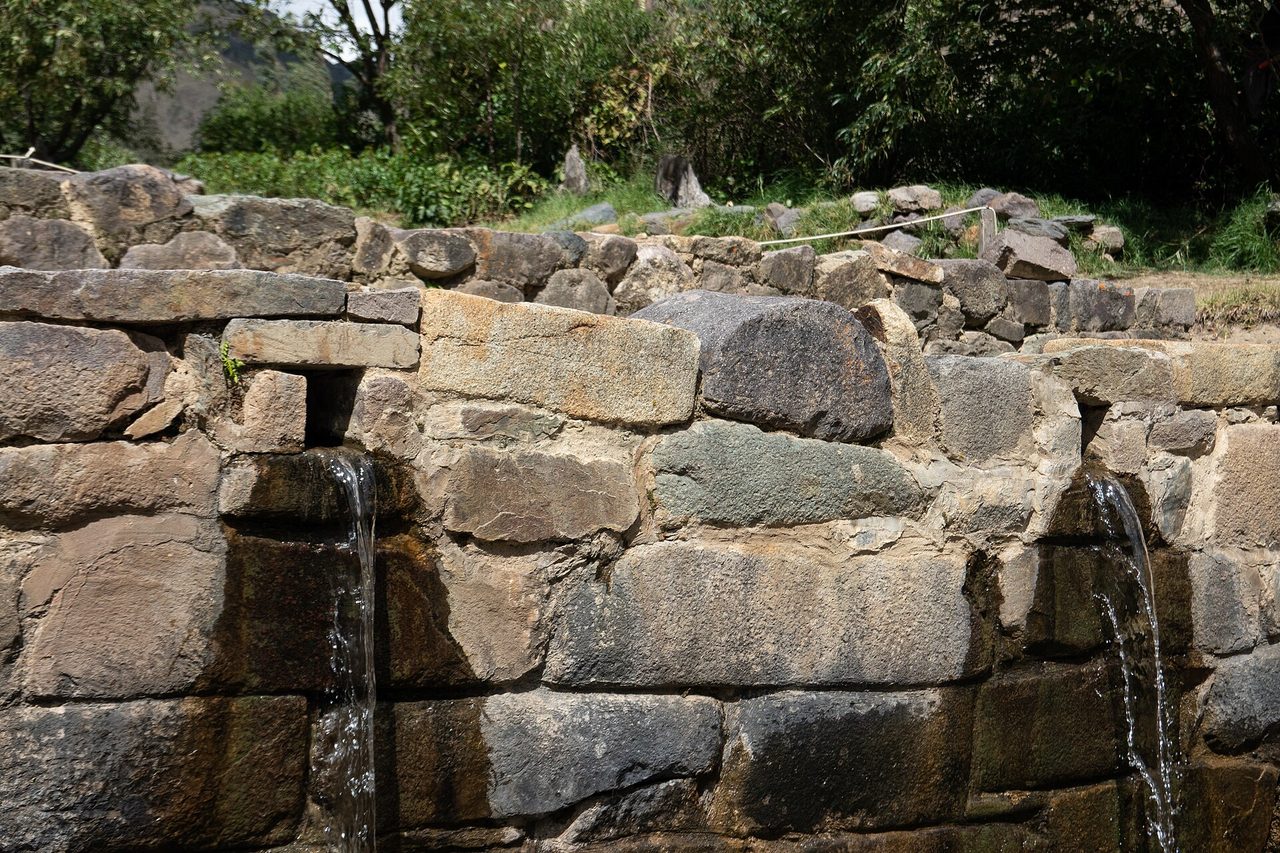
You will read in a lot of places that this is “the oldest continuously inhabited town in the Americas.” Treat that as marketing. Several settlements in Peru, Mexico and the southwestern United States have equal or better claims, and the phrase depends entirely on what you count as continuous. What is not in dispute is that the street plan is original and still functioning as a street plan, which is rarer and more interesting than the superlative.
Give the town an hour. Go up Calle Chaupi, Calle Lares and Calle Medio, look into the courtyards where the gates are open, and do it either before 9am or after 4pm, when the day-trip traffic is not standing in it.
The Temple of the Sun and the six stones that never got finished
Climb the seventeen terraces — it takes fifteen to twenty-five minutes at altitude, longer if you have just flown in — and at the top, past the Wall of Ten Niches and the Sun Gate, you reach six enormous upright slabs standing shoulder to shoulder. The largest is roughly four metres tall and two metres wide. Between each pair there is a thin vertical spacer stone, dressed to a fit you cannot get a card into. On the surface of the second slab there is a relief of the stepped Andean cross.
Then look at what is around it. Nothing. There is no building. Six stones, a fragment of wall, and open ground where the rest of the temple should be.
Almost every guide will describe this wall as the Temple of the Sun and move on. It is more accurate, and much more interesting, to say that this is the surviving western wall of a temple that was under construction when work stopped and never resumed. The dressed blocks scattered across the ground nearby are not rubble. They are components that had been delivered and were waiting to be placed.
Kachiqhata: where the stone came from, and the ones that never arrived
The stone is not granite, whatever the sign says. It is rhyolite — a rose-pink volcanic rock — and it does not occur on this side of the valley. It was quarried at Kachiqhata, a set of workings in a ravine on the opposite slope, roughly four kilometres away and several hundred metres higher, on the far side of the Urubamba river.
That means every one of those slabs was cut out of a mountainside, brought down a prepared slide, dragged across a river, hauled over the valley floor, and then pulled up a long earth-and-stone ramp to the temple platform. No wheels, no draft animals capable of the job. Just ropes, rollers, levers and an enormous number of people.
The extraordinary part is what you can still see from the terraces if somebody tells you where to look. Scattered on the slope below and beside the ramp are large dressed blocks lying at odd angles, exactly where they were left. Local Quechua speakers call them piedras cansadas — tired stones, too tired to go any further. Stand at the Temple of the Sun, face down-valley and slightly left, and you can pick out several of them on the open ground. Once you know they are there you cannot stop seeing them, and the site stops being a picturesque ruin and becomes a building site that was evacuated.
You can walk to the Kachiqhata quarries themselves. It is a half-day round trip from town, roughly four to five hours with a solid climb, unticketed, and almost nobody does it. Take water, take a hat, and do not start it in the afternoon. If you like this kind of thing, it belongs on the same shortlist as the other major Inca sites scattered across the country that get no coach traffic at all.
The rest of the site, and what may be roped off
Beyond the temple the path runs through the upper enclosures, along a cliff-edge walkway with a watchtower built into the rock, and then back down between two sets of terraces to the water temple and the Baño de la Ñusta at the bottom. Budget two hours if you are walking the full circuit and stopping to look.
One warning that most guides do not include: sections of this site close without notice. The trail across to the upper storehouses has been roped off repeatedly in recent years, and the side path up to Inka Watana has flipped between open and closed more than once. If a route is closed the staff will not always tell you until you are standing at the rope. Do not plan your visit around one specific corner of the site.
Pinkuylluna: free, ticketless, and the single most-missed thing in town
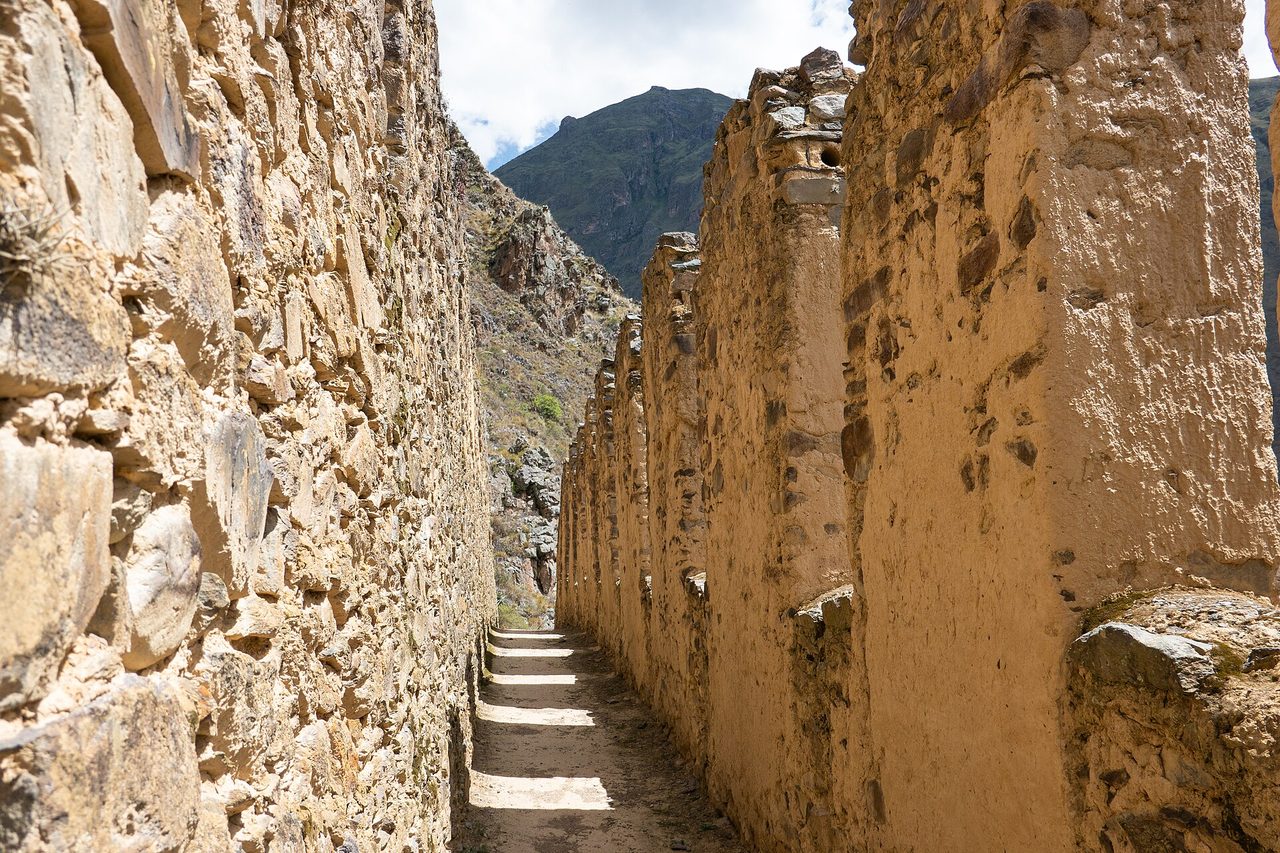
Stand in the Plaza de Armas and turn your back on the terraces. The steep hillside behind you has buildings on it — tall, narrow, gable-ended structures clinging to a slope that looks unclimbable. Those are qollqas, Inca storehouses, and the site is called Pinkuylluna.
It costs nothing. There is no gate, no ticket, no boleto stamp. The view from up there is better than the view from inside the paid site, because from Pinkuylluna you are looking at the terraces, the temple and the whole town laid out below you, which is the photograph everyone actually wants.
The practical detail nobody gives you:
- Where the path starts. Off Calle Lares, on the uphill side of the old town, between the first and second cross-streets. There is a small sign and a gap between two walls. If you are looking for a grand entrance you will walk past it. Ask anyone; “Pinkuylluna” and a hand gesture is enough.
- How long. Thirty to forty-five minutes up to the main group of storehouses for most people, and it can take nearly as long coming down because the steps are irregular. Allow ninety minutes to two hours in total if you want to sit at the top, which you should.
- Hours. Roughly 7am to 4.30pm. It is not staffed the way a ticketed site is, so do not count on being let up late in the day, and absolutely do not be on it at dusk.
- How steep. Only about 110–160 metres of gain, which sounds trivial and is not. The average gradient is around 25 per cent and the first section is the worst of it. There are wooden handrails in places. Some of them wobble.
Who should not do this. If you have a genuine problem with exposure, skip it. There are stretches where the path is narrow with a long drop on one side and the handrail is decorative rather than structural. If it has rained in the last few hours the stone is slick and the answer is no. If you arrived in the valley yesterday from sea level and you are still short of breath walking to breakfast, do the town first and come back tomorrow. And if you keep going past the main cluster of storehouses, be aware that the path degrades sharply and the railings stop.
Trainers with worn soles are not enough. This is the one thing in Ollantaytambo where the free-and-unregulated part matters: nobody is checking whether you should be up there. It also happens to be one of the best entries on any list of things worth doing in Peru that cost nothing at all.
January 1537: the battle everyone half-remembers
Manco Inca had been installed by the Spanish as a puppet, rebelled in 1536, besieged Cusco, and then fell back down the valley to Ollantaytambo. In January 1537 Hernando Pizarro came after him with around seventy horsemen, a few dozen Spanish foot soldiers and several thousand indigenous auxiliaries.
He was beaten. Manco’s forces held the high terraces and fired down on the approach, but the decisive move was on the flat: they diverted the Patacancha through prepared channels and flooded the plain in front of the site. Water reached the horses’ girths. Spanish cavalry, the thing that had won them every previous engagement, could not manoeuvre or charge. The Spanish withdrew after dark and rode back to Cusco.
Two things to keep straight, because competitors routinely garble both. The date is January 1537, not 1536 — 1536 is when the rebellion started. And this was a battle won, not a war won. Pizarro returned with a much larger force within months, Manco abandoned the site and withdrew north into the Vilcabamba, and in 1540 the Spanish Crown handed Ollantaytambo to Hernando Pizarro as an encomienda. What makes it worth knowing is simply how short the list of Spanish defeats is. There is more of this story in the broader history of the Inca sites and how they were abandoned.
Tickets: you need the Boleto Turístico, and there is no way around it
There is no single-site ticket for Ollantaytambo. You cannot pay twenty soles at the gate. Your only options are the full Boleto Turístico del Cusco or the partial circuit that includes it, and both of them cost more than a single visit is worth on its own, which is why it matters that you plan the rest of the circuit around it.
| Ticket | Price (foreign adult) | Valid | Covers |
|---|---|---|---|
| Boleto Turístico General (full) | S/130 | 10 days | 16 sites across Cusco and the valley |
| Circuit III (partial) | S/70 | 2 days | Pisac, Ollantaytambo, Chinchero, Moray |
| Circuit I (partial) | S/70 | 1 day | Sacsayhuamán and the ruins above Cusco |
| Full boleto, student 18–25 | S/70 | 10 days | Same 16 sites |
| Pinkuylluna | Free | — | No ticket required |
Figures verified September 2026. COSITUC administers the boleto and prices do move, so confirm at the ticket office before you build a budget around them.
Three things follow from that table. First, two partial circuits cost more than the full ticket, so if you are going to see Ollantaytambo and anything above Cusco, buy the full boleto. Second, if the valley is genuinely all you are doing, Circuit III at S/70 across two days is the efficient choice, but two days is tight for four sites — it is one of the reasons a bundled single-day tour of the valley’s main sites feels so rushed. Third, note the student column carefully.
On students: COSITUC still accepts an ISIC card for the 18–25 rate on the boleto. This is worth stating precisely, because the rule at the Machu Picchu ticket gate is now different — there they require a university photo ID with an expiry date, and ISIC is no longer accepted. Do not assume one rule applies to the other. And for the avoidance of doubt, Machu Picchu entry is not on the boleto at any tier; it is a separate ticket, currently S/163 for a foreign adult on a standard circuit and S/211 for circuits including Huayna Picchu or Machu Picchu Mountain, following the conservation surcharge that took effect on 1 May 2026.
One published error worth flagging, because it appears on more than one page-one result: several guides state the ticket is “S/130, or S/70 for students.” That conflates the student rate on the full boleto with the adult price of a partial circuit. They happen to be the same number and they are not the same product.
Timing your visit around the coach convoy
Ollantaytambo has a rhythm and it is extremely predictable, because the coaches all run the same loop out of Cusco. Most Sacred Valley day tours do Pisac in the morning, stop for a buffet lunch in Urubamba, and reach Ollantaytambo in the early afternoon. A second wave arrives around mid-morning from the reverse-order tours.
| Time | What the site is like |
|---|---|
| 7.00–8.30am | Near-empty. Sun has not cleared the ridge yet, so the temple is in shade until roughly 8am. Best hour of the day. |
| 8.30–10.00am | Filling. First coaches. Still comfortable. |
| 10.00am–2.00pm | Peak. Queues at the stair pinch points, forty-person groups stopped on the terraces, no clean photograph of the Sun Gate. |
| 2.00–3.30pm | Second peak as the afternoon loop arrives. Also the hottest and harshest light. |
| After 3.30pm | Emptying fast. Warm light on the terraces. You need to be through the gate before it closes. |
The gate opens at 7am and closes around 5pm, though last admission is earlier than closing and the staff enforce it. Unlike some sites around Cusco, you cannot slip in before opening — the entrance here is gated and guarded.
If you are staying the night in town, the honest best plan is to do Pinkuylluna in the late afternoon of your arrival day, when the coaches have gone and the light is coming across the valley, and be at the archaeological site gate at 7am the following morning. That sequence costs you nothing extra and transforms the visit. It also explains why the seasonal timing that works best for Cusco matters less here than the time of day does.
The railhead: why this town is on your itinerary whether you planned it or not
Most trains to Machu Picchu do not leave from Cusco. They leave from here. Cusco’s own station at Poroy has spent long stretches out of service, and the practical departure point for the overwhelming majority of visitors is Ollantaytambo, roughly ninety minutes by road from Cusco.
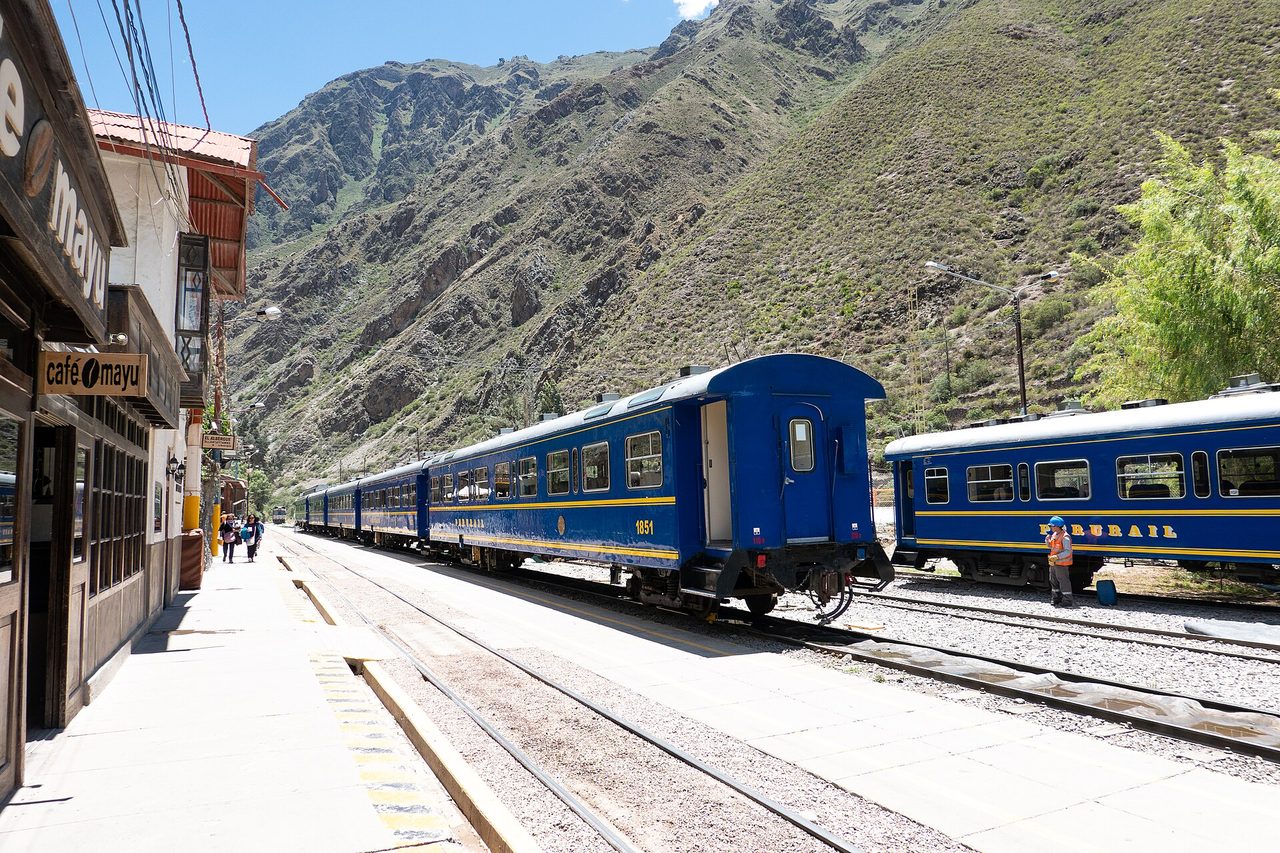
That single fact drives a lot of decisions on a Peru itinerary, and it is the strongest argument for sleeping here rather than treating the town as a photo stop. Details worth having:
- Journey time. Ollantaytambo to Aguas Calientes is about one hour forty minutes. Both PeruRail and Inca Rail run the route.
- Fares. Standard tourist class runs roughly US$35–95 per leg depending on departure time and season, with early-morning and late-afternoon slots priced highest. Panoramic and luxury services cost considerably more. Book ahead in the dry season; the popular departures sell out weeks in advance. Full breakdown in our guide to train options and classes on the Machu Picchu line.
- How early to arrive. Boarding opens thirty minutes before departure and you want to be on the platform by then. In peak season, or if you are collecting tickets rather than showing a phone, give yourself forty-five minutes. The station is small but the queues are not.
- The walk. From the Plaza de Armas to the station is about twenty minutes, mostly gentle downhill on the way there and a real climb on the way back. With luggage, take a mototaxi for a few soles. Do not attempt the walk uphill with a suitcase at altitude.
- Luggage. PeruRail operates left luggage at Ollantaytambo, free for ticketed passengers, open across a long window from the early hours until late evening. Inca Rail offers storage too. Trains cap you at one piece of hand luggage of about 8 kg with total dimensions around 115 linear cm, so leaving the big bag here is the norm, not the exception.
Overnight here versus a 4am start from Cusco
The standard budget move is to sleep in Cusco, take a 4am transfer, and board a mid-morning train. It works. It is also a miserable way to spend the front half of the day you are visiting Machu Picchu, and it puts you on a mountain road in the dark.
Staying in Ollantaytambo the night before means a lie-in, a fifteen-minute walk to the platform, and 500–600 metres less altitude while you sleep, which is not nothing if you are still adjusting. Rooms here are generally cheaper than equivalent rooms in the main Cusco neighbourhoods. The trade-off is that you give up an evening of restaurants and a city’s worth of options; Ollantaytambo goes quiet by about nine.
My view: if you are catching a train before about 8am, stay here. Later than that and Cusco is fine. Either way, read the sequencing advice in our guide to getting from Cusco to Machu Picchu before you book anything, because the order you do these in changes the price.
One dated caveat. On 30 December 2025 two trains collided on the line between Ollantaytambo and Aguas Calientes near Corihuayrachina, killing one crew member and injuring around forty people. Services were suspended briefly and Peru announced a rail safety overhaul in the aftermath. The route has been running normally since, but if you are reading this well after publication, check the operators’ own service notices rather than assuming.
Altitude: 2,790 m, and what that means next to Cusco
Ollantaytambo sits at about 2,792 metres. Cusco is around 3,400 m. That difference of roughly 600 metres is genuinely useful, and it is the reason a lot of experienced travellers now fly into Cusco, transfer straight down to the valley, and only come back up to the city at the end of the trip.
| Place | Elevation |
|---|---|
| Cusco | 3,400 m |
| Chinchero | ~3,760 m |
| Moray | ~3,500 m |
| Ollantaytambo | ~2,790 m |
| Machu Picchu | 2,430 m |
Look carefully at that table before you accept the standard advice. “Go to the Sacred Valley to acclimatise” is true of the valley floor and false of a valley day tour, because two of the four stops on the classic circuit are higher than Cusco. Sleeping in Ollantaytambo helps. Spending a day being driven up to Chinchero does not. Our fuller explanation of how the altitude around Cusco actually affects visitors covers the symptoms and the timelines.
Even at 2,790 m you will notice the terrace climb. Take it in stages, drink more water than feels necessary, and do not do Pinkuylluna and the archaeological site on the same morning as your arrival flight.
Getting here from Cusco
Sixty to seventy-two kilometres depending on the route, and about ninety minutes of driving. Anyone quoting two hours is being pessimistic or is routing you through a shopping stop.
| Option | Cost | Notes |
|---|---|---|
| Colectivo (shared van) | ~S/10–15 | From Calle Pavitos in Cusco. Leaves when full. Limited luggage room. Cheapest by a distance. |
| Private taxi | ~S/100–200 | Agree the fare before getting in. Sensible split between three or four people. |
| Hotel or agency transfer | US$25–60 | Fixed pickup time, useful if you have a train to catch. |
| Sacred Valley group tour | US$25–60 | Efficient but rushed; you get roughly an hour here, at the worst time of day. |
Colectivos also run between Ollantaytambo and Urubamba constantly for a couple of soles, which makes it easy to base yourself here and move around the valley. If you are working out how to string the whole country together, our guide to buses, flights and shared transport across Peru covers the longer legs.
What is overrated here, and who should skip it
Honesty section, because everything above is enthusiastic and that is not the whole picture.
The artisan market at the site entrance is not worth your time. It is the same alpaca-blend jumpers and mass-produced textiles you will find at every stop on the circuit, at prices set for people getting off coaches. If you want textiles, buy them from a weaving cooperative where you can see the work happening.
Hiring a guide at the gate is a coin flip. Quality varies enormously and several will tell you the site is a fortress, that the stones were cut with lasers, or some variant of the ancient-astronauts story. A good one is genuinely worth S/50–80 for a group. Ask what they will show you beyond the terraces before you agree, and if they cannot tell you where Kachiqhata is, walk away.
The terraces themselves are the most photographed and least remarkable part. They are big and they are impressive in a general way, but the terracing at other valley sites is comparable. The monoliths, the tired stones and the town are what make this place singular.
Who should skip Ollantaytambo entirely. If you have four days in Peru and Machu Picchu is the point, you will pass through here anyway and ninety minutes is a reasonable allocation — do not force a second day. If you have serious mobility limitations, be aware that the archaeological site is steep stone stairs almost throughout; there is a short lower circuit but it misses the temple. If you are travelling with small children, the town is delightful and the climb is not. And if you have already done the classic Inca Trail or another multi-day route, you may find yourself walking around here thinking that you have seen better stonework with fewer people around it. That is a fair reaction.
How long to stay
Ninety minutes gets you the terraces and the temple. Half a day gets you the site properly plus the old town. A full day plus a night gets you Pinkuylluna at golden hour, the site at 7am, and the walk out towards the quarries if you want it. Two nights is enough to use the town as a base for the rest of the valley without ever getting back in a tour van.
For most people planning a first trip, one night is the sweet spot, and it slots neatly into any of the standard route plans for a first trip through Peru. If you are already committed to a tight schedule, at least shift your visit out of the 10am–2pm window.
Practical notes
- Cash. There are ATMs on and near the Plaza de Armas but they run dry and charge well. Bring soles from Cusco. The boleto office does not reliably take cards.
- Passport. Carry it. You may be asked for it when buying the boleto and occasionally at the gate.
- Weather. The valley floor is warmer than Cusco and the sun is fierce. In the November-to-March wet months afternoon rain is normal and the stone steps get slippery; in the dry season nights are cold and days are dry and bright.
- Food. There are decent places around the plaza and along Calle Ventiderio, and the standard is generally better than the tourist-menu average, but this is not a dining destination. Eat well in the Cusco restaurant scene instead.
- Toilets. Inside the archaeological site, immediately left after the entrance gate. There are none on Pinkuylluna.
- Wi-Fi. Patchy. Download your train ticket and any offline maps before you arrive.
Frequently asked questions about Ollantaytambo
Is Ollantaytambo worth visiting?
Yes, but not for the reason most people go. As a ninety-minute stop on a coach circuit it is fine and slightly underwhelming. As a place to sleep for a night, walk the Inca streets, climb Pinkuylluna for free and be at the temple gate at 7am, it is one of the best value stops in the whole Cusco region.
Do I need the Boleto Turístico for the Ollantaytambo ruins?
Yes. There is no single-site ticket. You need either the full boleto at S/130 (10 days, 16 sites) or the Circuit III partial at S/70 (2 days, covering Pisac, Ollantaytambo, Chinchero and Moray). Pinkuylluna, on the opposite hillside, needs no ticket at all.
Is Pinkuylluna really free?
It is. No gate, no fee, no boleto stamp. It is open roughly 7am to 4.30pm and the view over the town and the main site is better than anything you get from inside the paid area.
How hard is the Pinkuylluna climb?
Steep rather than long. Thirty to forty-five minutes up, around 110–160 metres of gain, average gradient near 25 per cent, irregular stone steps and some unreliable handrails. Fine for most reasonably fit people in proper footwear. Not advisable if you have a real fear of heights, if it is wet, or if you arrived at altitude yesterday.
Is Ollantaytambo a fortress?
Not by design. It was a royal estate and ceremonial complex built under Pachacuti, with agricultural terracing and an unfinished sun temple. It was used defensively once, in January 1537, and the label stuck.
Who won the Battle of Ollantaytambo?
Manco Inca. He flooded the plain by diverting the Patacancha river, neutralised Hernando Pizarro’s cavalry and forced a night-time Spanish retreat to Cusco. It was one of very few Inca victories over the Spanish. Pizarro returned in force soon afterwards and Manco withdrew to Vilcabamba.
Where were the Ollantaytambo stones quarried?
At Kachiqhata, in a ravine on the opposite side of the Urubamba river, about four kilometres away and several hundred metres higher. The rock is rhyolite, not granite. Blocks abandoned in transit are still visible on the slope and are known locally as the tired stones.
Do Machu Picchu trains leave from Ollantaytambo or Cusco?
Overwhelmingly from Ollantaytambo. Cusco’s Poroy station has been out of service for long stretches, so nearly all visitors transfer by road to Ollantaytambo first. Our overview of the routes into Machu Picchu sets out the alternatives.
How early should I get to Ollantaytambo train station?
Thirty minutes before departure at minimum, since that is when boarding opens; forty-five in peak season. Allow twenty minutes to walk down from the plaza, or take a mototaxi if you have luggage.
Can I leave my luggage at the station?
Yes. PeruRail runs a left-luggage service at Ollantaytambo, free for ticketed passengers and open across a long daily window, and Inca Rail has storage as well. Given the 8 kg hand-luggage limit on the trains, most people leave a bag here and take a daypack to the town below Machu Picchu.
Is Ollantaytambo higher or lower than Cusco?
Lower, by roughly 600 metres. Ollantaytambo is about 2,790 m against Cusco’s 3,400 m, which makes it a better place to sleep in your first days. Note that Chinchero and Moray, both on the standard valley tour, are higher than Cusco.
What time do the tour buses arrive?
The heaviest traffic is 10am to 2pm, with a second surge until about 3.30pm. Before 8.30am and after 3.30pm the site is a different experience.
How many days do I need in Ollantaytambo?
One night covers it properly. Two nights if you want it as a base for the rest of the valley. Day-trippers get about ninety minutes and see roughly a third of what is here.
Is Ollantaytambo better than the other Sacred Valley sites?
It is the one with a living town attached, which none of the others have. For pure archaeology it is arguably the strongest site in the Sacred Valley outside Machu Picchu itself. If you only have time for one valley stop and you care about Inca engineering, make it this one; if you care about markets and colour, you may prefer elsewhere.
Can I visit without a tour?
Easily. A colectivo from Calle Pavitos in Cusco costs around S/10, the site is a five-minute walk from the plaza, and everything is signposted. Independent is cheaper, slower and better here than almost anywhere else on the day-trip circuit out of Cusco.
The short version
Do not treat this as a stop. Sleep here one night, climb the free hillside in the afternoon, be at the gate when it opens, and spend ten minutes at the Temple of the Sun looking down the valley for the stones that never made it. That last detail is the one nobody tells you about, and it is the one you will remember.