The Short Inca Trail (2-Day) Guide
The Km 104 hike is the only short route that walks the real Inca Trail and arrives at Machu Picchu through the Sun Gate. Here is what the 2-day, 1-day and “Express” versions actually get you.
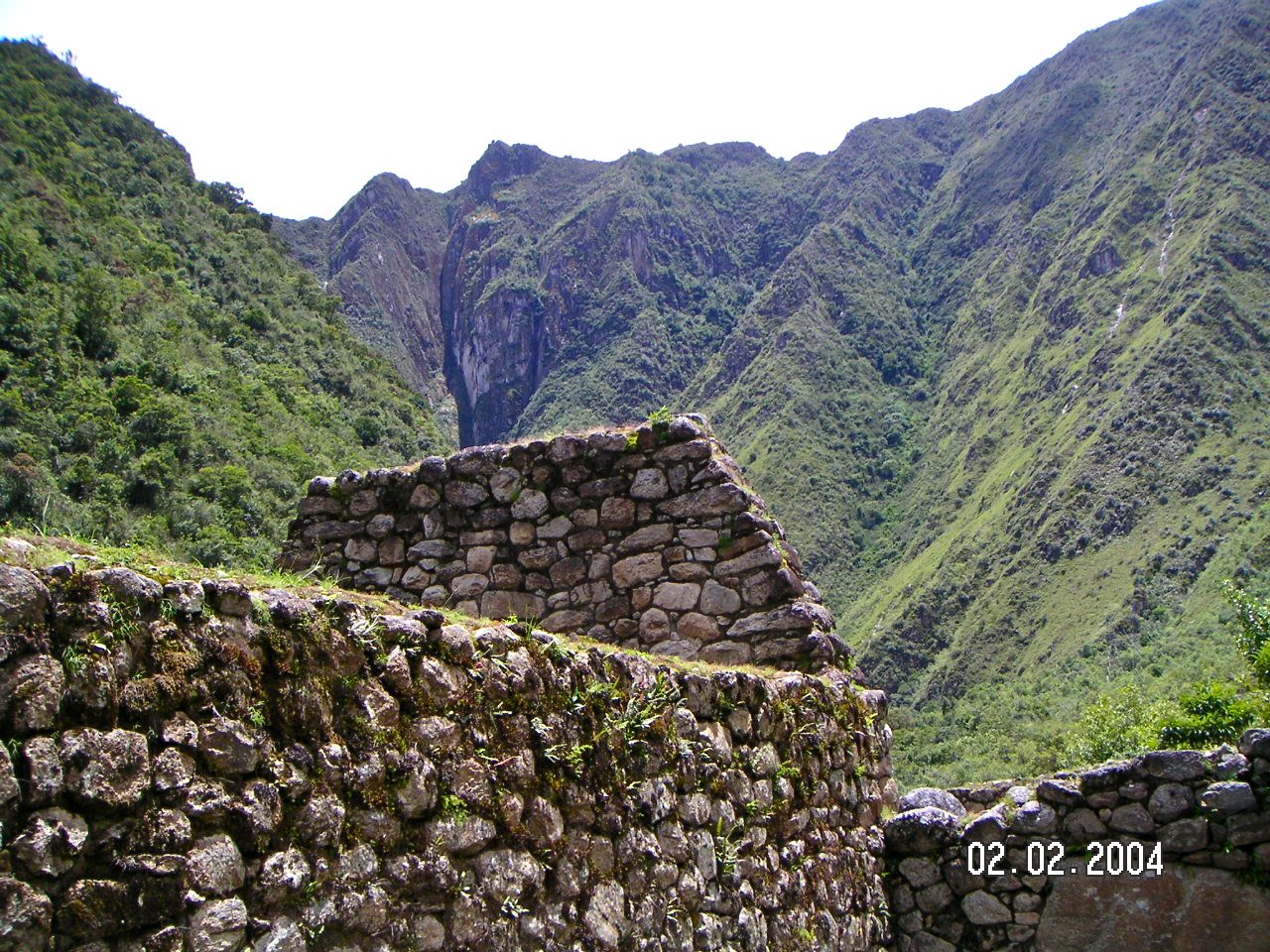
Here is the fact that should decide this for you, and almost nobody leads with it: the short Inca Trail is the only quick way to arrive at Machu Picchu on foot, through Inti Punku, the Sun Gate. Not the Salkantay route, which drops you at Hidroeléctrica and walks the railway line into town. Not Lares, which finishes with a bus. Not the train, obviously. If you want to come over the ridge and see the citadel appear below you the way the Inca road was built to deliver you, there are exactly two ways to do it, and one of them takes four days.
That is the whole case for this hike. Everything else about it — the cost, the naming confusion, the fact that the permits are easier to get — is secondary. I want to be honest about all of it, because the marketing around this trek is some of the sloppiest in Peru.
What the short Inca Trail actually is, and why it has four different names
You will see this sold as the “Short Inca Trail”, the “2-Day Inca Trail”, the “1-Day Inca Trail” and the “Inca Trail Express”. Occasionally “Royal Inca Trail” or “Km 104”. Travellers reasonably assume these are four different products. They are not. Underneath all of them is one walk: you get off the train at kilometre 104 of the Cusco–Aguas Calientes line, cross the Urubamba on a footbridge, and climb the last section of the Inca Trail to the Sun Gate. Roughly 10 to 12 km, depending on whose measuring wheel you believe, with around 700 m of net ascent. One day. Every version of this trek walks the same trail.
What changes is what happens after you come down off the ridge.
| Name you’ll see | Hiking | What actually differs | Typical 2026 price |
|---|---|---|---|
| Short Inca Trail / 2-Day Inca Trail | One day, Km 104 to the Sun Gate | Night in a hotel in Aguas Calientes, then a proper guided citadel visit on a timed ticket the next morning | $450–$700 |
| 1-Day Inca Trail / Inca Trail Express | Same day, same trail, faster pace | You descend from the Sun Gate and go straight into the citadel the same afternoon, then take the evening train out | $400–$550 |
| Royal Inca Trail | Same | Usually just a marketing label, sometimes a smaller group or an upgraded train | Varies wildly |
| 2-Day with camping | Same | A handful of operators camp near Wiñay Wayna instead of using a hotel; availability is inconsistent, so confirm before you pay | $550–$750 |
So the honest description of the “two-day” trek is: one day of hiking, one night in a town, and one morning at a ruin. Calling it two days is not a lie, but it does make people picture two days of walking, and I have met travellers on the train who were genuinely surprised to learn otherwise.
Which is the better deal? For most people, the two-day. The extra money buys you an unhurried afternoon on the trail, a shower, a bed, dinner, and then Machu Picchu in the morning when you are not shattered and the light is better. The one-day version compresses everything: you walk faster than you want to, you arrive at the Sun Gate around midday when the light is flat and the cloud has often burned off into haze, and you tour the citadel in the afternoon on tired legs before catching a train that gets you back to Cusco near midnight. It is cheaper by roughly a hundred dollars. I do not think that hundred dollars is worth what it costs you.
There is one situation where the one-day is genuinely better, and Heather Jasper at Horizon Guides makes this point well: if you take the one-day, tour the citadel that afternoon, then pay for your own extra night in Aguas Calientes and a second entry ticket the next morning, you get two separate visits to Machu Picchu and the option of adding a summit hike, which only runs in the morning slots. That is a niche play, but it is a real one for people who want maximum time inside the site.
Permits: why the short Inca Trail is still available when the classic one sold out last November
This is the part that sends most people to this page, so let me be precise about it.
The classic four-day route from Km 82 runs on a hard cap of 500 people per day, and that 500 includes guides, cooks and porters. In practice that leaves somewhere around 200 trekker places. Those places are released in one enormous batch each year — the 2026 allocation opened on 17 November 2025 — and the peak-season dates are gone within days. Everything about that system is covered in more depth in our breakdown of how Inca Trail permits are released and booked, and it is worth reading before you commit to anything.
Km 104 draws on a separate allocation. The figure quoted almost universally across Cusco operators and by Horizon Guides is 250 permits per day for the Km 104 entry, administered independently of the Km 82 quota. I want to flag one honest caveat: unlike the classic trail, there is no public live availability feed for Km 104, so nobody outside SERNANP and the licensed operators can verify that number against a live system. Treat 250 as the working figure, and treat any operator who tells you availability without checking as someone guessing.
What matters practically is the arithmetic. A separate pool of roughly 250, drawn on by far fewer people, and with almost no porters eating into it, because most Km 104 walkers carry their own daypack for a single day. The result is that the short trail routinely has space in June or July when the classic trail has been sold out since the previous November. That is the single most useful thing about it. If you are reading this in March and your July flights are already booked, this is very likely your only remaining way onto the Inca Trail at all.
Everything else about the permit works exactly like the classic route:
- Nominative and passport-tied. Your name and passport number are printed on it. You cannot sell it, transfer it or lend it to a friend who dropped out.
- Operator-only. There is no way to buy one yourself. You book through a licensed agency with a licensed guide, and not every agency in Cusco holds that licence.
- Bring the actual passport. Not a photo, not a photocopy. It is checked at the Km 104 control post, and if the number does not match you are put back on the next train.
- February is closed. The whole trail network shuts for the month for maintenance, Km 104 included. There is no exception and no workaround.
- No name changes after issue. If you booked as Sarah and your passport says Sara, sort it out before the permit is issued.
Lead time: for peak months I would book four to eight weeks ahead and not rely on it being there. For the shoulder months, two or three weeks is usually workable. That is dramatically less pressure than the classic route, but it is not the same as walking into an agency the day before. As of August 2026 the release date for 2027 Inca Trail permits had not been announced, so if you are planning that far ahead, watch for the announcement rather than assuming it repeats in November.
Day one, hour by hour
The early train, and the stop that is not a station
Most operators collect you in Cusco between 04:00 and 05:00 and drive you to Ollantaytambo for the first departure, which is a nasty start but the correct one. Some sell a Cusco departure from Poroy or San Pedro instead. If you have a choice, sleep in the Sacred Valley the night before. Ollantaytambo is at 2,790 m rather than Cusco’s 3,400 m, it is a lovely place to spend an evening, and it saves you the pre-dawn drive. Our guide to the towns and ruins of the Sacred Valley covers where to base yourself, and if you are coming straight from the airport, understanding how Cusco’s altitude affects arriving travellers should shape your first two days regardless of which trek you pick.
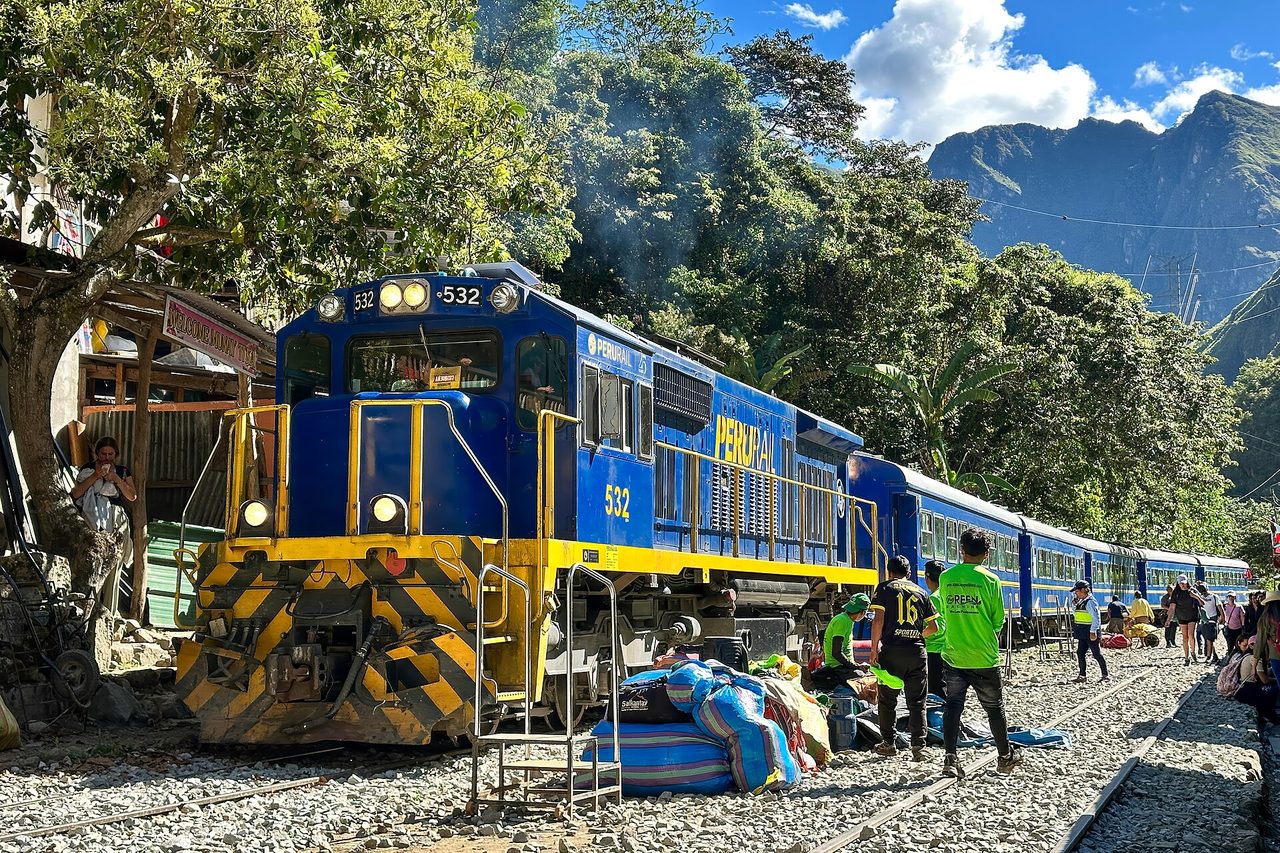
The train ride from Ollantaytambo is about 90 minutes. Km 104 is not a station. There is no platform, no sign worth the name, and no announcement in English. The train simply stops on the ballast and the crew, who know exactly who holds a Km 104 ticket, will come and get you. You step down onto gravel with your daypack. If you have ever wondered why every operator insists their guide travels with you on the train rather than meeting you at the trailhead, this is why. The window for getting off is short and the train does not wait.
The line itself is the only way in. Trains run roughly $35 to $60 per standard-class leg depending on service and season, and they are the single biggest cost inside your tour price. The practical differences between PeruRail and Inca Rail services matter more here than on a normal day trip, because you are buying a one-way ticket to a stop most travellers never use, which limits which trains your operator can put you on.
Chachabamba, the checkpoint, and the climb
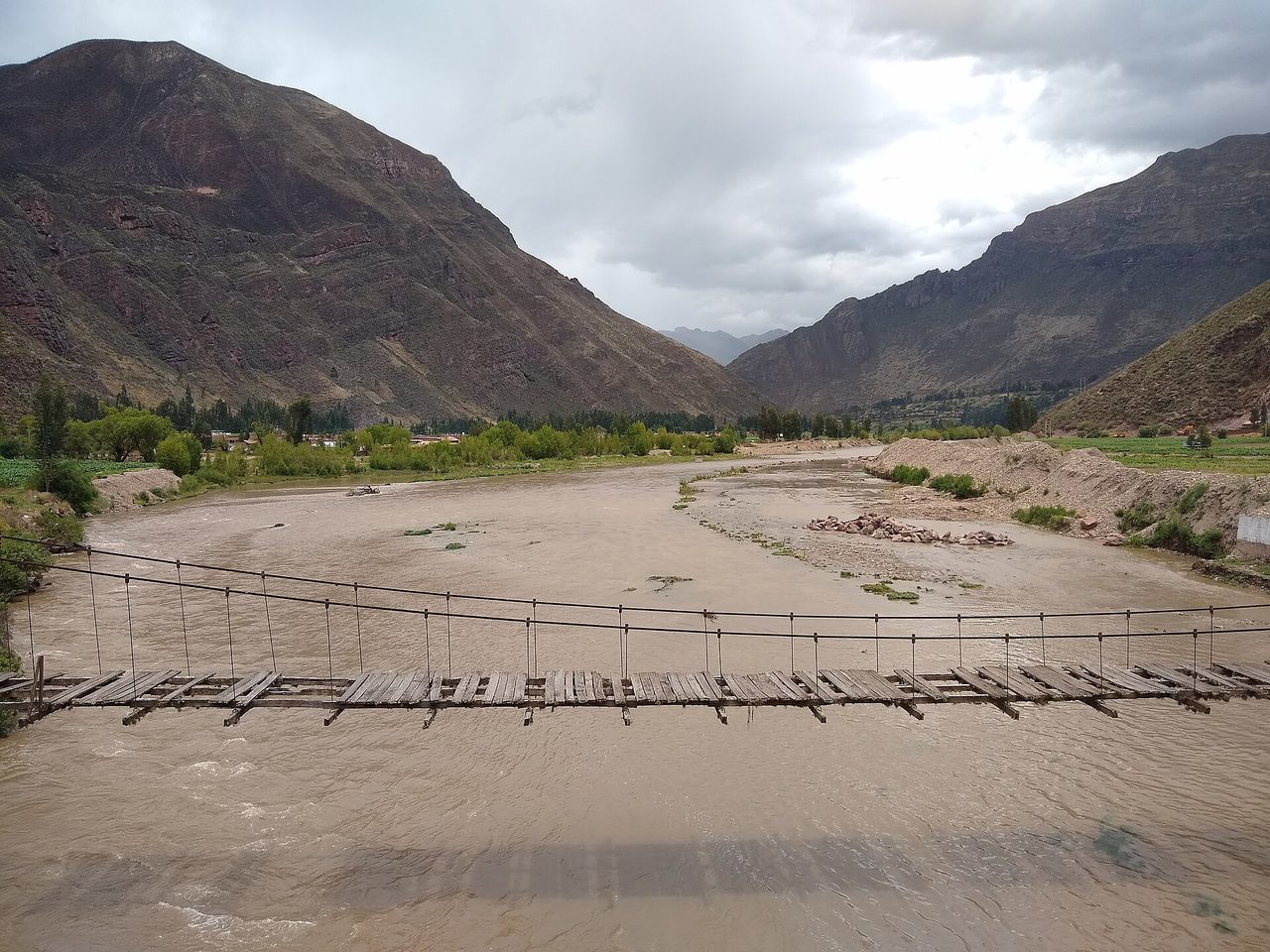
You cross the Urubamba on a footbridge, show your passport and permit at the control post, and you are on the trail. Chachabamba sits a few minutes up, at around 2,050 to 2,250 m depending on which part of the complex you measure. It is a modest site by Peruvian standards — a set of ritual baths, some terracing, a water system fed off the hillside — and the usual reading is that it functioned as a control and agricultural point on the road, gathering produce from the lower valley for the settlements above. Your guide will spend twenty minutes here. It is worth the twenty minutes and not much more, and its real value is as a warm-up before the day turns serious.
Then the trail goes up, and it does not really stop going up for about three hours.
This is the section people underestimate. You are climbing roughly 600 to 700 m on Inca stone stairs through cloud forest, at a lower altitude than the classic trail but in noticeably higher humidity. Cusco is dry. This is not. The steps are irregular, some of them are tall, and after rain they are slick. There is no shade in some stretches and there is no breeze in most of them. I have watched people who run half marathons at home stop and sit down on this climb, not because they were unfit but because they had mentally filed the day under “short walk” and had not eaten or drunk accordingly.
The other thing to understand: once you are past Chachabamba there is no bailout. No road, no side trail, no way to call a car. The only exits are forwards over the ridge or backwards to the railway, and backwards means waiting on the ballast for a train that may not stop for you. Plan on finishing.
Wiñay Wayna, which is the actual reason to do this
Around three to four hours in, the trail rounds a shoulder and Wiñay Wayna opens up. I will say this plainly: it is the best archaeological site on the entire Inca Trail, and it is better than most of what you will see inside Machu Picchu itself. A staircase of terraces poured down a near-vertical canyon wall, a run of ritual fountains stepping down the slope, upper and lower building groups, and a drop below you that goes straight to the river. Because it sits on a wall rather than a saddle, it appears to hang in mid-air in a way even Machu Picchu does not manage.
Almost nobody sees it. It is only reachable on foot from the Inca Trail, which means the Km 82 trekkers and the Km 104 trekkers and nobody else. On a normal day there might be forty people spread across it. You will eat lunch here, usually a proper packed box rather than the sad sandwich you are braced for, and you will have time to walk the terraces.
If you take one thing from this article other than the Sun Gate point, take this: the short Inca Trail is not a compromise version of a ruin tour. It contains the single best ruin on the route. Our wider survey of Inca sites across the country puts Wiñay Wayna near the top for a reason.
The last hour to Inti Punku
After Wiñay Wayna the gradient relents. You get an hour to ninety minutes of rolling trail along the flank of the mountain, one short flight of very steep steps near the end that everyone complains about, and then a stone doorway.
The Sun Gate sits at roughly 2,720 m. Machu Picchu itself is at 2,430 m, laid out below and to your right, with Huayna Picchu behind it. On the two-day itinerary you arrive here in mid-afternoon, which is unfashionable and, in my view, better: the sunrise crowd has long gone, the morning cloud has usually lifted, and the light comes across the site from the side rather than flattening it. You will very likely have the doorway to yourself for a few minutes.
One thing worth knowing about how special this access is: since the site reopened after the 2020 closure, walking up to the Sun Gate from inside the citadel has not been permitted. Day visitors cannot do it. The only people who stand in that doorway are those who walked in from Km 82 or Km 104. That is a rule most competitor pages skip, and it changes the calculation considerably.
The descent, and the thing nobody tells you
Here is the disappointment, and I would rather you hear it now than at 16:00 on the ridge.
On the two-day itinerary you do not visit Machu Picchu when you arrive. You walk down from the Sun Gate, roughly 45 minutes, you take the standard photographs from the upper terraces, and then you keep going, out of the gate, onto a bus, and down to Aguas Calientes. Your citadel visit is tomorrow. Depending on your operator and your ticket, the walk-down may be logged as a transit pass rather than a full circuit entry, so you cannot linger, backtrack, or wander into the temple sector on a whim. Rangers enforce the one-way flow.
People find this genuinely deflating. You have climbed for seven hours and the reward is to walk through the site with a guide saying “tomorrow”. Understand it in advance and it stops being a problem — the tomorrow version is unhurried, on fresh legs, with a real ticket and a real guide. But if you booked imagining that you would arrive at the Sun Gate and then spend the afternoon in the ruins, that is the one-day itinerary you wanted, not the two-day.
Total moving time for the day: six to eight hours for most people, plus stops. Operators advertise six to seven. Add an hour if you photograph everything, and add two if you are a slow descender, because the drop from the Sun Gate is harder on knees than the climb was on lungs.
Day two: the citadel, properly
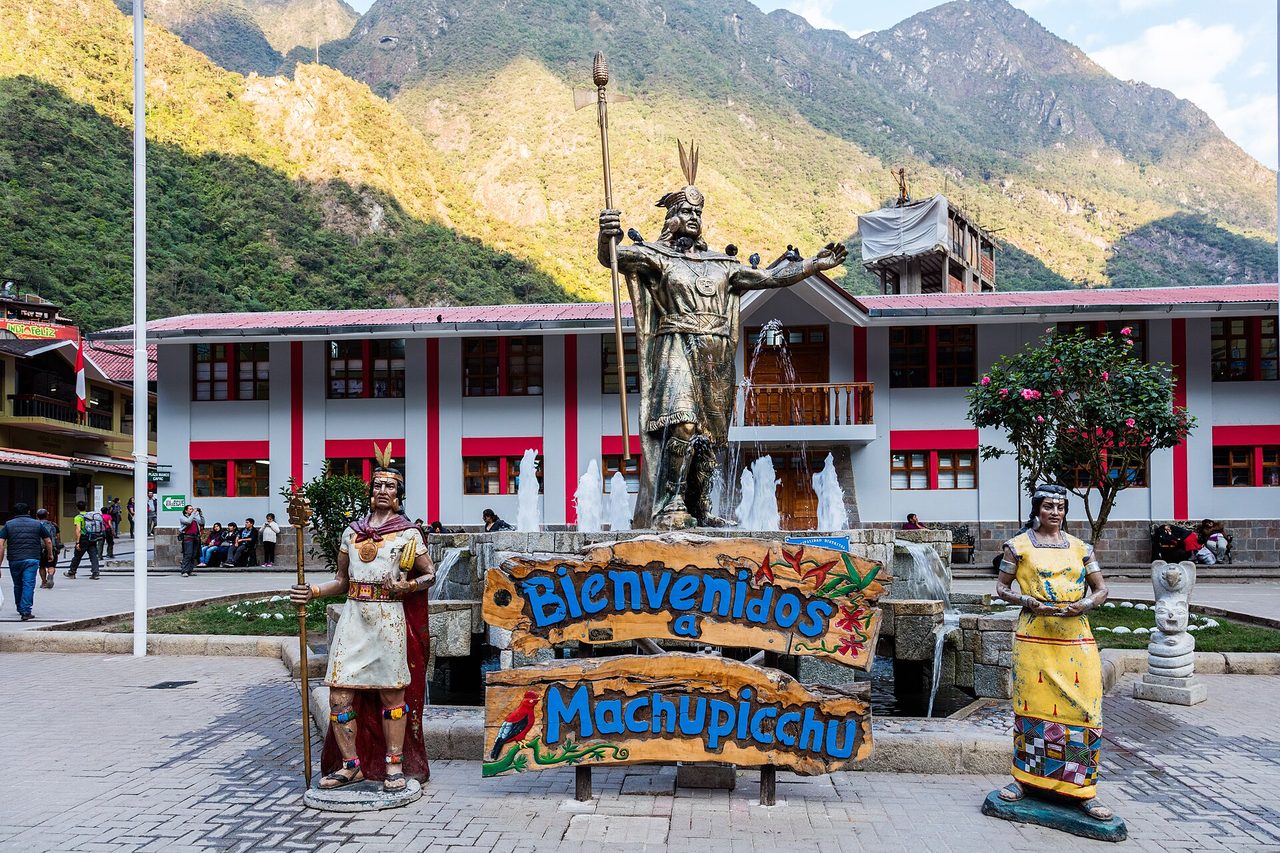
You sleep in Aguas Calientes, the strange, loud, overpriced little town wedged between the river and the cliffs that exists entirely to service Machu Picchu. It is not charming, the restaurants are mostly mediocre, and everything costs about forty percent more than it does in Cusco. It is also exactly where you want to be at 05:30. Our guide to making the most of Aguas Calientes covers the hot springs, which are fine and not more than fine, and where to eat that is not a tout’s cousin’s place.
The morning is buses and timed tickets. The Consettur shuttle up the switchbacks costs around $24 return and the queue starts before the first departure. Then you enter Machu Picchu on a normal timed ticket, which since the current rules came in means an assigned entry hour between 06:00 and 16:00, a 30-minute grace period, a fixed circuit, and two and a half to four hours inside depending on which route you hold. There are three circuits and ten routes, all one-way, and rangers do enforce them. The differences between them are covered in our guide to choosing the right Machu Picchu ticket and circuit, and it is worth knowing which one your operator has bought you before you arrive, because they are not equivalent.
Current entry pricing is S/163 for foreign adults, or S/211 for the circuits that include Huayna Picchu or Machu Picchu Mountain. Those figures replaced the older S/152 and S/200 on 1 May 2026 when a SERNANP conservation surcharge was added on top of the base ticket. If a page quotes you S/152, it is out of date. The surcharge does not apply to Inca Trail entries, which is a small mercy. Daily capacity is 4,500, rising to 5,600 on designated peak dates, and prices move, so check the official portal before you book.
If you want to add a summit hike on day two, decide at the moment of booking, not later. Both peaks have their own small quotas and their own morning-only time slots, and our comparison of Huayna Picchu against Machu Picchu Mountain should tell you whether either is worth the extra climb the day after a seven-hour hike. For many people it is not.
How hard is it, honestly?
Moderate. Which is a useless word, so here is what it means in practice.
What makes it easier than the classic trail: no camping, no consecutive days, no 4,215 m pass. The highest point of the entire route is around 2,720 m, which is below Cusco. If altitude is your worry, this route removes most of it. You sleep in a bed. You carry a daypack, not a duffel. And the day ends with a hot shower rather than a tent at 3,600 m.
What makes it harder than people expect: it is 700 m of climbing on uneven stone in humid air, done in one continuous effort with a fixed finishing time, with no way out once you have started. There is a schedule — you have to reach the Sun Gate before the trail control closes and the last buses run — so you cannot simply take all day. Groups do get moved along.
Who finds it hard, in my experience: people who have not walked a hill in a year and assumed “short” meant “easy”; people with knee problems, who will suffer far more on the descent than the ascent; people who fly into Cusco and start hiking 36 hours later, who feel terrible on day one even though the trail is low; and anyone in trainers with no tread when it has rained. Steep wet Inca stone is genuinely slippery.
Who finds it fine: anyone who does a long hilly walk a few times a year, teenagers, and a surprising number of people in their late sixties and seventies. There is no technical difficulty anywhere on the route. It is just sustained.
What it costs in 2026
Group departures for the two-day version generally run $450 to $700 per person, and the spread is mostly about train class, hotel quality and group size rather than anything on the trail. Private departures start around $800. Anything advertised meaningfully below $450 should make you ask what has been cut, because the fixed costs below do not compress much.
| Component | Typical cost | Notes |
|---|---|---|
| Train, Ollantaytambo to Km 104 | $35–$60 | Standard tourist class; a one-way ticket to a stop with no station |
| Train, Aguas Calientes back to Ollantaytambo | $35–$60 | Panoramic and luxury services cost several times this |
| Inca Trail permit and trail fee (Km 104) | Bundled | Not sold separately; the operator buys it in your name |
| Machu Picchu entry, day two | S/163 (about $44) | S/211 with a summit hike; the day-one walk-down is covered separately |
| Consettur bus, Aguas Calientes to the gate | ~$24 return | Day one is usually one-way down; day two is a return |
| Hotel in Aguas Calientes | $25–$90 | Included in the tour; upgrades are cheap and worth asking about |
| Licensed guide | Bundled | Mandatory. There is no unguided option on any Inca Trail permit |
| Meals | Bundled | Usually box lunch and dinner day one, breakfast day two |
| Cusco transfers | Bundled | Add $15–$25 if you are arranging your own from the Sacred Valley |
| Tips | $20–$40 | Guide, and driver if there is one. No porters on this route |
Add roughly $250 to $300 of unavoidable transport and entry before anyone has been paid to do anything, and you can see why the price does not fall much further. Set against the wider picture in our breakdown of what a Peru trip actually costs, this is one of the larger single-line items most travellers will book.
Compared with the four-day classic: $700 to $900 typically, sometimes more. So the short version saves you roughly $200 to $300 and two full days. If you are still weighing the four-day route against the alternatives, the head-to-head comparison of the Inca Trail and Salkantay sets the trade-off out in full. It is a smaller saving than most people expect, because the trains cost the same either way and the classic trail’s porters and camp are cheaper per day than the short trail’s hotel and train logistics.
Compared with just taking the train: a straightforward return day trip from Cusco with entry, bus and guide runs roughly $250 to $400. So you are paying somewhere between $150 and $400 extra for the walk, the Sun Gate and Wiñay Wayna. Our guide to doing Machu Picchu as a day trip from Cusco lays out the cheaper option in detail, and if budget is the deciding factor, look at the low-cost routes into Machu Picchu before you write the trek off entirely.
Short Inca Trail against the alternatives
| Short Inca Trail (2-day) | Classic Inca Trail (4-day) | Train day trip | |
|---|---|---|---|
| Days used | 2 | 4 | 1–2 |
| Distance walked | 10–12 km | ~43 km | Inside the site only |
| Highest point | ~2,720 m (Sun Gate) | 4,215 m (Dead Woman’s Pass) | 2,430 m |
| Nights camping | 0 | 3 | 0 |
| Arrives via the Sun Gate | Yes | Yes | No |
| Major ruins en route | Chachabamba, Wiñay Wayna | Llactapata, Runkurakay, Sayacmarca, Phuyupatamarca, Wiñay Wayna | None |
| Permit pressure | Moderate, separate quota | Severe, sells out ~10 months ahead | Ticket only |
| Typical 2026 price | $450–$700 | $700–$900+ | $250–$400 |
| Fitness needed | One sustained day | Three hard days at altitude | Walking around a site |
The non-Inca-Trail treks belong in the conversation too, even though they answer a different question. Salkantay is the big one: five days, a 4,600 m pass, dramatically better mountain scenery, no permit lottery, and generally cheaper. Lares is gentler and better for meeting Andean communities. Choquequirao is the serious one, four to five brutal days to a site almost nobody visits. All three are excellent. None of them walks the Inca road into Machu Picchu, and all three finish with a bus or a walk along a railway line. Our roundup of the best multi-day treks in Peru puts the options side by side, and if you are still deciding whether the citadel deserves this much of your itinerary at all, the honest case for and against Machu Picchu is worth ten minutes.
Who should not book the short Inca Trail
Most articles on this topic will not tell you to walk away. Here is when you should.
- You want to camp. The standard two-day has no camping. You sleep in a hotel in a town with karaoke bars. The night on the trail, the food coming out of a mess tent, the sky at 3,600 m — that is the classic route, and it is a large part of what people are actually remembering when they describe the Inca Trail. A few operators sell a camping variant near Wiñay Wayna, but it is inconsistently available and you should confirm it exists before you pay for it.
- You pictured walking into the citadel at sunrise through the Sun Gate. That is not this trek, and it is not the four-day trek either any more. You reach the Sun Gate in the afternoon, you descend, you sleep, and you enter on a timed ticket the next day like everyone else.
- You assumed “short” meant “easy”. It is a real hiking day: 700 m of stone stairs in humid air with no exit point. If your honest answer to “when did you last walk uphill for three hours” is “never”, take the train and enjoy Machu Picchu without the suffering.
- You have significant knee or ankle problems. The Inca stairs are unforgiving in both directions and there is no alternative surface.
- You have one day and want to see the ruins properly. A guided train day trip gives you more time inside the citadel, less stress and a lower price.
- You want the high Andes. This route tops out below Cusco. It is a cloud-forest walk, all green and humidity. If you came for glaciers and 4,000 m passes, this is not it — Salkantay or the Huaraz ranges are, and our overview of adventure options around the country covers the alternatives.
- It is February. The trail is closed. Take the train, or shift your dates.
Booking it without getting stung
A few things I would insist on before handing over a deposit.
Check the operator actually holds an Inca Trail licence. Plenty of Cusco agencies sell this trek and then hand you to someone else. That is not automatically bad, but it is where the failures happen: wrong meeting point, different guide, a train booking that does not exist. Ask who operates the departure, not who sells it.
Confirm the guide travels on the train with you. Because of the Km 104 stop, you do not want to be finding the trailhead alone.
Ask which train, both directions. “Train included” can mean an 18:20 departure that gets you into Cusco after 22:00, or a service that is not running that day. Get the times in writing.
Ask which Machu Picchu circuit you hold for day two. They are not equivalent and some do not include the classic view. This is the single most common source of disappointment on day two.
Ask what the hotel is. Aguas Calientes accommodation ranges from grim to genuinely good, and the upgrade is often only $30. Our guide to choosing where to stay across Peru gives a sense of what your money buys at each level.
Give exact passport details. They are printed on a permit that cannot be edited.
What to bring for one long day
You carry everything yourself. There are no porters on this route, so keep the daypack under about six kilograms.
- Original passport. Non-negotiable at the checkpoint, and again at the Machu Picchu gate.
- Two litres of water minimum. There is nowhere to buy any between Km 104 and the citadel.
- Shoes with real tread. Trail runners are fine; smooth-soled trainers are not.
- Rain shell, even in the dry season. This is cloud forest and it does what cloud forest does.
- Insect repellent. The mosquitoes and sandflies around Wiñay Wayna are the worst on the whole trail.
- Sun protection. Cloud cover is not the same as sun protection at 2,700 m.
- Small soles notes for toilets, snacks and tips. Card acceptance is patchy and the Aguas Calientes ATMs have queues.
- Machu Picchu bag rules apply on day two: packs over 40 x 35 x 20 cm are refused, along with tripods, drones and walking poles without rubber tips. There are lockers at the gate.
Our fuller advice on what to wear at Machu Picchu and on the trail goes into the layering question, which matters because you will start cold at 06:00 and be sweating by 09:00.
When to go
The dry season runs roughly May to September and delivers the clearest Sun Gate views, along with the most people and the highest prices. April and October are the sweet spot on this particular route: the cloud forest is still green, the stone is drier than it looks, and permits are far easier. The wet months from December to March bring genuine mud and slippery steps, and February closes the trail entirely.
One route-specific point that the general season advice misses: the short trail is at low altitude in a humid canyon, so the wet months are hotter and stickier here than they are in Cusco. A rainy-season day on Km 104 is a sweat, not a chill. Our guides to timing a Machu Picchu visit and the broader seasonal picture across Peru cover how this fits into a longer trip, and if you are still shaping the itinerary, how many days to allow for Machu Picchu is the right place to start.
Frequently asked questions
Is the short Inca Trail a real Inca Trail?
Yes. Same SERNANP permit system, same Inca-built stone road, same Sun Gate, same final approach that the four-day trekkers walk. You join it at Km 104 instead of Km 82. Anyone who tells you it is a marketing invention has not walked it.
Can I book Km 104 permits myself?
No. Like the classic trail, the permit is only issued to licensed operators, in your name and with your passport number, and a licensed guide is mandatory. There is no independent option.
How far in advance do I need to book?
Four to eight weeks for the peak months of June to September, two to three weeks for the shoulder season. That is a completely different world from the classic trail, where 2026 permits opened on 17 November 2025 and the good dates evaporated almost immediately. As of August 2026 the 2027 release date had not been published, so watch for the announcement rather than assuming a November repeat.
Do I actually enter Machu Picchu on day one?
On the two-day version you walk down from the Sun Gate and out through the site, usually on a restricted transit basis rather than a full circuit visit, then continue to Aguas Calientes. The proper visit is day two on a timed ticket. On the one-day version you tour the citadel that same afternoon.
Which is better value, the one-day or the two-day?
The two-day, for most people. The saving is about $100 and it costs you a rushed hike, a flat midday arrival at the Sun Gate, an afternoon in the ruins on tired legs and a late train. The one-day only wins if you are extremely tight on days, or if you plan to stay a second night independently and buy a second entry ticket.
Is there any camping on the short Inca Trail?
Not on the standard itinerary. A small number of operators run a variant that camps near Wiñay Wayna, but availability is inconsistent. If camping on the trail is the thing you want, the four-day classic route is what you are after.
Can I add Huayna Picchu?
Yes, on day two, but it must be booked at the same time as everything else. It has its own small quota, its own timed slots and it sells out months ahead in peak season. Bear in mind you will be climbing it the morning after a seven-hour hike.
How fit do I need to be?
Comfortable walking uphill for three continuous hours, and capable of six to eight hours of hiking in a day with breaks. No technical skill required. If you can do a long hill walk at home without dreading it, you can do this.
Is it worth it if I have already booked the train?
If the trains are refundable, yes. If they are not, the maths gets harder, because you would be paying for the trek on top. Look at the full set of routes into Machu Picchu and work out whether your existing tickets can be rolled into a Km 104 departure — several operators will do this if you ask before booking.
The verdict
The short Inca Trail is not a consolation prize and it is not a diluted version of the real thing. It is one long, hot, satisfying day on genuine Inca road, containing the finest ruin on the entire route, and it ends at a stone doorway that a day visitor is no longer allowed to reach. That is a specific and unrepeatable thing, and it is available with a fraction of the planning agony the classic trail demands.
What it is not: a camping trip, a high-altitude challenge, a sunrise arrival in the citadel, or an easy stroll. Book it knowing those four things and I think you will be very happy with it. Book it imagining any of them and you will spend part of your day feeling slightly cheated, which is a waste of a good mountain.
If you are still building the wider trip around it, our Cusco and Machu Picchu itinerary shows how neatly a two-day trek slots in without eating the whole week, and the broader Peru itinerary planner covers what to do with the days you just saved.