Best Restaurants in Cusco
Restaurant lists in Cusco go stale fast, so this guide works by category and price tier instead: the S/12 menu del dia, San Pedro market, what cuy really tastes like, and whether the tasting menus land at 3,400 m.
Most guides to the best restaurants in Cusco are lists of names, and lists of names are the worst possible format for this city. Half the places on page one have moved, changed hands or quietly closed since the article was written, and the reader walks twenty minutes uphill at 3,400 m to find a shuttered door. So this guide is organised the other way round: by category and by price tier, because those do not change. A market comedor is still a market comedor. The S/12 set lunch is still the S/12 set lunch. Learn the tiers and you can walk into any street in Cusco and know roughly what you are looking at, what it should cost, and whether you are about to be charged four times the going rate for a plate of lomo saltado.
I will name specific places, but only ones I could verify are operating as of mid-2026, and I will tell you where I am unsure. Everything in soles here was checked against 2026 sources; the dollar conversions use roughly S/3.4 to the US dollar, which is where the exchange rate sat in August 2026. Check it before you travel, because it moves.
Why lists of the best restaurants in Cusco go stale — including this one
TripAdvisor alone lists over a thousand restaurants in Cusco, a city of well under half a million people, and the turnover in the tourist-facing centre is brutal. Rents on the streets around the Plaza de Armas are priced for gringo footfall, seasons are sharply defined, and a place that is packed in July can be empty in February. That churn is why restaurant guides rot faster here than almost anywhere else I have written about.
Two examples I hit while researching this piece. Cicciolina, one of the longest-running kitchens in the city, is at Calle Palacio 110, second floor — confirmed on its own website. Several guides currently sitting on page one of Google still send you to Calle Triunfo 393, which is where it used to be. Jack’s Café, an expat institution, appears in older guides on Choquechaka and in current ones on Calle Ruinas. Neither guide is dishonest. They were both right when they were written.
The practical takeaway: treat any restaurant name you read online, mine included, as a lead rather than a plan. Before you commit to walking across town, check that the place still exists and is open today. Google Maps opening hours in Cusco are unreliable; Instagram is better, because Cusco restaurants live on Instagram and a kitchen that has not posted in four months usually has a reason. If you are working through the wider list of things worth doing in Cusco, build your eating around the neighbourhood you happen to be in rather than trekking to a specific address.
One more piece of framing. Cusco is not the whole story of Peruvian cooking — the coast does ceviche and the capital does the fusion, and our guide to Peruvian food covers the national picture. What Cusco does is Andean: tubers, corn, cured and slow-cooked meat, thick soups, and a set of festival dishes you will not meet anywhere else in the country.
What eating in Cusco actually costs: the four tiers
This is the single most useful thing to internalise. Cusco has four distinct price tiers, and the gap between the cheapest and the most expensive is roughly thirty-fold for the same number of calories.
| Category | Per person | What you get | Best for | Watch out for |
|---|---|---|---|---|
| Market stall / comedor | S/8–20 (US$2.50–6) | Broth or juice at a counter, or a full set lunch on a stool. Cash only. | Breakfast, lunch, seeing how the city actually eats | Go at peak turnover; avoid anything sitting out lukewarm |
| Neighbourhood menú del día | S/10–25 (US$3–7.50) | Soup, a main with rice and potato, a drink. Sometimes a small dessert. | Every lunchtime you are in the city | Only served roughly 12:00–15:00; gone by mid-afternoon |
| Picantería / quinta / local restaurant | S/25–45 (US$7–13) | A proper regional plate — adobo, chicharrón, chairo — and a beer or chicha | Sunday lunch, trying Cusqueño cooking done seriously | Many are lunch-only and shut by 16:00 or 17:00 |
| Tourist-facing midrange | S/50–90 (US$15–27) | English menu, alpaca steak, pisco sour, table linen, a view if you are near the plaza | A comfortable dinner when you are tired | The 10% servicio line; touts; laminated menus on the plaza |
| Fine dining, à la carte | S/150–300 (US$45–90) | Two or three courses plus a drink at a serious kitchen, service included | One planned dinner, ideally on night three or later | Book ahead; portions are small and altitude blunts appetite |
| Tasting menu | S/300–550+ (US$90–165) | Eight to twelve courses, often with a paired drinks flight | People who came to Peru partly for the food | Two hours of eating at 3,400 m is genuinely hard work |
Note what this table implies. You can eat extremely well in Cusco for S/40 a day. You can also spend S/500 on one dinner. The middle two tiers are where the value is, and the fourth tier — the tourist-facing midrange around the Plaza de Armas — is the one where you are most likely to overpay for something mediocre. If you are budgeting a whole trip, our breakdown of what a Peru trip costs puts these food numbers next to transport and accommodation.
The menú del día: Peru’s best-value meal, explained properly
If you take one thing from this article, take this. The menú del día is a fixed-price set lunch served across Peru, and in Cusco it costs between S/8 and S/25 depending on how far you walk from the Plaza de Armas. It is not a tourist product. It is what office workers, taxi drivers, students and shop staff eat, five days a week, and it is the single best value in Peruvian travel.
What you get. Three things, usually. A soup to start — quinoa, chairo, sopa de moraya, sometimes a light chicken broth. Then the segundo, the main plate: a protein with rice and potato, or two starches and a stew. Chicken, trout, a stir-fry, a milanesa, a lentil dish. Then a drink, most often a jug of chicha morada, refresco de maracuyá or a herbal mate. Some places add a small dessert or a piece of fruit. You get a choice of two to four segundos, chalked on a board or recited at you.
When it is served. Roughly 12:00 to 15:00, and that window is real. Turn up at 15:30 and the segundos are gone and someone will tell you politely that the menú is finished. Some places do an evening menú but it is less common and usually costs a few soles more. If you want to eat this way, you have to plan your day around a proper lunch — which is, incidentally, how Peru works. Lunch is the main meal.
Where to find them. Not on Calle Procuradores. Not on the Plaza de Armas. The rule is simple and geographic: the price of a menú falls the further you walk from the plaza. In the streets immediately around the centre you will see S/15–25. Walk fifteen minutes out along Avenida Tullumayo or towards Wanchaq, Magisterio or San Sebastián and the same meal is S/8–12. Inside the markets it can be S/8–12 for two courses. The tell is a small handwritten sign in the doorway reading MENÚ with a number, and a room full of people who are not carrying daypacks.
How to order. Walk in, sit down, and someone will ask you a question that sounds like a single word: ¿Menú? Say yes. They will list the segundos. Pick one. That is the entire interaction. If there is no sign, ask ¿Tiene menú del día? Bring cash in small notes; a S/100 note at a S/10 menú will cause a problem.
One honest caveat. Menú kitchens are working to a tight cost per plate, and hygiene standards vary. The busy ones turn their food over fast and that is your best protection. An empty menú restaurant at 13:30 on a weekday is a warning sign, not a bargain.
San Pedro market — and the markets Cusqueños actually use
San Pedro is the big central market, about a ten-minute walk downhill from the Plaza de Armas, and it is genuinely worth your time even though it now sees a steady stream of tour groups. It opens early, around 6am, and winds down in the late afternoon. The food is best at the two peaks: breakfast from about 7 to 9, and lunch from noon to about 2. Outside those windows the good stalls have sold out and what is left has been sitting. The market earns its place in our ranking of the Cusco attractions worth prioritising on the building and the crowd alone.
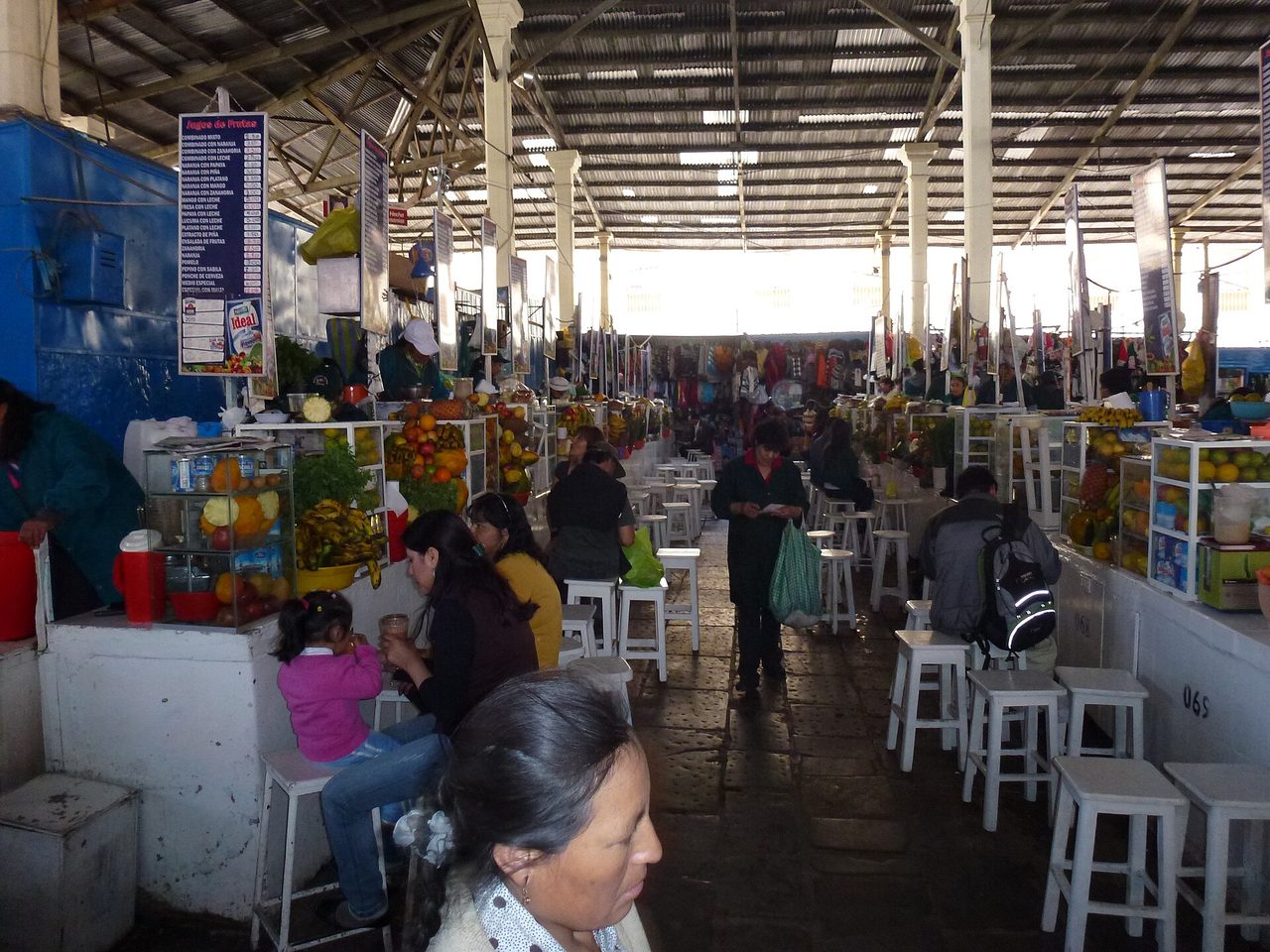
The juice corridor is the first thing most people find, and it deserves the attention. A row of counters stacked with fruit, each with a laminated board of combinations: papaya con leche, lúcuma, chirimoya, aguaymanto, maracuyá, the special with an egg in it. A big glass runs S/6–10 in 2026, and they will usually top up your glass from the jug. Simple single-fruit juices can be S/2–3. It is the cheapest good breakfast in the city.
Caldo de gallina is the other reason to come in the morning. A deep, clear hen broth simmered for hours, poured over noodles with a boiled potato, a piece of chicken and herbs, for something like S/5–8. At altitude, on your first mornings, it is a much better idea than a fried breakfast. The same counters do quinoa soup, and on weekends chicharrón cusqueño with mote and onion for around S/17–25.
The comedor rows are the sit-down section: long counters with a fixed set lunch. Two courses for S/8–12, a fuller menú for S/10–20. This is the same product as a neighbourhood menú del día, just served at a bar rather than a table.
Honest hygiene guidance. I do not think San Pedro is dangerous, and I would eat there. But I would follow three rules. Eat what is hot and has just come out of a pot — broths, soups, anything ladled and steaming. Eat where the queue is local and constant, because turnover is the actual safety mechanism. Skip anything that has been sitting uncovered at room temperature, and skip raw preparations, which in practice means being cautious about ceviche and about salads dressed with untreated water. Juices are the grey area: the fruit is fine, but ask them not to add ice unless you are relaxed about it. Plenty of travellers drink the juices with no consequence at all. Some do not.
The markets locals use instead. San Pedro has drifted towards tourists in the last decade, and Cusqueños increasingly shop elsewhere. Wanchaq market, east of the centre near the bus stops, is a working neighbourhood market with a good cooked-food section and a Sunday lechón tradition. San Blas market, up the hill in the artsy quarter, is small, mixed and open roughly 7:00–16:00 — sandwiches, juices, a couple of vegan stalls, and more English spoken than at Wanchaq. Vinocanchón out in San Jerónimo is the wholesale market and is enormous, chaotic and not a first-timer’s destination. Baratillo, on Saturdays near Avenida El Sol, is a flea market rather than a food market, and worth knowing about mostly so you keep your bag zipped.
Bring cash in soles. Market stalls do not take cards. The QR codes you will see everywhere are Yape and Plin, Peru’s domestic payment apps, and both generally require a Peruvian national ID to register, so visitors cannot use them.
Altitude and appetite: how to eat in your first 48 hours
This is the part almost every Cusco food guide skips, and it matters more than any restaurant recommendation. Cusco sits at 3,400 m. Machu Picchu, counter-intuitively, is nearly a kilometre lower at 2,430 m, and the Sacred Valley floor is around 2,800 m — which is why so many people feel better the moment they leave the city.
Three things happen to eating at this elevation. Appetite drops. Mild altitude exposure suppresses hunger, and a lot of visitors find they simply do not want dinner on night one. That is normal and not something to fight. Digestion slows. Heavy fried food, a whole roasted cuy, a plate of chicharrón — these sit badly in the first day or two and can make you feel far worse than the altitude alone would. Alcohol hits harder. Dehydration plus lower oxygen means a couple of pisco sours land like considerably more, and a hangover at 3,400 m is indistinguishable from mild altitude sickness.
What I would actually do:
- Day one. Soup and carbohydrate. Quinoa soup, caldo de gallina, choclo con queso, bread. Nothing fried. No alcohol. Drink a lot more water than feels necessary — three litres is a reasonable target at this elevation.
- Day two. A proper menú del día at lunch, something lighter in the evening. One drink with food is fine if you feel well.
- Day three onwards. Eat whatever you like. This is when the cuy, the chicharrón and the tasting menu make sense.
Coca tea versus muña. Mate de coca is offered free in almost every hotel lobby in Cusco and it does seem to help with headaches and digestion, though the evidence is largely traditional rather than clinical. It contains trace alkaloids and can trigger a positive drug test, which matters if your job screens you. Mate de muña — Andean mint — is the one locals reach for when the problem is specifically the stomach, and I find it more genuinely useful for that. Both are a couple of soles anywhere in the city. Neither is a substitute for going slowly. If you are planning a serious walk out of Cusco, the acclimatisation logic in our overview of Peru’s best treks applies to your stomach as much as your lungs.
What to eat in Cusco, specifically
Not generic Peruvian food. These are the things that are either native to Cusco or done meaningfully better here.
Cuy (guinea pig) — and whether you should
Cuy has been eaten in the Andes for thousands of years and remains a celebration food, served at weddings, baptisms and Sunday family lunches. In Cusco it is usually cuy al horno, marinated in garlic, cumin, salt and huacatay and roasted in a clay oven for the better part of an hour, then served whole — head, feet, teeth — with potato and a fresh salad.
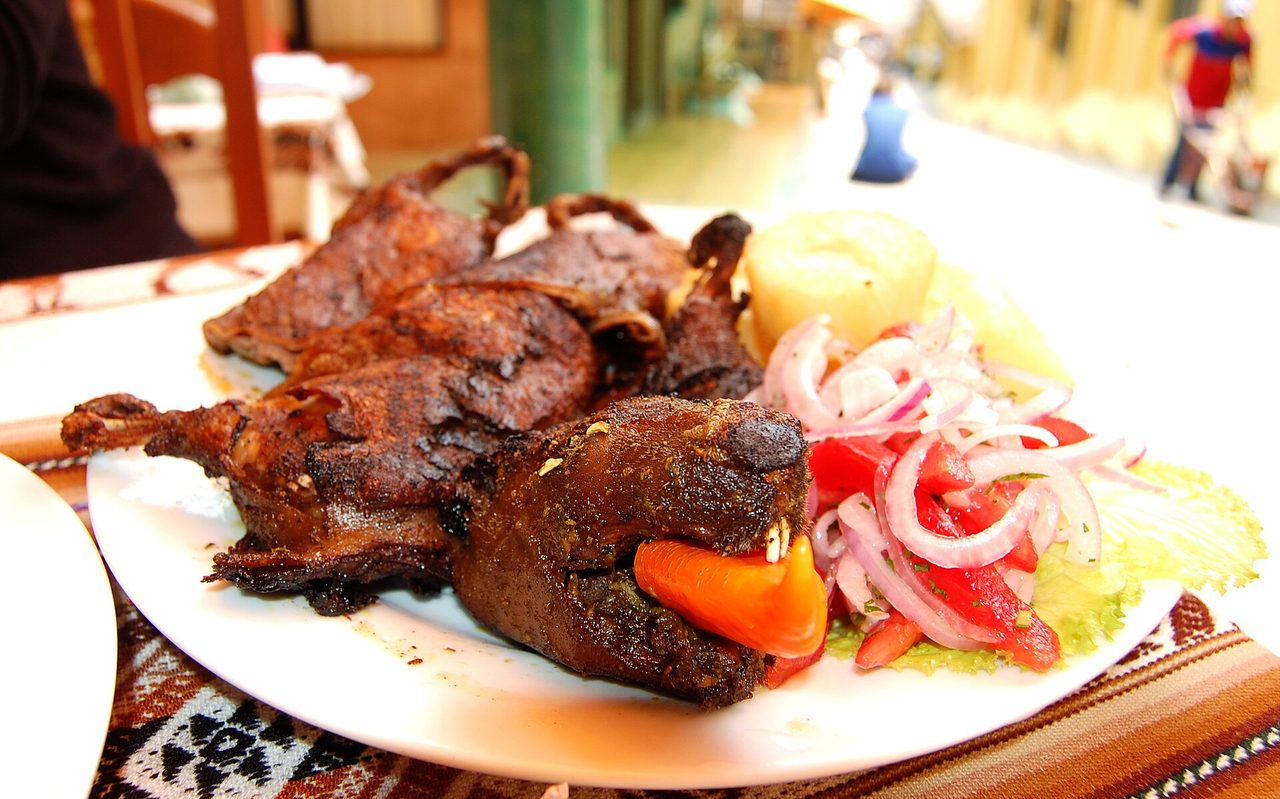
Honest verdict on the taste: it is fine. Dark, slightly gamey, closest to rabbit or to the darker parts of a duck, with skin that goes properly crisp when it is cooked well. The problem is the ratio. There is very little meat on a cuy and a great deal of bone and skin, and eating it is a fiddly, hands-on business that most people find more novel than delicious. If you are going to try it, do it once, at a place that roasts them properly, and accept that you are paying for an experience rather than a great plate of food.
On the ethics: they are farmed animals raised for meat, kept in far better conditions than most industrial poultry, and the discomfort Western visitors feel is almost entirely about the species being a pet at home. That is a real feeling and worth taking seriously, but it is not an argument about animal welfare. If it bothers you, do not order it. Nobody in Cusco will think less of you.
Where: the best cuy is not in the historic centre. The villages of the south valley — Tipón above all, about 45 minutes out — are where Cusqueños drive for it, and prices there run roughly S/38–58 against S/65–95 in a central tourist restaurant. Pachapapa in San Blas is the reliable in-town option and asks for 24 hours’ notice so they can roast one to order. Anywhere that can produce a whole cuy in twenty minutes reheated it.
Alpaca — the one I would actually order
Alpaca is the sleeper. It is very lean, mild, faintly sweet, closer to a good lean beef than to lamb, and it takes a hot pan well. Alpaca a la plancha, or a simple grilled steak with a huacatay or rocoto sauce, is one of the genuinely excellent things on Cusco menus, and unlike cuy it is not a novelty — it is just good meat. Because it is so lean it overcooks fast, so ask for it medium rare or medium at most. Expect S/45–75 in a midrange restaurant. Alpaca burgers and alpaca carpaccio turn up on tourist menus and are usually decent.
Chicharrón, and the pilgrimage to Saylla
Chicharrón cusqueño is pork simmered and then fried in its own fat until the outside shatters, served with mote (hominy corn), raw onion and huacatay. It is a breakfast and weekend dish, not a dinner dish. In San Pedro market you can get a plate for around S/17–25 in the morning.
The full version is a day out. Saylla is a village about 15 km south-east of Cusco, roughly 40 minutes by combi from Avenida de la Cultura, and it is the regional capital of chicharrón — a main street of open-sided chicharronerías with lawns and plastic chairs, full of Cusco families on Sundays. A plate runs roughly S/20–35. Combine it with the Inca terraced waterworks at Tipón, which sit a few kilometres further on and are among the most underrated Inca sites in Peru. Go hungry and do not plan anything for the afternoon.
Chiriuchu — the Corpus Christi dish
Chiriuchu is the most Cusco thing you can eat, and it is deliberately strange. The name is Quechua for “cold chilli”, and it is served cold, on one plate, unmixed: roasted cuy, boiled hen, Cusco chorizo, dried charqui, queso paria, a maize torreja, toasted cancha corn, fish roe and cochayuyo seaweed from the coast, with rocoto and huacatay. Coast, highlands and jungle on a single plate. The Andean Parliament declared it regional cultural heritage in 2024.
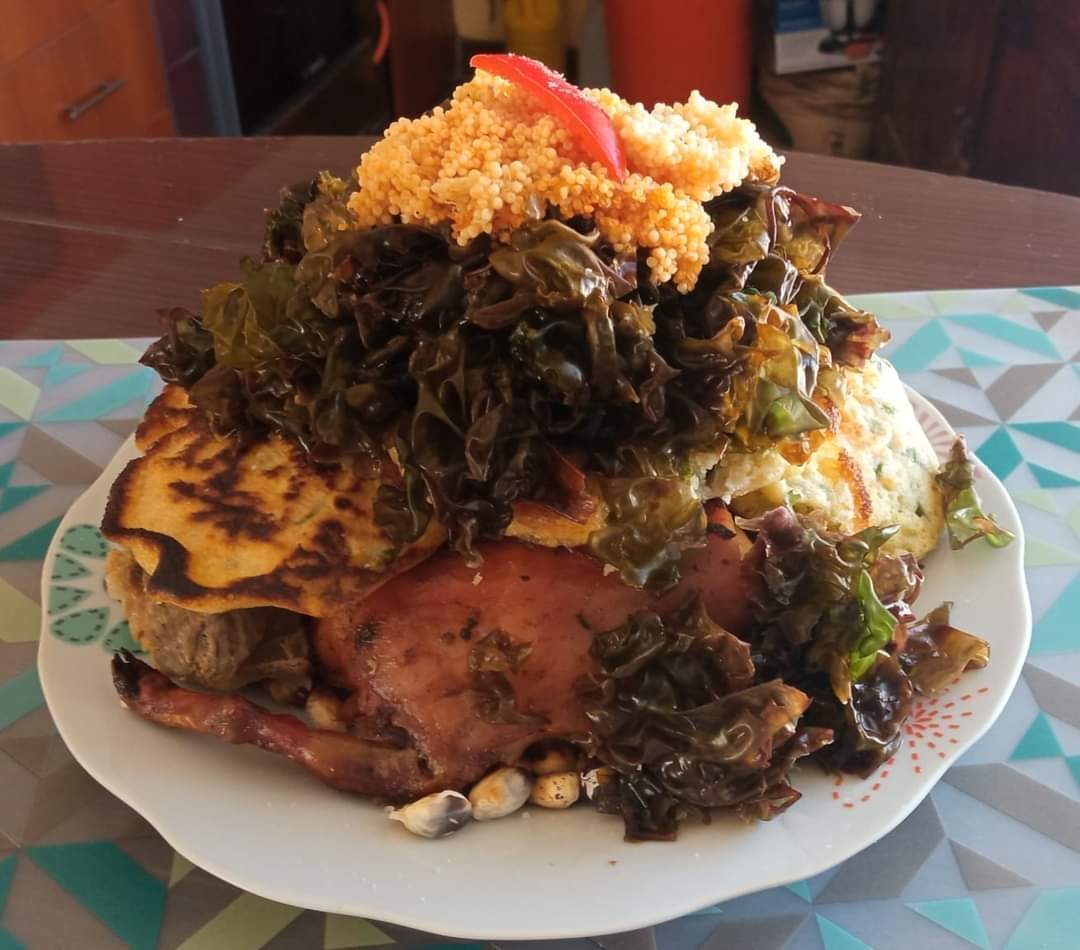
It is seasonal in practice. The moment for chiriuchu is Corpus Christi in June, when scores of chiriucheras set up around Plaza San Francisco and the whole city queues. Outside that window you can find versions year-round at San Pedro market and at a handful of restaurants including Chicha and Pachapapa, but they are approximations. Expect roughly S/25–38 at a market stall or picantería and S/47–75 at a smart restaurant.
Be warned that the first mouthful is confusing. Cold roast meat, cold cheese, seaweed and fish roe do not resolve into a familiar flavour. The instruction is to eat each element separately rather than combining them, and it does make more sense that way. If you are timing a trip around festivals, our guide to the best time of year to visit Peru covers when Corpus Christi and Inti Raymi fall.
Adobo on a Sunday morning
Adobo cusqueño is pork shoulder marinated overnight in chicha de jora, ají panca and rocoto, then cooked slowly until the broth turns mahogany and thick. It is eaten for breakfast, on Sundays, with pan de Oropesa — the dense round bread from the village of Oropesa nearby, which has protected-origin status. Locals call it levanta muertos, the thing that raises the dead, and its reputation as a hangover cure is not accidental.
You will not find it on a tourist menu at 8pm on a Wednesday. Go to Wanchaq or San Pedro market on a Sunday morning, or to a picantería in San Sebastián or San Jerónimo. Around S/10–20. It is one of the most distinctive meals in the city and almost no visitors eat it.
Lomo saltado, chifa and the Chinese influence
Lomo saltado — beef seared hard with red onion, tomato and soy, served with both chips and rice — is Peru’s national comfort dish and a direct product of Chinese immigration in the nineteenth century. It is on every menu in Cusco at every tier, which makes it a decent benchmark: S/20–30 in a neighbourhood restaurant, S/45–65 in a tourist-facing one, and if someone on the plaza wants S/80 for it you are being charged for the balcony.
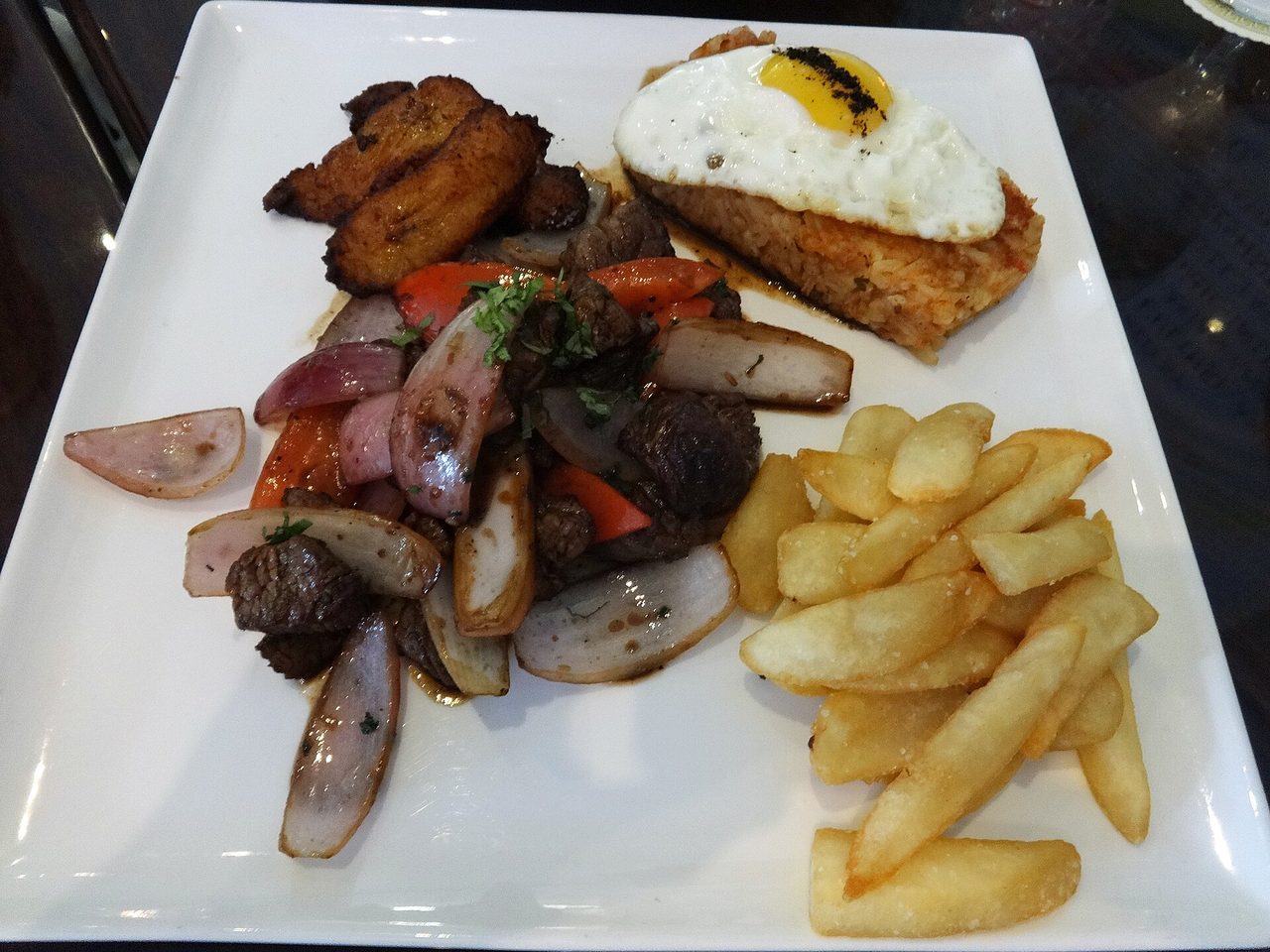
The wider chifa tradition — arroz chaufa, tallarín saltado, wonton soup — is everywhere and is cheap, reliable and usually cooked hard and fast, which is not a bad property in a city where you are thinking about your stomach. A chifa menú is one of the safest S/12 lunches in Cusco.
Trucha, choclo con queso and the soups
Trout is farmed all over the highland lakes and rivers and appears constantly on menú boards, usually fried whole or a la plancha with rice and potato. It is good, it is cheap, and it is a sensible order when you want protein without heaviness. Trout ceviche also exists up here, made with the local fish instead of sea bass — treat it with the same caution you would any raw preparation in a place where you are not sure about the water.
Choclo con queso is the great Andean street snack: a cob of Sacred Valley giant corn, kernels the size of a thumbnail and far starchier and less sweet than corn you know, boiled and handed over with a slab of fresh white cheese. S/3–7 on any street corner. It is the best thing to eat when you are half-hungry and adjusting to the altitude.
Then the soups, which are the real backbone of Cusqueño home cooking and are badly underrepresented on tourist menus. Chairo, thick with chuño (freeze-dried potato) and dried mutton. Kapchi de habas, a creamy broad bean stew with cheese and egg, which is one of the best vegetarian dishes in Peru and almost impossible to find in the centre. Quinoa soup, which is what you should be eating on night one. Most of these live at picanterías and markets, at S/10–18.
The neighbourhood tier: picanterías, quintas and the S/25–45 restaurant
This is the tier most visitors never reach, and it is where Cusco cooking is at its best. A picantería is a traditional regional restaurant — the Arequipa version is more famous, but Cusco has them too. A quinta is the Cusco variant: a family-run place, often with a courtyard or garden, a rotating chalkboard menu, big portions, and lunch-only hours that typically end around 16:00 or 17:00.
These places are concentrated outside the historic core — Magisterio, Wanchaq, San Sebastián, San Jerónimo — and they are where you eat adobo, chairo, kapchi, lechón and properly made cuy. Cusqueñísima in Magisterio, about fifteen minutes from the centre, is the one I would send someone to first: grandmother-standard Cusco recipes, open daytime hours only, and a local rather than tourist clientele. Expect S/25–45 a head with a drink.
Nearer the middle, San Blas and the streets just off it hold a cluster of mid-price kitchens that are neither backpacker canteens nor special-occasion restaurants. Pachapapa, on the San Blas plazoleta, does Cusqueño dishes and woodfired breads in a courtyard. La Bohème does crêpes, soups and salads and is one of the few places with reliable gluten-free options. Casalino does focaccia and pizza and opened a second branch opposite San Pedro market in March 2026, which is a useful thing to know if you have spent the morning in the market and want to sit down properly.
Practical note on hours: the lunch-only pattern catches people out constantly. If a place is described as a picantería or a quinta, assume it closes in the late afternoon and does not reopen. Cusco genuinely eats its big meal in the middle of the day, and if you plan every dinner around 8pm you will only ever meet the tourist tier. That rhythm is worth building into how you sequence a Peru itinerary if food matters to you.
The tourist-facing midrange, and exactly how the traps work
The Plaza de Armas and the streets immediately off it are the most heavily worked tourist restaurant zone in Peru. That does not mean everything there is bad — several of the best kitchens in the city are within three blocks of the cathedral. It means the noise-to-signal ratio is terrible and the specific tactics are worth knowing.
The laminated menu tout. Someone stands in the arcade holding a plastic menu and stops you. They are paid per head, which means their incentive is to fill a table, not to feed you well. The good restaurants in Cusco do not need someone standing in the street. This is not a scam exactly — some touts represent perfectly acceptable places — but as a filter it is close to perfectly negative.
Calle Procuradores. Universally called Gringo Alley, a narrow lane running north-west off the plaza, wall-to-wall with bars, pizzerias and clubs, and the highest density of promoters in the city. In the evening it is also where the drink-spiking warnings concentrate, and where unlicensed tour sellers and worse operate. It is not a no-go street — people walk it all day — but I would not choose to eat there and I would not accept a drink there from someone who approached me.
The free pisco sour. The classic hook: a promoter offers a complimentary pisco sour or a two-for-one to get you seated. The drink is real and the maths is simple — you are paying for it in the food prices, and once you are at the table with a drink in front of you the switching cost is high. Free-shot offers at club doors on Procuradores are a different and more serious matter, and the standard advice applies: do not accept a drink you did not watch being poured.
Cover charges and live music. Some plaza-facing restaurants add a cover for the folk band that comes round, or a “table charge”. Peruvian consumer rules require any surcharge to be clearly displayed and itemised on the bill, so if it appears from nowhere you are entitled to question it. Check the printed menu for a line of small text before you sit down.
The 10% servicio. Mid-range and upmarket restaurants in Cusco commonly add a 10% service charge, sometimes alongside the 18% IGV sales tax, and it must be shown on the bill. Two honest things about it. First, if servicio is on the bill you do not need to tip on top; leaving small change for genuinely good service is normal, 20% on top is not. Second, that 10% is not guaranteed to reach the person who served you — it is legal for the business to keep or redistribute it, and practice varies. If you want to make sure a specific waiter benefits, a few soles in cash into their hand does that more reliably than the line on the card machine. In market comedores and menú restaurants, nobody expects a tip at all; rounding up is plenty.
The view tax. A balcony table over the Plaza de Armas costs roughly double for identical food. Sometimes that is a fair trade. Just know you are buying the balcony, not the cooking, and consider having a drink there and dinner elsewhere. The same logic applies in Aguas Calientes, where the restaurant strip beside the river is even more captive than Cusco’s.
Fine dining in Cusco: what S/250 buys, and whether it lands at 3,400 m
Cusco has a real high-end scene, and unusually for a small Andean city it is not just hotel restaurants. A handful of kitchens are worth knowing about, and I have limited this list to places I could confirm are operating in 2026.
Chicha por Gastón Acurio, on Plaza Regocijo, is the Cusco outpost of Peru’s most influential chef and is open daily from noon to 22:30 according to its own site. The premise is regional Cusqueño cooking taken seriously rather than Lima food transplanted, and it is the most reliable place in the city to eat traditional dishes — including chiriuchu out of season — cooked to a high standard. Reckon on S/60–110 for a main.
Cicciolina, Calle Palacio 110 on the second floor, has been running for two decades and does Mediterranean-Andean cooking and tapas in a low-lit colonial room. It is the place most long-term residents name first. There is a separate café on Calle Ruinas under the same ownership, which is a cheaper way to sample the kitchen.
MAP Café sits in a glass box in the courtyard of the Museo de Arte Precolombino on Plazoleta Nazarenas, and is the most theatrical dining room in Cusco. Contemporary Peruvian cooking, tasting menus available, and prices at the top of the local range — roughly S/65–130 a main.
Beyond those, the reliably good end of the market includes Uchu (a stone-grill steakhouse on Calle Palacio), Limo and Miwa (Nikkei, the Japanese-Peruvian tradition, both strong on raw fish), Morena and Sagrado (Peruvian haute cuisine near the plaza), Oculto and Osda (small plates and wine), and the restaurants inside the Belmond, Marriott and Luxury Collection hotels around Nazarenas, which are expensive and competent.
Now the candid part. A long tasting menu at 3,400 m is harder work than it sounds. Appetite is suppressed, alcohol amplifies, and two and a half hours of ten small courses with a wine flight is a genuine physical undertaking in your first days. I have watched people spend S/500 on a menu they could not finish on night one because they booked it before they arrived.
My honest verdict: Cusco fine dining is worth doing, once, and it is best on night three or later. If your budget only stretches to one splurge in Peru, I would spend it in Lima, where the internationally ranked kitchens are and where you can eat at sea level with a normal appetite — our guide to what to do in Lima covers the food scene there. If you want the Andean version of that experience, the destination restaurant beside the terraces at Moray in the Sacred Valley is closer to the produce and a more remarkable setting than any dining room in Cusco — though it sits higher than the city, not lower, so the altitude caveat applies twice over. Book it weeks out. Also worth saying plainly: the gap in quality between a S/250 dinner and a S/40 lunch at a good picantería is much smaller in Cusco than the price gap implies.
Vegetarian, vegan and coeliac in Cusco
Cusco is one of the easier cities in South America to eat plant-based, largely because it has been a backpacker hub for forty years. San Blas in particular has a cluster of dedicated vegetarian and vegan kitchens. Green Point, on Carmen Bajo, is the best known — a fully plant-based restaurant in a covered garden, open long hours daily, and confirmed operating in 2026. El Encuentro, on Calle Tigre in the centre, does vegetarian and vegan versions of Peruvian classics cheaply, including a set lunch in the low teens of soles. Several market stalls at San Blas and San Pedro are vegan-only.
Outside those places it is harder than you expect. The traditional Andean repertoire looks vegetarian-friendly — potatoes, corn, quinoa, beans — but soups are almost always built on meat stock, and “vegetarian” on a menú board sometimes means a plate with the meat left off rather than a dish designed without it. Kapchi de habas and solterito (a broad bean, cheese, corn and tomato salad) are the two genuinely traditional vegetarian dishes worth asking for. Useful phrases: soy vegetariano/a, sin carne, sin caldo de pollo.
Coeliac is the harder case. There is very little formal gluten-free certification in Cusco and cross-contamination awareness is limited. The good news is that a lot of Andean food is naturally gluten-free: potato and corn dishes, grilled meats, quinoa, most soups. The risks are soy sauce in anything saltado or chifa, breaded milanesas, wheat thickeners in stews, and bread arriving on the table by default. A small number of restaurants advertise gluten-free options credibly — the vegan places and one or two of the international kitchens — but if you are strictly coeliac rather than avoiding gluten by preference, self-catering some meals is realistic and the markets make it easy. Carry a written card in Spanish explaining the condition; verbal explanations get nodded at and misunderstood.
Water, ice and stomachs
Tap water in Cusco is treated but is not safe to drink, and the pipe network is old enough that even locals boil or filter. Do not drink it. The practical rules: bottled or filtered water only, and check the seal. Be cautious with ice in cheap places, though ice in established restaurants is generally made with treated water. Salads and uncooked vegetables are the classic vector because they are washed in tap water. The old formula still holds — boil it, cook it, peel it, or leave it.
A filter bottle is the environmentally better answer and works well here; if you are boiling, note that water needs three minutes at a rolling boil above about 2,000 m rather than the usual one. Carry oral rehydration salts, which are sold in any Cusco pharmacy for a couple of soles under the name sales de rehidratación oral, and take them at the first sign of trouble. Dehydration at altitude compounds fast and turns a mild stomach upset into a wrecked day. There is more of this kind of groundwork in our general Peru travel tips.
Where to walk for dinner, by neighbourhood
San Blas. The hillside quarter above the plaza, and the best single area to wander for dinner. Concentration of independent kitchens, vegan places, small bars, coffee. The catch is the climb: it is steep, and at 3,400 m the walk up from the plaza is a genuine effort in your first days. Take a taxi up and walk down. That climb is the same reason San Blas divides opinion when you are choosing which Cusco neighbourhood to stay in.
The historic centre off the plaza. Calle Plateros, Calle Palacio, Calle Ruinas, Santa Catalina Ancha. Most of the serious restaurants are here, one or two blocks back from the arcades, and the density of touts drops sharply as soon as you leave the square itself.
The Plaza de Armas arcades. Views, balconies, mariachi-volume folk bands, and a price premium of roughly double. Fine for a drink at sunset. I would not make it my default dinner.
Wanchaq, Magisterio, San Sebastián. Fifteen to twenty-five minutes out by taxi (S/6–12 within the city, agreed before you get in). Almost no tourists, the best regional cooking, lunch hours only. This is where I would spend a Sunday.
Around San Pedro market. Cheap, busy, good for daytime eating, quieter and slightly edgier after dark. Worth a morning; not where I would linger at 10pm.
Taxis in Cusco are unmetered and you agree the fare before boarding. If you are moving around the country the same principle of asking first applies to almost everything — see our guide to getting around Peru.
A three-day eating plan I would actually follow
Assume you land in Cusco in the afternoon and are going on to the ruins later in the week.
Day one. Mate de coca or muña at the hotel. Walk slowly. Early dinner of quinoa soup and choclo con queso somewhere close to where you are sleeping. No alcohol, three litres of water, in bed early. Total spend: under S/40.
Day two. San Pedro market at 7:30 for caldo de gallina and a juice, S/12–18. Sightseeing. A menú del día somewhere ten minutes off the plaza at 13:00, S/12–20. In the evening, something midrange in San Blas — alpaca a la plancha, one pisco sour, S/60–90. Total: S/90–130.
Day three. If it is a Sunday, adobo at Wanchaq market in the morning, then chicharrón at Saylla with a stop at Tipón. If it is not, lunch at a picantería in Magisterio, S/25–45. Dinner at one of the serious kitchens in the centre if you want the splurge, S/150–300, booked that morning.
That is three days that cover every tier and cost less than two dinners on the plaza would. Add the food budget to your ticket costs when you plan — Machu Picchu entry alone is S/163 for a foreign adult in 2026, or S/211 for the circuits that include Huayna Picchu or Machu Picchu Mountain, and the official portal is the only reliable source for current prices. Our guides to Machu Picchu tickets and to doing Machu Picchu on a budget go into the detail, and if you are only in the region briefly, the logistics of a day trip from Cusco will determine which of these meals you actually get to eat.
Common questions about eating in Cusco
What is a menú del día and how much should it cost?
A fixed-price set lunch: soup, a main plate with a choice of two to four options, and a drink. In Cusco it runs S/8–12 in outer neighbourhoods and markets, S/15–25 in the streets near the Plaza de Armas. Served roughly 12:00–15:00 only. If someone quotes you S/40 for a “menú turístico” on the plaza, that is a different and much worse product.
Is it safe to eat at San Pedro market?
Yes, with judgement. Eat hot food that has just been ladled out, eat where the local queue is longest, go at breakfast or lunch peak, and avoid anything sitting uncovered at room temperature. Be more careful with raw preparations and with ice. Most travellers eat there without any problem; the ones who get ill usually ate something lukewarm in the mid-afternoon lull.
Where should I try cuy, and is it any good?
The south valley villages, Tipón above all, for around S/38–58, or Pachapapa in San Blas with 24 hours’ notice for roughly S/65–95. As for good: it is fine but bony, closer to rabbit than to chicken, and most people find the experience more interesting than the eating. Order it once and do not build a day around it.
Does alpaca actually taste good?
Yes, and it is the meat I would order over cuy every time. Lean, mild, faintly sweet, similar to a good lean beef. Ask for it medium rare because it dries out quickly. S/45–75 for a steak in a midrange restaurant.
Do I tip in restaurants in Cusco?
Check the bill first. Mid and upper-tier restaurants usually add a 10% servicio line, in which case no further tip is required — and be aware that money is not guaranteed to reach your server. If there is no servicio, 10% in cash is generous and appreciated. At market stalls and menú restaurants, tipping is not expected; round up if you want to.
Can I drink the tap water?
No. Use bottled or properly filtered water, including for brushing your teeth if you want to be careful. Boiling works but needs three minutes at this altitude rather than one.
Is Cusco fine dining worth the money?
Once, and not on your first night. The kitchens are genuinely good, but appetite is suppressed at 3,400 m and a long tasting menu is hard work before you have acclimatised. If you only have one big food splurge in the whole country, Lima is the stronger bet.
What time do people eat in Cusco?
Breakfast from 6:30 or 7:00. Lunch, the main meal, between 12:00 and 15:00. Dinner is later and lighter, from about 19:00, with tourist restaurants serving until 22:00 or 22:30. Traditional picanterías and quintas are lunch-only and shut in the late afternoon.
Is Cusco good for vegetarians and vegans?
Better than most of the Andes. San Blas has a proper cluster of dedicated vegan and vegetarian restaurants and the markets have plant-based stalls. Outside those, be specific when ordering: soups are usually made with meat stock even when the visible ingredients are not.
Are the restaurants on the Plaza de Armas a rip-off?
The balcony ones charge roughly double for the same food, which is a view premium rather than a rip-off. The genuine traps are the touts with laminated menus, the free-drink hooks on Calle Procuradores, and undisclosed cover charges. Walk one or two streets back from the square and both the prices and the quality improve.
What should I eat on my first day at altitude?
Soup and starch. Quinoa soup, caldo de gallina, choclo con queso, bread, plenty of water, mate de coca or muña. Skip fried food, skip a big dinner, skip alcohol entirely. Save the cuy and the chicharrón for day three.
The short version
Eat lunch, not dinner. Walk away from the plaza before you sit down. Learn the four price tiers and you will never be badly overcharged. Do San Pedro market early, do a menú del día most days, do one picantería lunch and, if you want it, one serious dinner after you have acclimatised. And check that anywhere you have read about — here or anywhere else — is still open before you walk across town for it. That last piece of advice is the only one in this article guaranteed not to go out of date. If Cusco is one stop on a longer route, our overviews of the best places to visit in Peru and of where to base yourself around the country will help you decide how many of these lunches you actually get.