Machu Picchu by Train: PeruRail vs Inca Rail, Honestly Compared (2026)
The Machu Picchu train, decoded: PeruRail vs Inca Rail, what every class really buys you, 2026 fares, the stations trap, luggage rules and the booking strategy that survives high season.
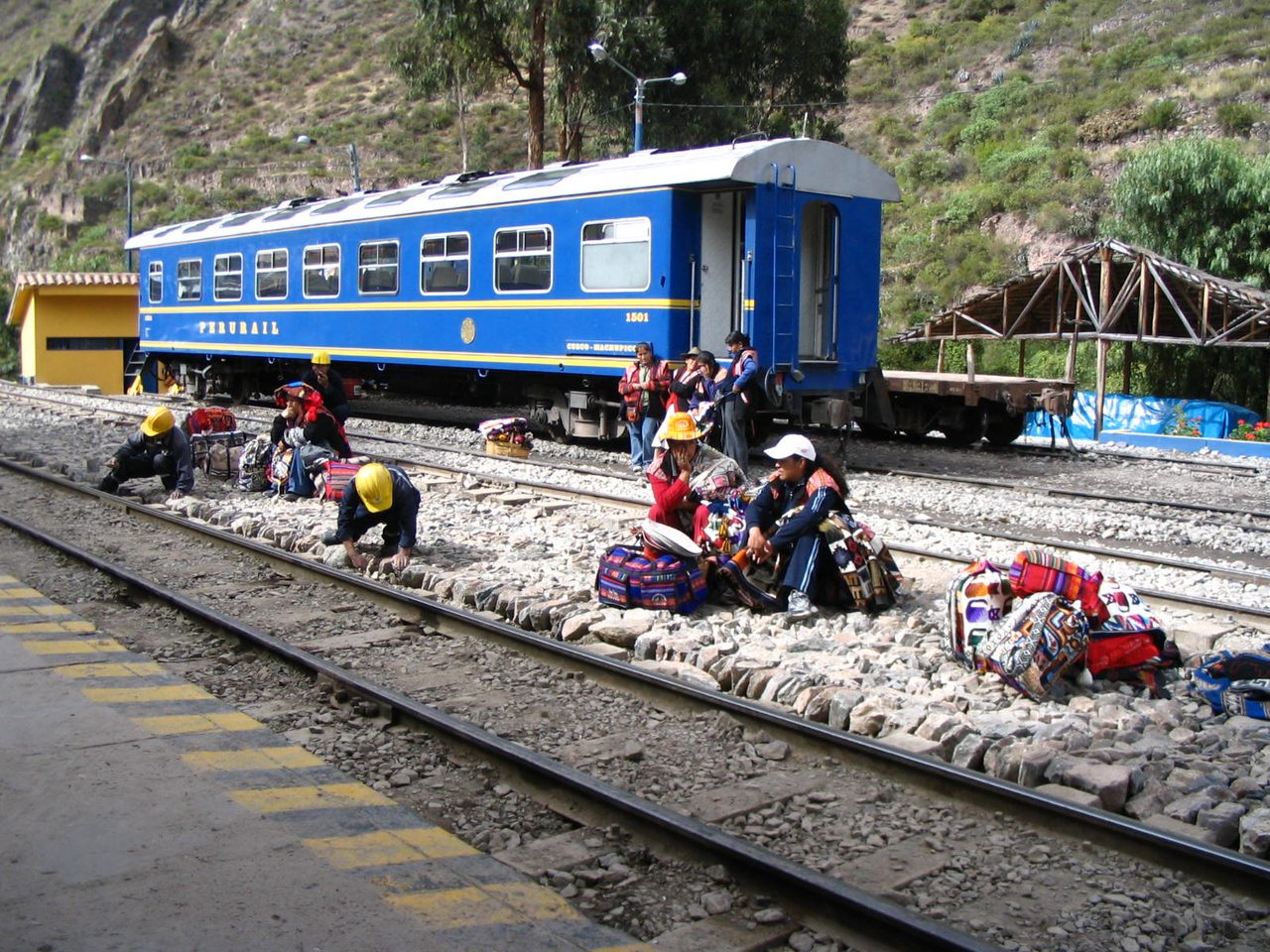
The train to Machu Picchu is the only famous train I know that’s famous for where it goes rather than what it is — and that’s a disservice, because the ride itself is one of the great short rail journeys on earth. Ninety minutes down the Urubamba gorge, snow peaks giving way to orchids, the river turning from Andean gray to jungle white alongside you — I’ve done it perhaps a dozen times across every class both companies sell, and I still fight for the window seat.
This guide is everything I know about the machu picchu train, arranged for decision-making: PeruRail vs Inca Rail (spoiler: the timetable matters more than the logo), what each class actually buys you, real 2026 prices, the stations trap, the luggage rule, and the booking strategy that keeps a sold-out July from ruining your week.
The short version: two companies — PeruRail (more departures) and Inca Rail (slightly cheaper, open-air 360° car) — run from Ollantaytambo in the Sacred Valley to Aguas Calientes below the ruins. Standard classes cost about US$35–60 per leg; panoramic classes US$70–90; the Belmond Hiram Bingham is a rolling gala at US$300+ each way. Book the entrance ticket first, then trains 1–3 months out in high season. Both companies are good; buy the departure time, not the brand.
This is the rail deep-dive of our Machu Picchu guide — the full route context (roads, treks, budget vans) lives in how to get to Machu Picchu.
First, the geography (or: why “the train from Cusco” is a trick phrase)
There is no meaningful direct train from Cusco. The workhorse station is Ollantaytambo, 1.5–2 hours from Cusco by road, deep in the Sacred Valley; from there it’s about 1 h 45 min by rail to Aguas Calientes. The alternatives:
- Poroy (25 min from Cusco): a handful of departures taking ~3 h 20 min — scenic, slow, and closed in the rainy season (roughly January–April), when services retreat to Ollantaytambo.
- Bimodal from Cusco: both companies sell bus-plus-train tickets from Cusco (PeruRail from Wanchaq station, Inca Rail from near the plaza) that bundle the road leg to Ollantaytambo with your rail seat. Marginally dearer than DIY, considerably simpler at 4:30 a.m.
- Urubamba: a boutique station with rare departures, mostly for Sacred Valley hotel guests.
- Hidroeléctrica: the back-door walk-in route — no tourist trains, just the tracks you walk beside; that adventure is covered in the budget guide.
Rule of thumb: unless a luxury service or bimodal ticket says otherwise, plan around Ollantaytambo — and strongly consider sleeping there the night before your train; the town is lovely and the 4 a.m. Cusco van disappears from your life.
PeruRail vs Inca Rail: the honest comparison
Travelers agonize over this like it’s Boeing vs Airbus. On the ground the differences are modest:
| PeruRail | Inca Rail | |
|---|---|---|
| Daily departures | ~20+ in high season | ~10–12 |
| Standard class | Expedition (US$35–60/leg) | Voyager (US$30–55/leg) |
| Panoramic class | Vistadome / Vistadome Observatory (US$70–90) | The 360° (US$65–85), with open-air observation car |
| Luxury | Hiram Bingham by Belmond (US$300–500+/leg) | First Class / The Private (charter) |
| Personality | The institution: more frequency, Belmond polish up top | The challenger: slightly keener prices, that open balcony car |
| Stations | Ollantaytambo, Poroy, Urubamba, bimodal from Wanchaq (Cusco) | Ollantaytambo, bimodal from Cusco center |
My allegiance, for what it’s worth: Inca Rail’s 360° open-air car is the single best value-for-experience feature on the route — standing in the wind with the gorge pouring past beats any window. But I have never once regretted booking whichever train fit my entrance slot better. Frequency is PeruRail’s ace; if your timing is tight, they simply have more trains.
What each class actually gets you
Standard: Expedition / Voyager (the right answer for most people)
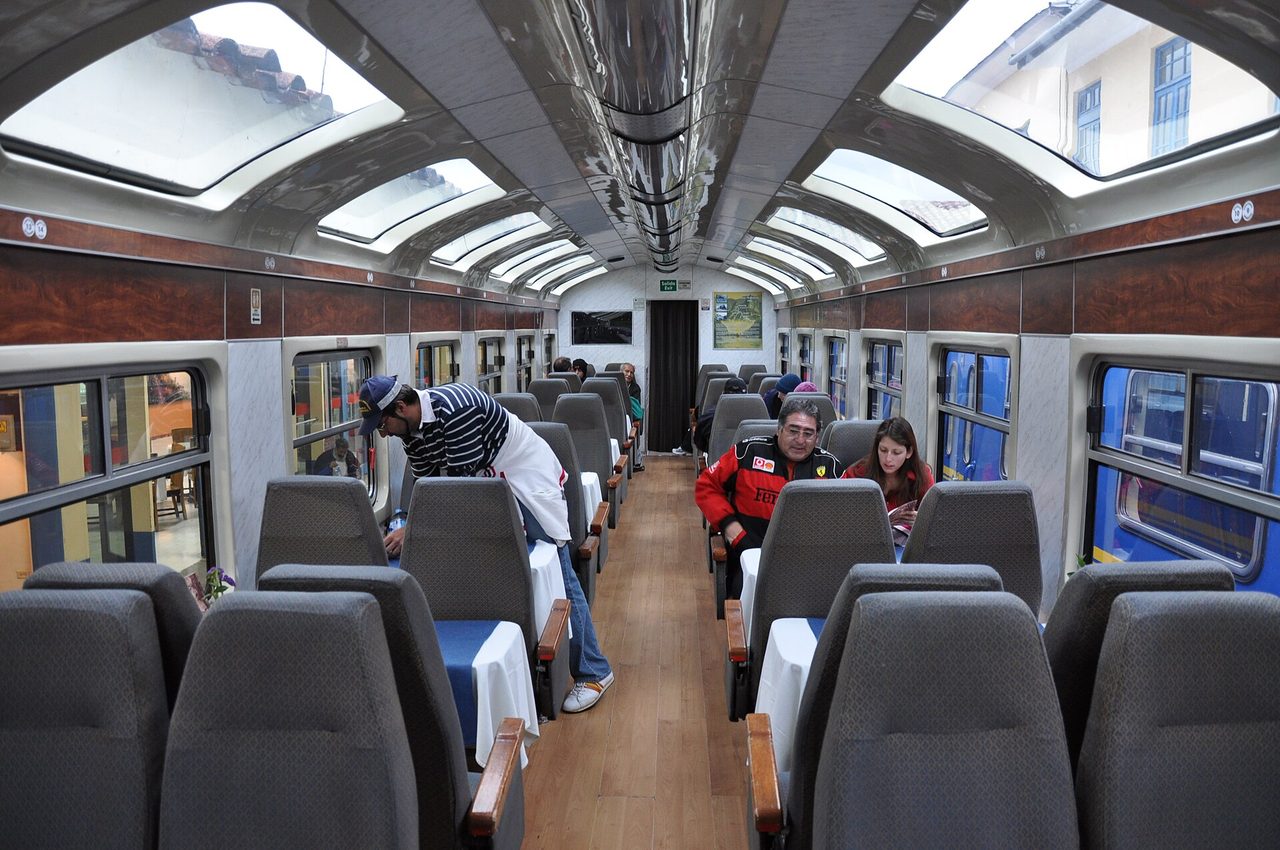
Comfortable seats in fours around a table, big windows plus skylight panels, a small snack and coffee, luggage racks sized to the official allowance. The scenery is identical to the expensive cars — it’s outside, and it’s free with every class. If you’re watching the budget, spend the savings on a night in Aguas Calientes instead; it buys more Machu Picchu than any train upgrade. (The whole cost stack is itemized in the Peru trip cost guide.)
Panoramic: Vistadome / The 360° (worth it one way)
Bigger glass, ceiling windows that turn the gorge into an IMAX, better snacks (think quinoa bites and decent coffee), and on the Vistadome’s return leg, a cheerfully chaotic onboard fashion show of baby-alpaca knitwear, briefly modeled by staff and sold at prices better than Cusco’s tourist shops — ridiculous and delightful in equal measure. The 360° counters with its open-air car, which photographers should consider decisive. My standing advice: panoramic one direction, standard the other — the novelty is real but 90 minutes of it is plenty.
Luxury: the Hiram Bingham (an event with wheels)
Belmond’s 1920s-styled Pullman is less a train than a moving dinner party: white tablecloths, brunch with wine outbound, cocktails and a live band in the bar car, afternoon tea at the Sanctuary Lodge folded into some fares, guides included. US$300–500+ per direction, and the reviews it earns are dreamy for a reason. Do it once, one way (outbound, when you’re fresh), if it’s a milestone trip — and know that nothing about the citadel itself is different when you arrive. See our honest take on Peru’s luxury splurges in where to stay in Peru.
2026 prices, without the asterisks
Fares float with demand, direction and departure time (dawn and late-afternoon trains price higher), so treat these as the realistic ranges you’ll actually see at checkout, per adult:
| Class | One way, Ollantaytambo–Aguas Calientes | Round trip |
|---|---|---|
| Expedition / Voyager | US$35–60 | US$70–120 |
| Vistadome / The 360° | US$65–90 | US$130–180 |
| Vistadome Observatory | US$85–105 | US$170–210 |
| Hiram Bingham | US$300–500+ | US$600–1,000+ |
| Bimodal from Cusco (standard) | US$60–80 | US$120–160 |
Children under 12 ride at roughly 30–50% off; infants under 3 free on a lap. Both operators price in dollars and take foreign cards with far less drama than the entrance-ticket site — book directly at perurail.com or incarail.com and skip the third-party markup.
Every tier on the line, ranked by what the money actually buys
Both operators price dynamically, which is why the bands below run wider than the headline figures anyone quotes, the table above included: the floor of each range is a February weekday booked months out, the ceiling a July dawn departure bought late. Ten named services run this stretch of track, and the thing to establish before comparing them is that the view is not one of the variables. The gorge is outside. Every carriage passes through the same one at the same speed.
| Service | Per leg | Glass | Food included | Time | Verdict |
|---|---|---|---|---|---|
| PeruRail Expedition | US$50–85 | Wide side windows, no observation car | Nothing — snacks sold on board | 1 h 30–45 | The correct default. Book it and stop thinking |
| Inca Rail The Voyager | US$50–80 | Wide side windows, no observation car | Nothing — sold on board | ~1 h 40 | The same product in a different livery. Choose on departure time |
| PeruRail Vistadome | US$75–130 | Side and roof panels — a genuine glass ceiling | Snack box | 1 h 30 | The one upgrade with a real optical difference. One leg is plenty |
| Inca Rail The 360° | US$77–135 | Panoramic sides plus an open-air observation car; Inca Rail claims no roof glass on any tier | Snack and one drink | ~1 h 40 | Buy it for the balcony, not the windows |
| Inca Rail The Prime | Not separately published | Large windows, no open-air car | Snack and a premium drink | ~1 h 30 | Priority boarding and a better biscuit. Skip it |
| PeruRail Vistadome Observatory | US$95–180 | Panoramic carriage plus a dedicated observatory bar car with an open-air balcony | Snack box, hot infusions, coffee, bottled water | 1 h 30 | PeruRail’s reply to the 360°. Worth it only if the balcony is the point |
| PeruRail “Sacred Valley” (Urubamba) | US$90–175 where sold | Dining car, 33 seats | Gourmet lunch out, dinner back | ~2 h 30 | No longer listed among PeruRail’s Machu Picchu services; Urubamba now appears in the timetable as a Vistadome working. Confirm it exists before planning around it |
| Inca Rail The First Class | US$180–425 | Dining car, lounge-bar car, open-air balcony | Three courses, wine, cocktails, tea in Aguas Calientes | ~1 h 40 | A restaurant that moves. The most inconsistently priced ticket on the line |
| Inca Rail The Private | Charter, quoted on request | Private carriage with its own open-air area | Four courses, premium wine, pisco cocktails | ~1 h 40 | Eight seats, booked over WhatsApp rather than online. For a wedding party, not a couple |
| Hiram Bingham | US$460–600 | 1920s Pullman, two bar cars, observation car with an open platform — outbound only | Brunch out, four courses back, drinks, guide, shuttle | 1 h 30 from Ollantaytambo | Genuinely a party. Buys you nothing at the gate |
Read the food column against the glass column and the ladder resolves. Above Vistadome you are buying catering and theatre: the premium fares are, almost exactly, the price of a good dinner plus the price of standing outside. Not an argument against them — four courses at altitude with a river going past is a decent evening — but very much an argument against believing an upgrade improves Machu Picchu. It does not. Whether the citadel repays the whole exercise is a separate question, and we take a run at it in is Machu Picchu worth it.
Booking strategy: the four rules
- Entrance first, train second, always. Your circuit’s entry hour dictates which trains work. A 6 a.m. slot without a night in Aguas Calientes is a booking error, not a plan.
- Lead times: June–August, book 60–90 days out for the good departures (the 6:10–7:00 outbounds and 15:20–16:22 returns sell first); shoulder season, 3–5 weeks; green season, days—though Poroy’s closure concentrates everything on Ollantaytambo, so don’t dawdle in February either.
- Don’t book the last train home. The 18:20-ish final departures leave zero slack for a slow shuttle queue or an overrun guide. Take the second-to-last; use the spare hour on trout and beer by the river in Aguas Calientes.
- Mixed-class and mixed-company itineraries are fine. The systems don’t care. Vistadome out, Expedition back, or PeruRail out and Inca Rail home — buy the times you want.
Booking mechanics: releases, cards, names and the price of changing your mind
There is no release date, and that matters
People ask when train seats “drop” the way Inca Trail permits drop. They don’t. Neither operator publishes a release date; the calendar is simply open, usually about a year out. The catch is that PeruRail runs two seasonal timetables — January to April, and May to December — republishing each a few weeks before its season starts. Book eleven months ahead and your 15:20 can quietly become a 15:37. Buy early for the seat; re-check the time a month out.
Lead times by season: three months is not paranoid for late June to early September or the week either side of Inti Raymi; four to eight weeks in April–May and October–November; two to four weeks in the January–April rains, when the timetable is thinner anyway. PeruRail’s own definition of peak runs 1 April to 14 November plus 21–31 December — longer than most people budget for. If your dates are still soft, the seasonal breakdown for Peru is worth reading first.
Foreign cards, and the two ways checkout fails
Both sites price in dollars, take the four major card brands, and take PayPal, which is the workaround when a bank keeps declining. Two specific traps. PeruRail’s checkout times out after twenty minutes, and its own troubleshooting page recommends booking from a Windows or Android device because the passenger form breaks on some Apple browsers — if the fields are overlapping, that is the bug, not you. Second, PeruRail sometimes flags a purchase for verification, and satisfying it means the cardholder appearing in person at an authorised sales point with ID and the physical card, at least 24 hours before travel, or the booking is cancelled. Buy on the card you are actually travelling with. Inca Rail routes foreign payments through its European entities, so the charge lands from the Netherlands or the UK rather than Peru — harmless, but tell your bank, along with the rest of your practical prep for Peru.
The name on the ticket is not decorative
Tickets are nominative. The name and document number have to match the passport you present at boarding, and staff do check — the original, not a photograph of it. A typo in your own details can be corrected once, at least 24 hours out. Handing the ticket to a different person is a separate transaction: PeruRail charges US$6 per leg and wants both passports, Inca Rail charges 10% of face value and makes you do it in person in Cusco. Promotional fares cannot be renamed at all.
What changing or cancelling actually costs
Forget flat fees. Under PeruRail’s current purchase terms, a change or a cancellation costs 10% of the ticket value, 15% on the Hiram Bingham, requested at least 24 hours before departure and subject to availability — and if you downgrade you forfeit the difference rather than getting it back. Inca Rail is the same 10% and the same 24 hours, 72 if your booking includes extras, and it refuses any change to a return leg once the outbound has been used. Both refuse everything on promotional fares. Both treat a no-show as a total loss, and that is the rule that bites: miss the train and you have not bought a later one.
Choosing your departure times like a local
The timetable rewards strategy. Outbound, the dawn trains (5:00–7:00) exist for day-trippers and dawn-slot ticket holders — they’re the first to sell out and the most delay-sensitive; the mid-morning departures (8:00–11:00) are the overnighter’s sweet spot, cheaper and calmer, landing you in Aguas Calientes for lunch, the museum and the hot springs before an early night. Returning, the crowd crush is the 14:55–16:22 block (every day-tripper on the mountain is aiming at it); if you’ve stayed the night and visited at dawn, the 12:46–13:37 returns are blissfully underbooked, and if you’re in no hurry, the early-evening trains give you a full afternoon and the gorge at golden hour. Two practical notes: allow a hard minimum of 90 minutes between exiting the citadel and any train (shuttle queue plus the walk through town), and re-confirm your return time the day before — both operators occasionally re-time services by 10–20 minutes seasonally, and the platform announcement is in rapid Spanish.
Station logistics, decoded
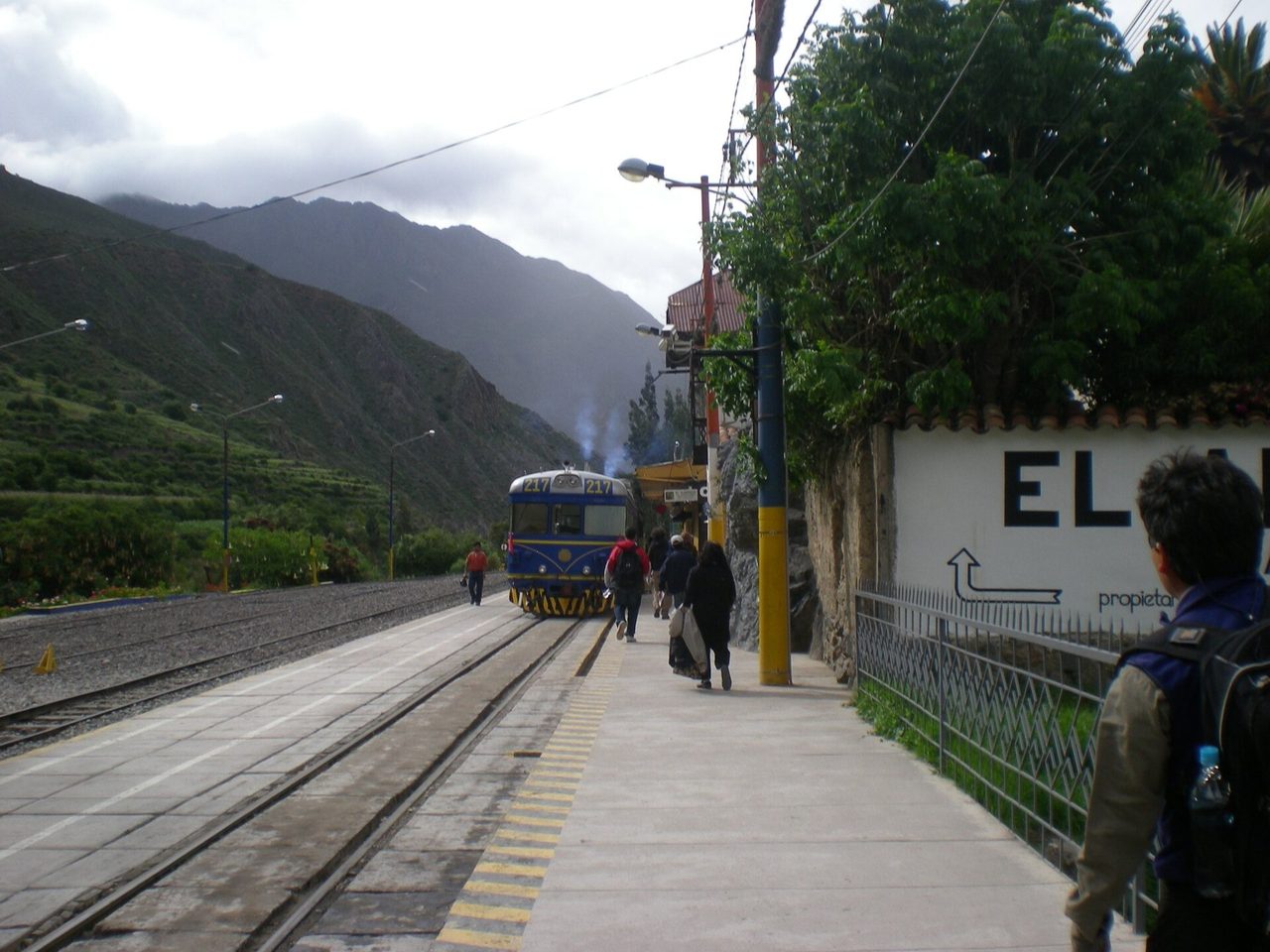
Ollantaytambo: the station sits ten minutes’ walk below the plaza down a lane of grill restaurants and pisco bars; colectivos from Cusco (Pavitos street, S/12–15) and taxis (US$25–40) drop at the top. Arrive 45 minutes early in high season — boarding is orderly but the platform gets happily chaotic. There’s decent coffee inside the gate and better empanadas just outside it. Poroy: a taxi from central Cusco runs 25–35 minutes and S/25–40; there’s little there, so time your arrival tightly. Aguas Calientes: you step off essentially into the artisan market — hold your bag, follow the river, and your hotel is within twelve minutes’ walk because everything is. For the shuttle up to the ruins, the Consettur booth and bus line are along the river road to your left; details in the getting there guide.
Which station you actually want
Station choice is where bookings go wrong, partly because the engines list places most visitors have never heard of and PeruRail collapses three of them into a single Cusco option at search. The 2026 picture:
| Station | Where | 2026 operation | Suits |
|---|---|---|---|
| Ollantaytambo | Sacred Valley, 1 h 30–2 h from Cusco by road | Year-round, every service, desk open 04:15–21:00 | Almost everyone |
| San Pedro | Calle Cascaparo, central Cusco | Seasonal, roughly May–December; a couple of morning departures | Anyone who wants the switchback climb out of the city |
| Poroy | 20–25 min above Cusco | Seasonal, roughly April–December; about one outbound, around 07:35 | Almost nobody now — San Pedro took over most of its role |
| Wanchaq | Central Cusco | Not a rail departure for Machu Picchu — it is where every PeruRail bimodal coach starts | Bimodal ticket holders |
| Urubamba | Mid Sacred Valley | A handful of Vistadome workings, desk open mornings and evenings only | Guests of the valley hotels around it |
| Av. El Sol 843 | Central Cusco | Inca Rail’s bimodal boarding point — not the Plaza de Armas office, which sells tickets only | Inca Rail bimodal |
The seasonal logic is simple once you see it. When the rains close the Cusco-side stations, roughly January to April, everything sold as a Cusco departure becomes bus-plus-train, transferring at Ollantaytambo or, on some frequencies, at Pachar just short of it. The rail leg is unchanged; you just start on a coach.
Choosing by base: sleeping in Cusco, buy bimodal and let someone else own the 4 a.m. problem; based in the valley, use Ollantaytambo and take the extra hour in bed. If you are still splitting nights between the two, how long to spend in Cusco lays out the trade-off and the full Cusco–Machu Picchu route comparison covers the options that are not rail at all. One underrated argument for the valley: sleeping at 2,790 m rather than 3,400 m is the easiest thing anyone can do about Cusco’s altitude.
The luggage rule everyone panics about
Both companies limit onboard bags to roughly 5–8 kg per passenger (one bag or backpack, about 62 linear inches). Here’s the calming truth: it’s enforced with Andean pragmatism — a normal daypack-plus-tote sails through — and it exists because there’s simply no hold. The correct move is to leave your main luggage in Cusco or your Sacred Valley hotel (every hotel on this circuit stores bags free; it’s as routine as handing over a key) and travel to Machu Picchu with one night’s kit. Large backpacks aren’t allowed into the citadel anyway. Pack list in what to wear to Machu Picchu.
The numbers each operator publishes today
PeruRail’s current Machu Picchu policy is one backpack up to 8 kg and 100 cm total (height plus length plus width), or one carry-on up to 12 kg and 115 cm. Inca Rail allows one piece up to 8 kg and 118 cm, and says plainly that its carriages have no luggage racks. Neither allowance improves when you buy a premium ticket — the Hiram Bingham is stricter still, with no extra bags on board at all. If you genuinely must bring more, PeruRail will carry excess for roughly US$15 for a carry-on and US$25 for a checked bag up to 23 kg, arranged at the station.
The 157 cm figure that circulates widely belongs to PeruRail’s Cusco–Puno route, which does have a checked-bag allowance. The Machu Picchu trains are tighter. The citadel is tighter again: the gate turns back anything much over 40 x 35 x 20 cm.
Where to leave the big bag
Free storage exists and almost nobody uses it. PeruRail holds luggage at Ollantaytambo station, roughly 04:15 to 21:00, and at the Aguas Calientes station from about 05:00 to 22:00. Inca Rail runs its own free custody beside its Ollantaytambo ticket office and at its Cusco office on Av. El Sol, on presentation of your ticket, for up to thirty days — each bag needs a lock and they will not accept valuables. Between those and your hotel, nobody needs a suitcase on this train.
The ride itself: what to watch for
Sit on the left side heading to Machu Picchu, right side returning — that’s the river side. The 90 minutes unfold in acts: the wide farmland below Ollantaytambo with Veronica’s glacier hanging over it (km 82, where Inca Trail hikers wave goodbye from the platform); the gorge narrowing until the tracks and river share the same shelf; the vegetation flipping from eucalyptus and agave to tree ferns, bromeliads, the first orchids; and if you’re sharp-eyed around km 104, ruins on the far bank — Chachabamba and, high above, Wiñay Wayna. Cloud forest arrives like a curtain. Then the brakes, the river roar, and a station in a town with no roads.
It’s also, mercifully, a journey with no altitude penalty — you descend from Ollantaytambo (2,790 m) to Aguas Calientes (2,040 m), which is why the train day often feels like the easiest of a Peru trip. The wider transport picture — flights, buses, colectivos — is in getting around Peru.
Which side to sit on, and why half your carriage faces backwards
Worth stating precisely, because the guides on page one contradict each other about it. Leaving Ollantaytambo for Aguas Calientes, you want the left. The Urubamba runs along that flank for most of the descent; the right gives you rock wall, a good deal of it at arm’s length. Coming back, you want the right, which is the same water on the same side of the train now pointed the other way.
Two complications. The seating plan is the first: both operators sell facing bays of four around a table, so two seats in every bay travel forwards and two travel backwards, and “the left side” means left relative to the direction of travel, not left as you walk down the aisle. Numbering will not tell you which. If the booking engine shows a seat map, take a window on the correct flank and accept whichever way the chair points; if it doesn’t, ask at check-in, because staff move people when a carriage is not full. The second: on any service with roof glass the penalty for the wrong side shrinks, since you get canyon wall overhead instead of river below — a different show rather than a worse one.
One caveat that saves money. If you are travelling in the dark — the 05:05 out, anything after about six in the evening coming back — none of this matters at all. Sit wherever the table is emptiest and spend nothing on the upgrade.
How the bimodal from Cusco actually works
Since Poroy spends a third of the year closed, both companies lean on bimodal tickets: an official coach from Cusco that connects directly to your train at Ollantaytambo, sold as one reservation. PeruRail’s leaves from Wanchaq station (ten minutes from the Plaza de Armas); Inca Rail’s from their office near the plaza. The coach leg takes about two hours, the connection is guaranteed — if the bus hits traffic, the train waits or they rebook you, which is precisely the insurance a 4:50 a.m. colectivo doesn’t offer. It costs US$15–25 more than assembling the legs yourself and removes the single most stressful hour of the day-trip schedule. For dawn departures, nervous planners, and anyone traveling with kids or grandparents: just buy the bimodal.
Kids, knees and other practicalities
The train is the easy part of a Machu Picchu day for mixed-generation groups — step-up boarding, tables to color on, a snack trolley, and scenery that holds even a screen-native eight-year-old for most of an hour. Booking notes: children’s fares (roughly 30–50% off) require the child’s passport number, seats are assigned so book the whole family in one transaction, and the four-around-a-table layout means a family of four gets a private bay by default. For travelers with limited mobility, both operators will arrange boarding assistance if asked at booking; Ollantaytambo’s platform is level, and Aguas Calientes’ station is flat to town — but be honest about what comes after, because the citadel itself is uneven stairs from gate to gate. One more grown-up note: the Vistadome’s alpaca fashion show finale involves audience participation. Sit mid-carriage if you wish to spectate rather than model.
Three train-and-hotel pairings that just work
- The classic overnight: 10:32 out of Ollantaytambo, afternoon in Aguas Calientes (springs, museum), dawn entry, 12:46 return. Calm at every joint; the pairing I book for friends.
- The Sacred Valley base: stay two nights in Ollantaytambo, day-return to the ruins on the 7:05 out / 16:22 back with a midday entrance. No Cusco vans at all, fortress at sunset as a bonus — the underrated version of the whole pilgrimage.
- The splurge arc: Hiram Bingham brunch service out, night at a top Aguas Calientes hotel, dawn entry with Huayna Picchu, Vistadome home. If Peru is your fiftieth-birthday trip, this is the itinerary the birthday deserves.
The return leg, which is where day trips actually break
Most planning goes into the outbound and treats the return as an afterthought. It is the other way round: the outbound has slack in it, and the return is a hard constraint that reaches backwards through the whole day and decides which entrance hour you are allowed to buy.
Start with the real last departures. From Aguas Calientes the final train leaves around 21:50 and reaches Ollantaytambo near 23:37 — where it stops. No coach waits at that hour, so it only works if you are sleeping in the valley. The last service that actually delivers you to Cusco is the 18:20 bimodal, roughly four hours, into Wanchaq about 22:30; rail departures towards the Cusco-side stations finish earlier still, around 17:23 in the dry season. So the last train home and the last train to Cusco are different trains, and that distinction is why the afternoon block sells out before anything else on the timetable.
Now work backwards. Allow 25–30 minutes on the shuttle down, plus a queue that is longest between two and four in the afternoon, plus ten minutes through town to the platform. Ninety minutes from citadel exit to train is the honest figure, not the sixty you will be tempted to use. Circuits run 2.5 to 4 hours depending which one you hold. Do that arithmetic against an 18:20 departure and your latest safe entrance hour for a same-day return to Cusco is about midday. An afternoon slot is fine if you are staying the night below the ruins and useless if you are not, which is the trap inside most cheap Cusco day-trip packages.
Two consequences. Evening trains sell first because they are the only ones that work for day-trippers, so a day trip means competing for the scarcest inventory on the line — book that leg before anything else. And if the numbers refuse to work, the fix is not a faster train but an extra night, the case for which is made in how many days to give Machu Picchu and costed into our Peru itinerary suggestions.
Delays, strikes and the rainy-season asterisk
Most days, the trains run like Swiss ambitions. The exceptions cluster: in the January–March rains, slides occasionally close sections of track (2010’s washout famously stranded thousands; modern responses are faster and better-drilled), and a few times a year regional strikes pause services for a day with short notice. Operators rebook affected passengers without charge, hotels flex, and the sky clears — but two planning rules follow: never make your Machu Picchu day the last possible day before an international flight, and in the wet season keep a WhatsApp line to your hotel or operator, who hear about disruptions hours before the websites admit them. Season strategy in full: best time to visit Machu Picchu.
Three dates from the last eight months
Abstract warnings are useless, so here is what has actually happened on this line recently, dated so you can judge how stale it is.
30 December 2025: a PeruRail service and an Inca Rail service collided head-on near Corihuayrachina, between Ollantaytambo and Aguas Calientes. One driver was killed and around forty people injured, most of them foreign visitors. Services were suspended and restored on 1 January 2026; Peru’s consumer authority opened an investigation into both operators.
25 January 2026: a mudslide at PK 114.7 suspended the Machu Picchu–Hidroeléctrica section. Worth understanding precisely, because that is the branch the back-door route uses, not the main line — Ollantaytambo services ran throughout. The cheap way in is also the fragile way in.
4 August 2026: a wildfire near km 107 threw rock onto the track and forced the suspension of the Ollantaytambo line, cancelling around ten frequencies and leaving travelers waiting at stations across Cusco and the valley. Crews cleared it overnight and services resumed on 5 August. The Ministry of Culture activated a force-majeure protocol so affected visitors could reschedule or refund entrance tickets bought through the official portal.
The pattern is one-day closures rather than one-week ones, with a competent recovery each time. Check the operators’ own notice pages before you travel rather than trusting anything here, this paragraph included, to still be current.
What to do on the day it happens to you
Contact the operator first and the entrance-ticket portal second. Both railways rebook without charge when the fault is theirs, and the force-majeure protocol on entrance tickets is real but has to be claimed rather than granted. Your hotel will know before any website does. Then salvage the day rather than lose it — our list of day trips out of Cusco is the obvious place to start.
A short, fond history of the line
The railway is older than the fame it serves. Built in stages from 1913–1928 to link Cusco with the tea and coca plantations of the Santa Ana valley, the line happened to run directly beneath an unexcavated royal estate — which is why, when Bingham’s photographs turned Machu Picchu into a household name, the infrastructure for visiting it already existed. The workers’ camp at kilometer 110 became Aguas Calientes; the plantation railway became, car by car, one of the world’s great tourist trains. It remains a working narrow-gauge mountain railway with all the character that implies: the zigzag switchbacks climbing out of Cusco (your bimodal bus skips these, slightly sadly), gradients that explain the journey times, and the constant companionship of a river that built the gorge the engineers borrowed. The Incas themselves ran this corridor on foot, of course — parts of the Inca Trail parallel the tracks — and there’s a pleasing continuity in the fact that six centuries later, everyone still funnels down the same green slot in the mountains to reach the same front door.
Machu Picchu train FAQ
PeruRail or Inca Rail — which is better?
Neither, honestly — book the departure that fits your entrance slot. Tiebreakers: PeruRail for frequency and the Belmond experience; Inca Rail for slightly lower fares and the 360°’s open-air car.
How long is the train ride to Machu Picchu?
About 1 h 45 min from Ollantaytambo; ~3 h 20 min from Poroy (May–December only); around 4 hours door-to-door on bimodal services from Cusco.
Is the Vistadome worth the extra money?
One way, yes — the glass ceilings genuinely change the gorge. Both ways, meh. If forced to choose one panoramic leg, take it outbound in the morning light and save the return for a nap in Expedition.
Do the trains sell out?
In June–August, the convenient times absolutely do — 60–90 days ahead. Some train, at some hour, almost always has space; whether it pairs with your entry slot is the real question. Book the pair together.
Can I take my big backpack on the train?
Officially no (5–8 kg limit); practically, modest overages ride unremarked, but the citadel gate will stop anything over ~20 L regardless. Store the big bag in Cusco; future-you, sprinting for the 5:30 a.m. bus, will be grateful.
Is there a cheap way to skip the train entirely?
Yes — the Hidroeléctrica van-and-walk route, about a quarter of the price and four times the hours. Full instructions and honest warnings in Machu Picchu on a budget.
What’s the difference between Vistadome and Vistadome Observatory?
The Observatory adds a dedicated observation car with open-air balcony sections and live música on some departures — PeruRail’s answer to Inca Rail’s 360°. Nice, not necessary; decide by schedule.
Can I change or cancel a train ticket?
Both operators allow date/time changes for a fee (typically US$10–15 plus fare difference) up to a day or two before travel, with stingier rules on promotional fares; full refunds are rare. In practice, changes are easy in the green season and nearly pointless in July, when there’s nothing free to change to. Buy the flexible fare if your entrance slot isn’t locked yet — though the correct order (ticket first) makes that scenario avoidable.
Do I need my passport for the train?
Yes — carried, matching your ticket name, checked at boarding alongside a printed or mobile ticket. Same passport gets checked again at the citadel gate, so keep it on your person, not in the stored luggage.
Which side of the train has the better view?
Left going down to Aguas Calientes, right coming back — the river side in both directions. Seats face each other in fours, so the side matters more than the seat number, and half of any bay travels backwards.
When do train tickets go on sale?
There is no release date; the calendar is open roughly a year out. What moves is the timetable — PeruRail publishes separate January–April and May–December schedules, so a departure booked very far ahead can be re-timed by a few minutes. Book early, then re-check the time a month before you travel.
What is the last train back to Cusco?
Around 18:20 from Aguas Calientes on the bimodal, into Cusco about 22:30. There are later trains — the last leaves near 21:50 — but they terminate at Ollantaytambo close to midnight with nothing onward, so they only work if you are sleeping in the valley.
What happens if the line closes while I’m there?
Recent closures have lasted a day rather than a week: a fire near km 107 on 4 August 2026 suspended services and they resumed the next morning. Operators rebook at no cost, and the Ministry of Culture will let you move an entrance ticket bought on the official portal. Confirm current status with the operator before you set out — nothing on this page ages faster.
Final thoughts
In a trip full of logistics, the train is the one piece I’d tell you to stop optimizing and start enjoying. Any class, either company, window seat, phone away: the Urubamba gorge does the rest. Book it after your entrance ticket, keep a bag light enough to lift one-handed, sit on the river side — and when the cloud forest closes over the line somewhere past km 104, understand that you’re traveling a corridor the Incas walked, Bingham rode, and every visitor since has stared out of exactly like you’re about to. Some journeys are transfers. This one’s part of the show.
Sources
- PeruRail — official schedules, classes and fares
- Inca Rail — official schedules, classes and fares
- Ministry of Culture — entrance tickets (book before trains)
- PeruRail — luggage allowance and free station storage
- Inca Rail — luggage policy and custody service
- Belmond — Hiram Bingham service and inclusions
- Seat61 — independent Peru rail timetables and fares
Photo credits
All images are used under their stated licenses; thank you to the photographers.
- Photo: robennals / CC BY 2.0 via Wikimedia Commons — source
- Photo: Jorge Láscar from Australia / CC BY 2.0 via Wikimedia Commons — source
- Photo: Flickr contributor / CC BY 2.0 via Wikimedia Commons — source
About this guide: Written by the Peru Tourism Guide team — writers and trip-planners who have explored Peru’s Andes, coast and Amazon over many visits and put hundreds of travelers on the right train to Machu Picchu. We update this guide as timetables and fares change.
Last updated: August 2026.